C Programming

Working with Pointers

Working with Pointers in C

A pointer is a variable that represents the location of a data item, such as a variable or an array element. Pointers are used frequently in C, as they have a number of useful applications. For example, pointers can be used to pass information back and forth between a function and its reference point. Pointers provide a way to return multiple data items from a function via function arguments to
be specified as arguments to a given function.

Class in C++

Introduction to Classes in C++

A class is an organisation of data and functions which operate on them. Data structures are called data members and the functions are called member functions, The combination of data members and member functions constitute a data object or simply an object.

mycplus

Constructors in C++

A constructor is a special method that is created when the object is created or defined. This particular method holds the same name as that of the object and it initializes the instance of the object whenever that object is created. The constructor also usually holds the initialization of the different declared member variables of its object.

Arrays in C Programming

Arrays in C Programming

In C Programming, an array can be defined as number of memory locations, each of which can store the same data type and which can be referenced through the same variable name. Arrays can be of two types i.e. One Dimensional Array (such as lists) and Multidimensional Arrays (such as tables or matrices).

Functions-in-C

Functions in C Programming

Function groups a number of program statements into a unit and gives it a name. This unit can be invoked from other parts of a program. A computer program cannot handle all the tasks by it self. Instead its requests other program like entities – called functions in C – to get its tasks done. A function is a self contained, named block of statements that perform a coherent task of same kind.

Input and Output in C

Input and Output in C: Stream Functions

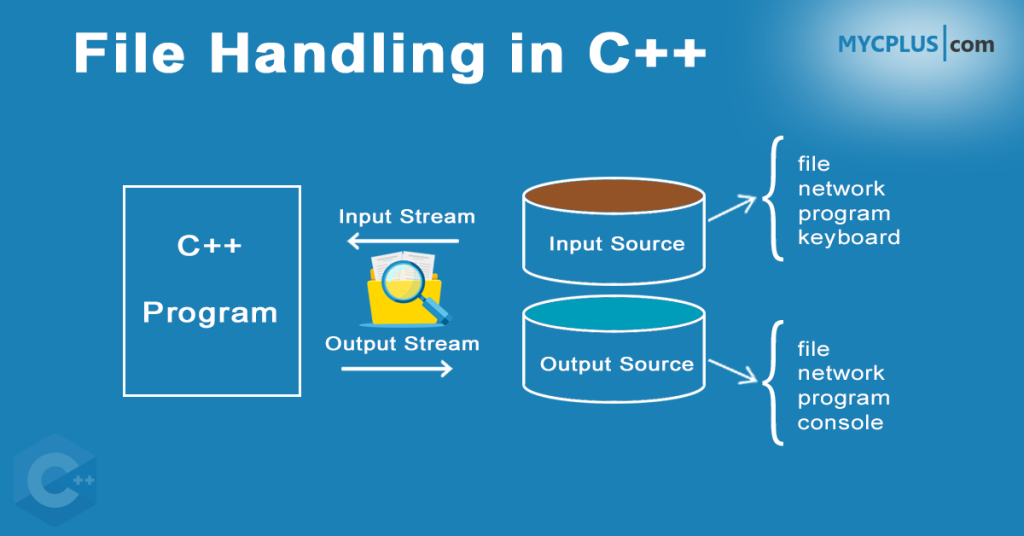
The standard way of handling all input and output is done with streams in C programming regardless of where input is coming from or where output is going to. This approach has definite advantages for the programmer. A library package has been evolved which is known as known as the Standard I/O Library which is used in any C program by using stdio.h header. First, however, we need to understand exactly what the terms input and output mean in context of C.

Conditional Statements in C

Conditional Statements – Decision Statements – if, else

C programs are executed in a sequence, but we can control the execution of program by using any control mechanism by which we can compare things and come to a decision. This involves using some operations called Relational Operators, conditional statements called if-else and loops. We have fundamental operators to compare two values.

Bank Management Software

Bank Management Program

This is an automated software system written in C programming language for Bank Management which can handle accounts for customers. It uses files to handle the daily transactions, account management and user management. Its not a complete accounting software just like implemented in the banks, but still it can manage the accounts of the customers using the files at back end. It has a nice graphical layout written in C Language.

libGD - Graphics Library

LibGD – Dynamic Image Creation Library

LibGD is an open source Graphics library for the creation of images dynamically by programmers. GD is written in C, and “wrappers” are available for Perl, PHP and other languages. GD is commonly used to generate charts, graphics, thumbnails, and most anything else, on the fly. While not restricted to use on the web, the most common applications of GD involve website development. It allows to quickly draw images complete with lines, arcs, text, multiple colors, cut and paste from other images, and flood fills, and write out the result as a PNG or JPEG file.  

Scroll to Top