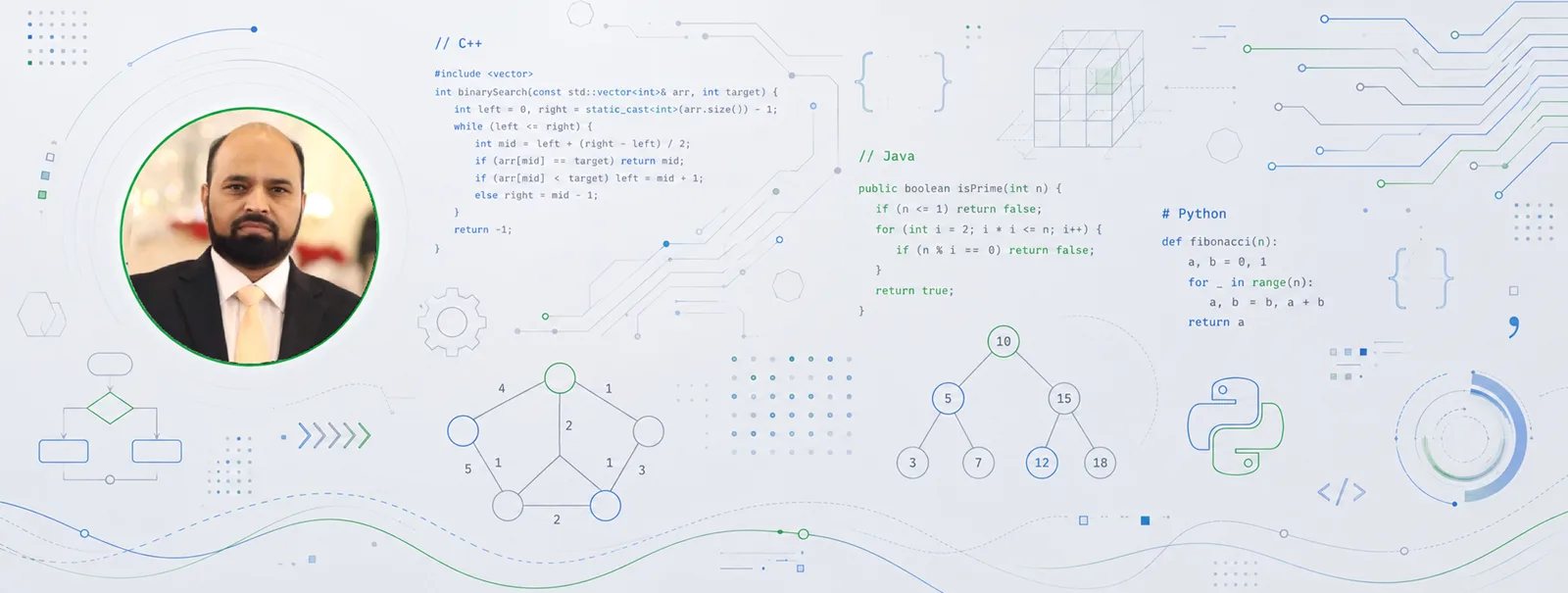

Muhammad Saqib – Senior Software Engineer & Founder of MyCPlus

Muhammad Saqib author banner — MyCPlus

Muhammad Saqib is the founder and lead author of MyCPlus, the programming-education site he launched in 2004. The idea grew out of his own struggle learning to program at university — C was the first language he picked up — and the help he wished he’d had became the site he built for others. What began as a C and C++ resource has since grown into a broad hub of tutorials, working code examples, and computer science guides across many languages and skill levels.

He holds an MSc in Computer Applications from the University of Plymouth, UK (2008) and has spent over 15 years building large-scale software across automotive, healthcare, retail, mobility, and education. Along the way he has worked with Ford, Hyundai, Trilogy/DevFactory, OT EMR, Al Othaim Markets, and NUST–SEECS, and today leads backend engineering as Technical Team Lead at a public transportation authority.

A hands-on, polyglot engineer, he works across C/C++, Java, C#, PHP, Python, and JavaScript, and writes here about programming, software engineering, DevOps, Agile, and computer science.

More than twenty years on, MyCPlus keeps the goal it started with: clear tutorials, real source code, and a place for learners to get unstuck — written by someone who has been on both sides of the problem.

c-algorithms-library

C Algorithms Library

This article is about a collection of common Computer Science algorithms which may be used in C projects. The C Programming Language has a much smaller Standard Library as compared to other more modern programming languages such as Java or Python. The library provides a basic set of mathematical functions, string manipulation, type conversions, and file and console-based I/O.

multi-paradigm programming in C++

Multiparadigm Programming in Standard C++

A multi-paradigm programming language allows programmers to choose a specific single approach or mix parts of different programming paradigms. The power of C++ is such that it can be used to implement any paradigm. It supports procedural and class based object oriented programming as well as there is functional programming support in the modern standard library versions. The free-form nature of C++ can also be used to write obfuscated C++ which in one context can be seen as artful control over the language.

Ternary Operator with Examples in C

Ternary Operator with examples in C

In C Programming, ternary operator allows executing different code depending on the value of a condition. The returned value is the result of the expression when the code is executed. The main advantage of using ternary operator is to reduce the number of lines of code and improve the performance of application. In C, the real utility of ternary operator is that it is an expression instead of a statement i.e. you can have it on the right-hand side (RHS) of a statement. So you can write certain code statements more concisely.

hello_world_cpp

C++ “Hello World” Program

Typically, the best way to learn programming is by writing code. The first program beginners write is “Hello, World!” which is often used to illustrate the syntax of a programming language. You can take a look at the list of Hello World Programs in 300 Programming Languages to see how “Hello, World!” looks like in different programming languages.

Ten Most Recommended C books for Expert Programmers

[et_pb_section fb_built=”1″ _builder_version=”3.22″ custom_padding=”0px|||||”][et_pb_row _builder_version=”4.0.9″][et_pb_column type=”4_4″ _builder_version=”4.0.9″][et_pb_text _builder_version=”4.0.9″ inline_fonts=”Georgia”] C is a great programing language to start as a beginner

file handling in C++

File Handling in C++

C++ treats files as data streams flowing into and out of a program. Each stream type has its own class, complete with functions that handle reading, writing, and managing file I/O efficiently.

Hello World

List of Hello World Programs in 300 Programming Languages

Hello, world! Programs are usually written to make the text “Hello, world!” appear on a computer screen. This is also a basic sanity check for an installation of a new programming language. The first Hello World program appeared in chapter 1.1 of the first edition of Kernighan & Ritchie’s original book about C, ‘The C Programming Language’, in 1978. This is considered to be the first ever “Hello World!” program.

Beginning C++ Programming

Beginning C++ Programming

C++ has come a long way and is now adopted in several contexts. Its key strengths are its software infrastructure and resource-constrained applications, including desktop applications, servers, and performance-critical applications, not to forget its importance in game programming. Despite its strengths in these areas, beginners usually tend to shy away from learning the language because of its steep learning curve.

Ternary Operator Diagram

Ternary Operator with examples in C++

In C++, ternary operator allows executing different code depending on the value of a condition, and the result of the expression is the result of the executed code. The ternary operator uses 3 operands. It evaluates a condition and after that chooses one of its two branches to execute, depending upon the result of condition. The symbol for ternary operator is “? :”. The syntax for the ternary operator is: ? : ;

Types of Polymorphism in C++

Polymorphism in C++

Simply speaking, polymorphism is the ability of something to be displayed in multiple forms. Let’s take a real life scenario; a person at the same time can perform several duties as per demand, in the particular scenario. Such as, a man at a same time can serve as a father, as a husband, as a son, and as an employee. So, single person possess different behaviors in respective situations. This is the real life example of polymorphism. Polymorphism is one of the important features of Object Oriented Programming (OOP).

Effective Modern C++

Effective Modern C++

Effective Modern C++ follows the proven guideline-based, example-driven format of Scott Meyers’ earlier books, but covers entirely new material. This book describes how to write effective software using C++11 and C++14—i.e. using modern C++.

Scroll to Top