Java Programming Tutorials — Source Code Examples, Arrays, GUI and Core Java Concepts
Java remains one of the most widely used programming languages in the world — taught in universities, used in enterprise systems, and powering billions of devices through the Java Virtual Machine. Its write-once-run-anywhere philosophy, strong object-oriented foundation and rich standard library make it a first-choice language for students learning programming fundamentals and professionals building scalable enterprise applications.
MYCPLUS has been publishing Java programming tutorials and source code examples since 2004. This section covers Java from the ground up — starting with core language fundamentals and progressing through practical topics including arrays and data structures, graphical user interface development with Java Swing and AWT, object-oriented design patterns and real-world application examples you can compile and run immediately.
With over 45 articles covering beginner through advanced Java concepts, you will find clear explanations of Java syntax and core programming principles, practical source code examples for common programming challenges, and hands-on GUI tutorials that show how to build interactive Java applications from scratch. Whether you are a student working through your first Java course, a developer brushing up on fundamentals, or a programmer transitioning from C++ or Python — this section gives you the practical Java resources you need.
What You’ll Learn:
- Core Java fundamentals — variables, data types, control flow, methods, constructors and the foundational Java programming model explained with practical examples
- Arrays and data structures in Java — single and multi-dimensional arrays, ArrayList, LinkedList, stacks, queues and practical data structure implementations in Java
- Object-oriented programming in Java — classes, inheritance, polymorphism, interfaces, abstract classes and encapsulation with real-world Java source code examples
- Java GUI development — building graphical user interfaces with Java Swing and AWT, event handling, layout managers, buttons, forms and interactive application design
- Java collections and generics — working with the Java Collections Framework, iterators, generics, Maps and Sets for efficient data management in Java applications
- Practical Java source code — ready-to-compile Java programs covering algorithms, sorting, searching, file handling and common programming challenges for hands-on learning
Why MYCPLUS: Trusted by Java developers and students since 2004 — every tutorial includes working source code you can compile and run immediately, with clear explanations designed for real-world Java programming skills.
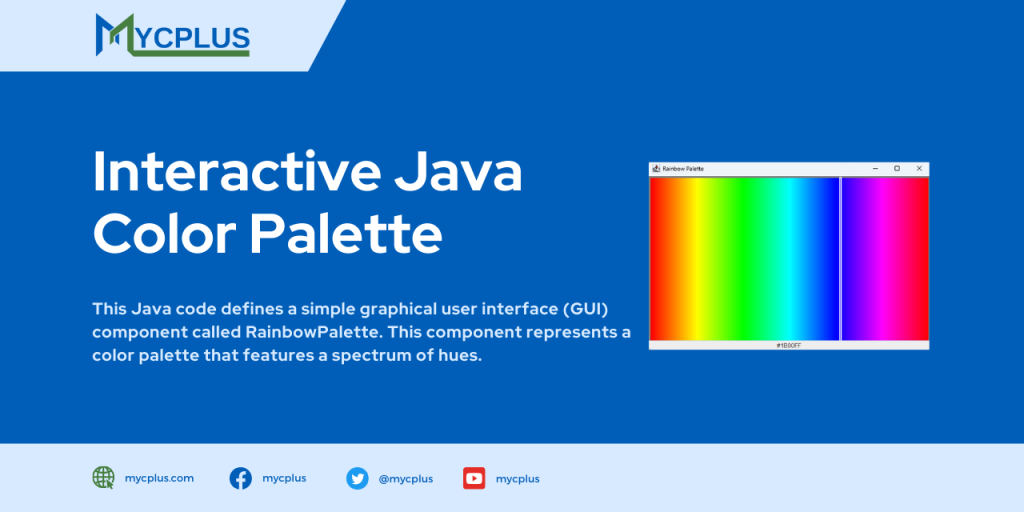
This Java code defines a simple graphical user interface (GUI) component called RainbowPalette. This component represents a color palette that features a spectrum of hues. Users can interact with the palette by clicking on different colors, and the selected color’s HEX value is displayed in a text box below the palette.
Java Source Code
This Java program calculates and displays information about the volumes of the Earth and the Sun. It also show the ratio of their volumes.
Java Source Code
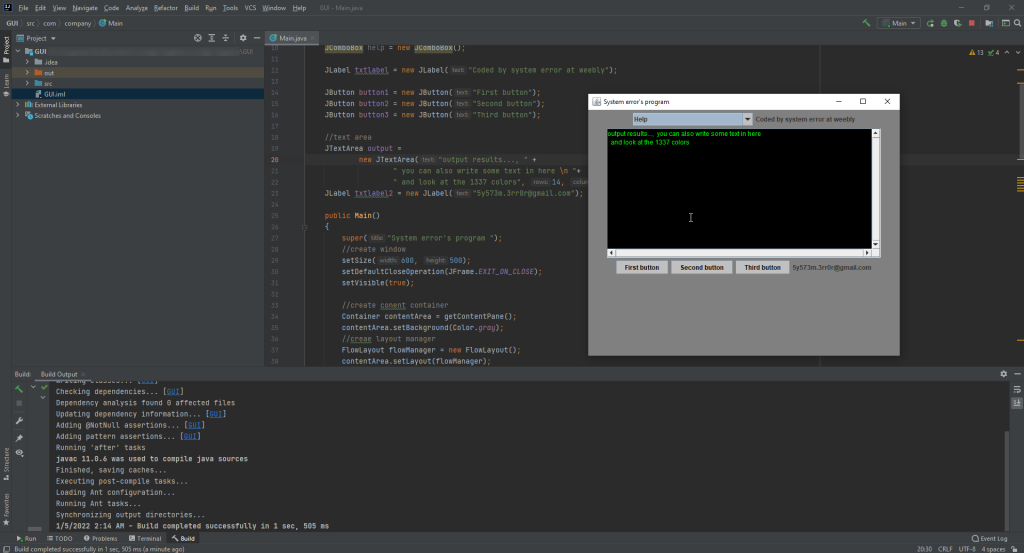
This Java source code is an example of a Graphical User Interface (GUI) with different GUI elements such as TextBox, Buttons, TextArea, Text Area and Labels. It is implemented using Java Swing API which provides a set of “lightweight” (all-Java language) components. This code example extends the functionality of JFrame class to show a JFrame window and Implements ActionListener on buttons to catch the click event on those buttons.
Graphics Java Source Code
This Java source code implements a basic calculator with a graphical user interface (GUI) using AWT and Swing. The program is structured in a way that makes it suitable for novice programmers to understand and learn about GUI development in Java. It serves as an excellent starting point for those looking to explore basic GUI applications and understand the principles of event-driven programming.
Java Source Code
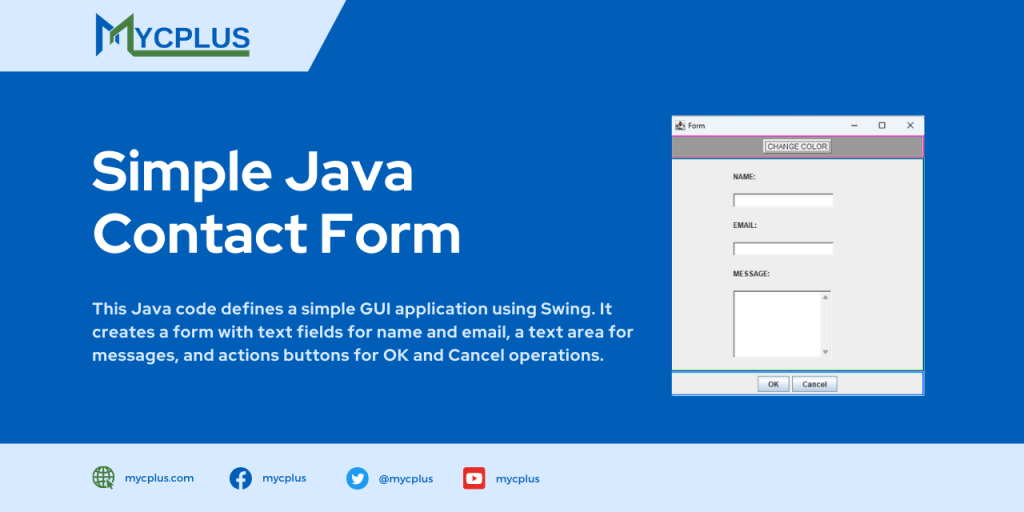
The following Java code defines a simple GUI application using Swing. It creates a form with text fields for name and email, a text area for messages, and actions buttons for OK and Cancel operations. Additionally, there is a button to change the background color of the form.
Java Source Code
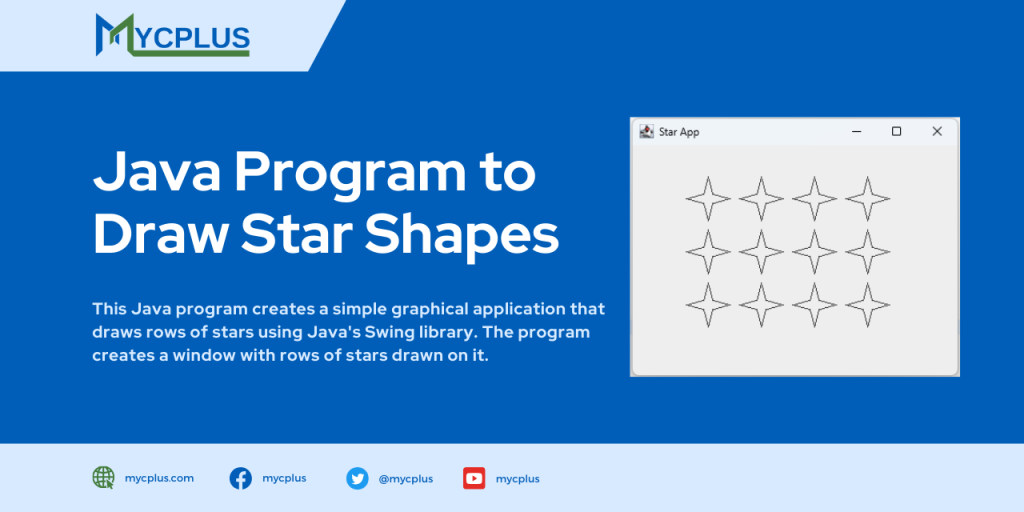
This Java program creates a simple graphical application that draws rows of stars using Java’s Swing library. The program creates a window with rows of stars drawn on it. The Star class defines the shape of a star, the StarPane class handles the drawing logic, and the StarApplet class sets up the main frame for the application. This example showcases basic GUI programming with Swing.
Java Source Code
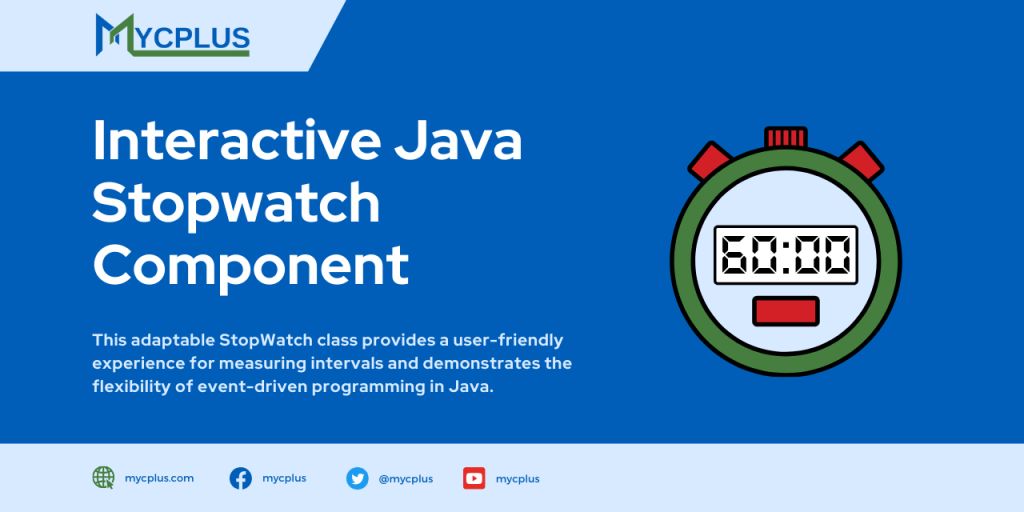
The StopWatch class introduces a versatile stopwatch component with enhanced functionality in Java. Extending JLabel and implementing the MouseListener interface, this interactive component not only measures elapsed time but also dynamically updates to display the current time in the format “Hours:Minutes:Seconds:Milliseconds”.
Java Source Code
The program demonstrates sorting techniques by sorting a list of words based on their frequency count. Novice programmers can learn about basic file handling, data structures, generics, and sorting algorithms through this program, gaining foundational knowledge applicable to a wide range of Java applications.
File Handling Java Source Code
This program demonstrates a few routines for processing binary sort trees. It uses a binary sort tree of strings. The
Data Structures Java Source Code
This Java source code defines a simple mouse tracking program using Swing which is a graphical user interface toolkit. The program displays a window with a drawing surface that captures and visualizes various mouse events. The mouse’s current coordinates, modifier keys (Shift, Control, Meta, and Alt), and the type of the most recent mouse event are displayed in real-time on the window.
Java Source Code
A RGBColorChooser shows three sliders that the user can manipulate to set the red, green, and blue, components of a
Java Source Code
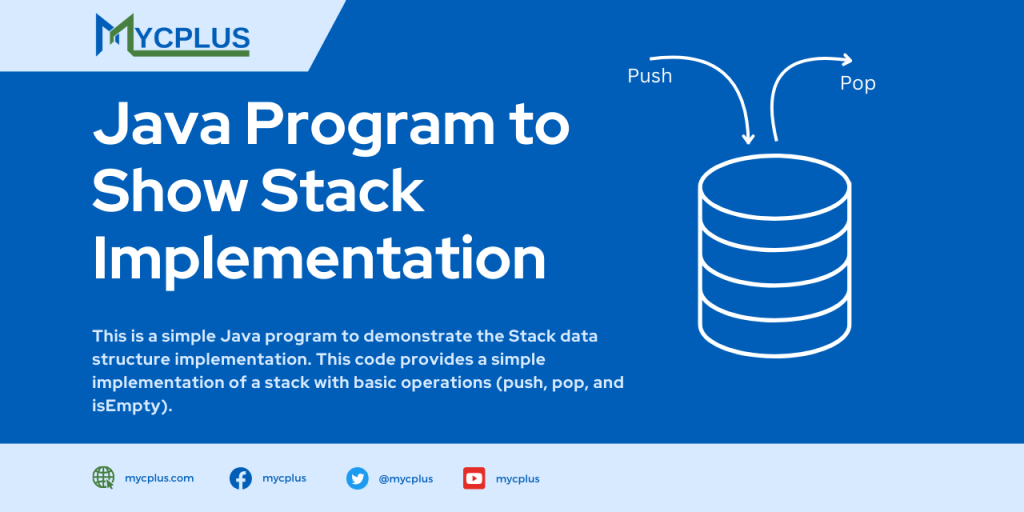
This java code implements stack functionality by using arrays. It can Pop and Push an item in stack with the help of array. The item can only be an integer number and internally the java program uses arrays to maintain items in stack.
Data Structures Java Source Code