

StepMania is a free, open-source rhythm game engine written in C++, with Lua for themes and scripting. Chris Danford started it in 2001 as a Dance Dance Revolution simulator, and it grew into an engine for dance-pad, keyboard and other rhythm games. Its code is behind commercial arcade games, from In The Groove to StepManiaX, and behind the community forks most players use today: ITGmania, Etterna and Project OutFox.
This profile covers what StepMania is, how its songs and charts work, its version history, the games built on it, its forks, and which version to use in 2026. Versions and dates were checked against the project repositories and other sources in October 2026, and the chart example was validated with a simfile parser.
What Is StepMania?
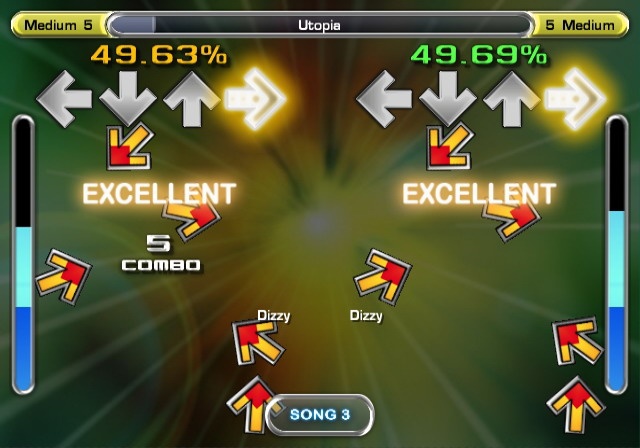
StepMania is an open-source rhythm game engine written in C++, with Lua themes, released under the MIT licence for Windows, Linux and macOS. Created by Chris Danford in 2001, it plays dance, pump and keyboard rhythm games from user-made song files. Its latest stable release is 5.0.12 (2016); active development has moved to forks such as ITGmania, Etterna and Project OutFox.
StepMania at a glance
| Created by | Chris Danford, 2001; later the StepMania team and the Spinal Shark Collective (StepMania 5) |
|---|---|
| Latest stable release | 5.0.12, August 2016 |
| Latest preview | 5.1 beta 2, July 2018 (development dormant since) |
| Written in | C++, with Lua for themes and scripting |
| Licence | MIT (bundled songs CC non-commercial; MP3 decoding uses GPL libraries) |
| Runs on | Windows, Linux and macOS |
| Game modes | Dance (4- and 8-panel), pump (5-panel) and keyboard-style modes |
| Song formats | .sm and .ssc simfiles (plus older .dwi); OGG or MP3 audio |
| Commercial games | In The Groove (2004), In The Groove 2 (2005), Pump It Up Pro (2007), StepManiaX (2017) |
| Active forks | ITGmania (pads), Etterna (keyboard), Project OutFox (many modes; closed source) |
From DDR Simulator to Rhythm Game Engine
StepMania began as an open-source clone of Konami’s Dance Dance Revolution arcade games, and its first major versions borrowed DDR’s interface. Releases came quickly, up to StepMania 3.9 in 2005, which became the long-running stable version.
What followed was a split. In 2010, after almost five years without a stable release, Danford released a 2006 build as StepMania 4 beta. Meanwhile, a group called the Spinal Shark Collective continued the newer code as sm-ssc, which became the official StepMania 5.0 on May 30, 2011. StepMania 5.0.12, released in August 2016, is still the latest stable release, and 5.1 reached beta 2 in July 2018 (StepMania on GitHub).
StepMania’s history also crossed into the arcade business. Roxor Games built the arcade game In The Groove (2004) on StepMania, and its developers contributed code back to the project. Konami sued Roxor in 2005, and in October 2006 the case was settled with Konami taking over the In The Groove intellectual property (Game Developer’s report).
How StepMania Works
StepMania separates the engine from everything you see and play:
- The engine is written in C++ (with small parts in assembly). It handles timing, input, audio playback, rendering and scoring.
- Themes control every screen, menu and gameplay overlay, and they’re written in Lua. Changing the theme can make StepMania look like a completely different game.
- Songs are folders containing an audio file (OGG or MP3), artwork, and a simfile that holds the charts (the step patterns) for each difficulty.
- Game modes go beyond four-panel dance: StepMania supports dance, pump (five-panel) and keyboard-style modes, played on dance pads, keyboards or controllers.
- The licence is MIT for StepMania’s own code, so commercial products can be built on it. Songs bundled with the source are under a non-commercial Creative Commons licence, and builds with MP3 support pull in GPL-licensed decoders.
The main simfile formats are .sm (the classic StepMania format), .ssc (the StepMania 5 format, which adds per-chart timing) and the older .dwi format from the Dance With Intensity simulator.
A Minimal StepMania Chart
A .sm file is plain text made of tagged fields. This one describes a song at a steady 120 BPM with a single Beginner chart for four-panel dance (dance-single):
#TITLE:My First Song;
#ARTIST:Example Artist;
#MUSIC:song.ogg;
#OFFSET:-0.050;
#BPMS:0.000=120.000;
#STOPS:;
#NOTES:
     dance-single:
     MyName:
     Beginner:
     1:
     0.1,0.1,0.0,0.0,0.0:
1000
0100
0010
0001
,
1001
0000
0110
0000
;
How the chart reads:
- Each line is one row of the four panels, in the order Left, Down, Up, Right.
1is a tap note and0is empty. - Commas separate measures. A measure with four rows has one row per beat, so at 120 BPM each row is half a second apart.
- The five fields after
#NOTES:are the game type, the chart author, the difficulty name, the numeric difficulty (meter), and the groove radar values. #OFFSETshifts the chart against the audio, in seconds, so the first beat lines up with the music.
We validated this file with the open-source Python simfile library (version 2.1.1). It parses as a StepMania simfile with one dance-single Beginner chart at meter 1 and 8 notes across 4 columns, timed half a second apart at 120 BPM.
Games Built on StepMania
| Game | Year | How it relates to StepMania |
|---|---|---|
| In The Groove | 2004 | Roxor Games’ arcade dance game, built on StepMania; later ported to PS2 and PC. Its IP went to Konami in the 2006 settlement |
| In The Groove 2 | 2005 | The arcade sequel, sold as an upgrade kit and in dedicated cabinets built by Andamiro |
| Pump It Up Pro | 2007 | Fun in Motion and Andamiro’s spin-off of Pump It Up, which uses a heavily modified build of StepMania 4 |
| StepManiaX | 2017 | Step Revolution’s arcade and home dance game, derived from the StepMania codebase by former In The Groove and Pump It Up Pro developers. Still updated in 2026 (Wikipedia’s StepManiaX article) |
You can read more about the first of these in our article on In The Groove.
Is StepMania Still Developed in 2026?
The main StepMania project is barely active. StepMania 5.1 never left beta, and Wikipedia describes its development as dormant. The GitHub repository still receives occasional maintenance commits, such as build and macOS fixes in mid-2026, but there hasn’t been a new release since July 2018.
The real development is happening in the forks:
- ITGmania is a fork of StepMania 5.1 focused on In The Groove-style pad play. It’s fully 64-bit, adds built-in network features and many fixes, and released version 1.3.0 in June 2026 (ITGmania on GitHub).
- Etterna started as a fork of StepMania 5.0.12 with a focus on keyboard players, and grew into its own game with multiplayer and an online scoreboard. Version 0.75.1 was released in September 2026 (Etterna on GitHub).
- Project OutFox, formerly called StepMania 5.3, is a fork of the 5.0 and 5.1 code that supports many rhythm game styles, including dance, instrument and keyboard modes, and runs on systems such as the Raspberry Pi. Unlike StepMania, it has been distributed as a closed-source fork (About Project OutFox).

Which StepMania Should You Use?
- For a dance pad and In The Groove-style play: ITGmania. It’s built specifically for that style of play, and it stays open source like StepMania.
- For keyboard play: Etterna, with its scoring system and online rankings.
- For many different rhythm game styles, or a Raspberry Pi cabinet: Project OutFox.
- For a commercial arcade or home dance machine: StepManiaX, the actively supported commercial descendant.
- For studying the engine’s code: StepMania 5.0.12 or the 5.1 branch on GitHub.
- For building your own rhythm game from scratch: a general-purpose engine such as Godot, where you write the timing and scoring yourself.
For more open-source engines, see our directory of open-source C++ game engines.
Key Takeaways
- StepMania is an open-source rhythm game engine written in C++ with Lua themes, created by Chris Danford in 2001.
- It’s MIT-licensed, so commercial products can be built on it, as In The Groove, Pump It Up Pro and StepManiaX were.
- Songs are folders with an audio file and a simfile (
.smor.ssc) that holds the step charts for each difficulty. - The latest stable release is 5.0.12 (2016), and 5.1 stopped at beta 2 in 2018.
- Active development lives in the forks: ITGmania (pads), Etterna (keyboard) and Project OutFox (many modes).
Conclusion
StepMania started as a fan-made DDR simulator and became the shared foundation of a whole rhythm game ecosystem, from arcade cabinets to keyboard ranking communities. The main project has gone quiet, but its MIT licence let others carry it forward, and in 2026 its code is still being played, charted and improved under new names.
For more engines across every genre, browse our game development hub.