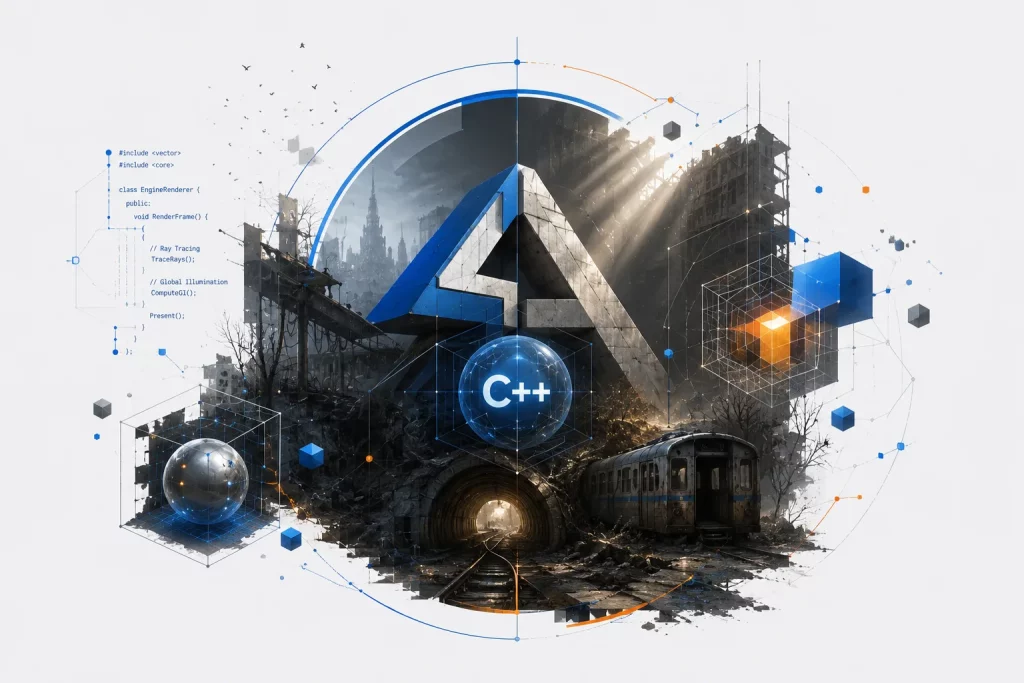


REDengine is the proprietary C++ game engine CD Projekt Red built for The Witcher 2 and refined across The Witcher 3 and Cyberpunk 2077 — some of the most acclaimed open-world RPGs ever made. It is also an engine with an ending: after Cyberpunk’s Phantom Liberty expansion, CD Projekt Red retired REDengine and moved its entire future, starting with The Witcher 4, to Unreal Engine 5. This is the complete story — every version, every game, and why one of gaming’s most celebrated studios walked away from its own technology.
What Is REDengine?
REDengine (officially styled with “RED” capitalized) is a proprietary 3D game engine developed in C++ by Polish studio CD Projekt Red, purpose-built for one genre: vast, non-linear, story-driven open-world RPGs. Unlike Unreal or Unity, it was never licensed or sold — every REDengine game was made by CD Projekt Red itself.
That specialization was its superpower. The engine’s streaming, dialogue, quest, and cinematic systems were designed around branching narratives with real consequences, which is a large part of why The Witcher 3’s hundreds of quests feel hand-crafted rather than generated. It’s also why the engine ultimately proved impossible to scale: technology this bespoke has to be substantially rebuilt for every new game.
For how REDengine compares to the wider field, see our complete list of top 100 game engines written in C/C++.
Origins: From BioWare’s Aurora to REDengine
The first Witcher game (2007) was not a REDengine title. CD Projekt Red licensed BioWare’s Aurora Engine — the Neverwinter Nights technology — and modified it so heavily that the studio concluded it needed its own engine to realize its ambitions. Development of that in-house replacement began during The Witcher’s production, and in 2011 it debuted with The Witcher 2: Assassins of Kings.
The name followed the studio’s branding (CD Projekt RED), and each numbered version arrived with a flagship game. But the numbering hides an important engineering truth the studio only admitted publicly years later: REDengine’s versions were not incremental upgrades. Because each game differed so much from the last, CD Projekt executives have explained that every version was in practice rebuilt nearly from scratch — an enormously time-consuming approach that shaped the engine’s eventual fate.
REDengine Version History
| Version | Year | Flagship game | Key additions |
|---|---|---|---|
| REDengine 1 | 2011 | The Witcher 2: Assassins of Kings | Debut; Havok physics, Scaleform GFx UI, FMOD audio; 32/64-bit Windows |
| REDengine 2 | 2012 | The Witcher 2 Enhanced Edition (Xbox 360) | Console support; later OS X and Linux ports via the eON compatibility layer |
| REDengine 3 | 2015 | The Witcher 3: Wild Hunt | True open-world streaming, volumetric effects, dynamic weather and day/night cycle, flexible deferred + forward renderer |
| REDengine 4 | 2020 | Cyberpunk 2077 | Ray-traced global illumination, dense urban crowds and traffic, vertical city streaming; later path tracing (2023) |
Games Made With REDengine
REDengine’s catalog is short and extraordinary — five major releases, all CD Projekt Red’s own:
- The Witcher 2: Assassins of Kings (2011, REDengine 1; 2012 Enhanced Edition on REDengine 2) — the branching-narrative showcase whose choices reshape entire chapters.
- The Witcher 3: Wild Hunt (2015, REDengine 3) — the engine’s masterpiece and a perennial greatest-of-all-time contender, roughly 35 times larger than The Witcher 2, with its Hearts of Stone (2015) and Blood and Wine (2016) expansions. A Nintendo Switch port followed in 2019, and a next-generation update with ray tracing arrived in December 2022.
- Cyberpunk 2077 (2020, REDengine 4) — the engine’s most ambitious and most troubled release: a dense, vertical, ray-traced Night City that overwhelmed last-generation consoles at launch, then was steadily redeemed through years of updates, including the path-traced Overdrive mode (2023).
- Cyberpunk 2077: Phantom Liberty (2023, REDengine 4) — the acclaimed expansion accompanying the game’s celebrated 2.0 overhaul, and the final new release built on REDengine.
Worth clarifying, since search results often get this wrong: Gwent: The Witcher Card Game and Thronebreaker (both 2018) were built in Unity, not REDengine, and the original The Witcher (2007) ran on BioWare’s Aurora. REDengine’s real catalog is exactly the five releases above.


CD Projekt Red retired its proprietary REDengine and moved The Witcher 4 to Unreal Engine 5 in a landmark 2022 partnership.
Distinctive Features of REDengine
- Narrative-first architecture. Quest, dialogue, and cinematic systems were first-class engine citizens, built for branching stories with long-range consequences — the feature set that made The Witcher 3’s non-linear structure feasible for a mid-sized studio.
- Open-world streaming. REDengine 3 eliminated loading screens across a continent-scale map; REDengine 4 pushed the same technology vertically, streaming Night City’s towers, crowds, and traffic.
- Atmosphere simulation. Dynamic weather, full day/night cycles, and volumetric clouds, fog, and smoke — Skellige’s storms and Night City’s smog are the same core systems in different costumes.
- Cinematic rendering. A flexible deferred + forward pipeline with filmic color grading, bokeh depth of field, and lens flares; REDengine 4 added ray-traced global illumination and, in 2023, one of the first full path-tracing modes in a AAA game, plus early adoption of DLSS 3.5 Ray Reconstruction.
- Advanced character tech. Facial animation and an automated lip-sync system that localized convincingly across ten-plus languages — essential for dialogue-heavy RPGs.
- Middleware pragmatism. Rather than reinventing everything, REDengine integrated Havok (physics), Scaleform GFx (UI), and FMOD (audio) — a small studio’s engine built with big-studio components.
Why CD Projekt Red Switched to Unreal Engine 5
In March 2022, CD Projekt Red announced that the next Witcher game would be built on Unreal Engine 5 under a multi-year strategic partnership with Epic Games — with CDPR engineers helping Epic improve UE5’s open-world capabilities in return. The reasons, as company leadership has explained since:
- The rebuild problem. Each REDengine “version” was substantially a new engine, which meant every project began with years of technology work before content could flow.
- Parallel production. The studio now develops multiple AAA projects simultaneously — The Witcher 4 (codename Polaris) and its planned trilogy, the Cyberpunk 2077 sequel (Project Orion), and a new IP (Hadar). Maintaining a proprietary engine across all of them wasn’t viable.
- Cyberpunk’s lesson. The 2020 launch exposed how much of the team’s energy went into fighting the technology rather than building the game; Epic’s mature tooling, documentation, and hiring pool remove that tax. CDPR’s VP of technology put it plainly: “That’s not to say the REDengine was bad” — the studio remains proud of it, but its ambitions outgrew it.
- Epic opened the black box. CDPR engineers were given deep access to Unreal’s internals — decisive for a studio accustomed to controlling every layer of its stack, and formalized in a partnership where REDengine’s open-world expertise now flows into UE5 itself.
Importantly, the transition was staged: Cyberpunk 2077’s expansion stayed on REDengine rather than migrating mid-project, which is why Phantom Liberty (2023) became the engine’s finale. The Unreal Engine era begins with The Witcher 4 — revealed in December 2024 with Ciri as protagonist, in full-scale production with over 500 developers as of 2026, demonstrated in a UE5 tech demo running at 60fps on a base PS5 (June 2025), and confirmed to launch no earlier than 2027.
Is REDengine Dead?
Retired for new games, but not abandoned. The distinction matters:
- No new game will be built on REDengine — The Witcher 4, the Cyberpunk sequel, and the new Hadar IP are all Unreal Engine 5 projects.
- REDengine 4 is still actively maintained for Cyberpunk 2077, which continued receiving substantial updates (2.x series) and reached new platforms in 2025, including the Nintendo Switch 2 and Mac — a proprietary engine still being ported half a decade after its last game shipped.
- The Witcher 3 continues to receive REDengine patches, with a cross-progression update planned for 2026.
- In May 2024, CD Projekt Red released the free REDkit for The Witcher 3 — official modding tools that put a working slice of REDengine 3’s toolset in the public’s hands for the first time, following the original Witcher 2 REDkit from 2013.
Can You Download REDengine?
No — REDengine was never publicly released or licensed. Unlike Unreal, Unity, or even CryEngine, it was internal-only technology for CD Projekt Red’s own games, and with the studio’s move to Unreal Engine 5, a public release is effectively ruled out.
There are two honest alternatives depending on what you’re after:
- To mod REDengine games: the free REDkit for The Witcher 3 (2024) is the closest you can get to the real engine — a genuine, official toolset for building quests, environments, and cinematics inside REDengine 3.
- To build your own open-world RPG: Unreal Engine 5 is the pragmatic choice — it’s free until your game earns $1M, and it’s literally where CD Projekt Red’s own open-world expertise is going. Godot and Unity remain strong free-to-start options for smaller-scoped RPGs.
Browse more of our game development coverage for deep dives into each of these engines.
Frequently Asked Questions
Conclusion
REDengine’s story reads differently from most retired engines: it wasn’t outcompeted, it was outgrown — and by its own maker’s success. The same bespoke, rebuild-everything philosophy that made The Witcher 3 feel impossibly hand-crafted became untenable the moment CD Projekt Red decided to become a multi-project studio. There’s a quiet lesson here that applies to any codebase: the architecture that gets you your masterpiece is not always the architecture that survives it.
What REDengine leaves behind is more than nostalgia. Its open-world streaming and narrative tooling now inform Unreal Engine 5 through the Epic partnership, its final game keeps shipping to platforms that didn’t exist at its launch, and REDkit hands its actual tools to the modding community. Few proprietary engines get an afterlife this generous — retired at its peak, with its DNA written into the engine that replaced it.