
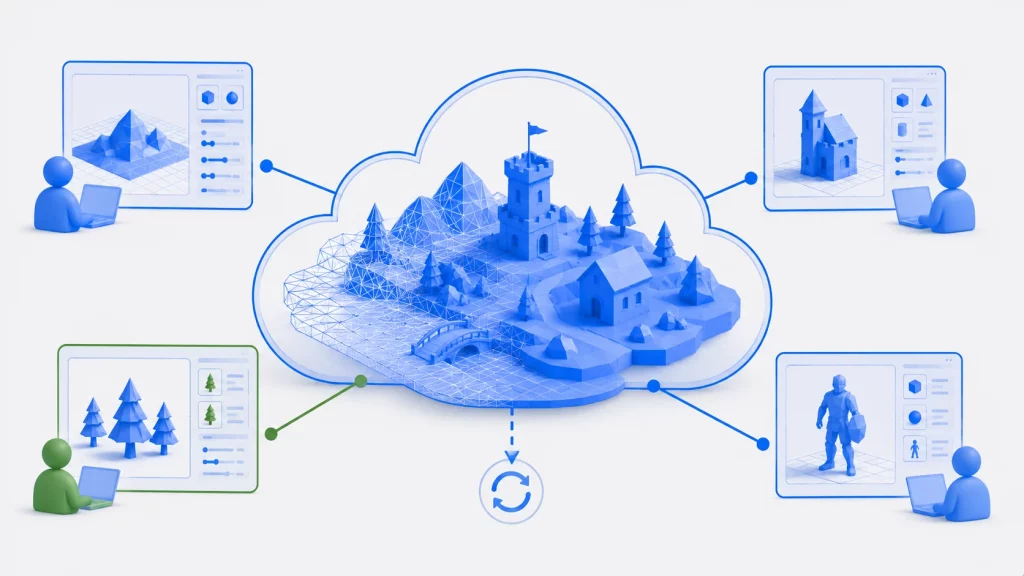
HeroEngine is a 3D game engine and server platform built specifically for creating massively multiplayer online (MMO) games. Its defining innovation was cloud-based, real-time collaborative development — letting an entire team build and edit a live game world together, from anywhere, with no nightly builds. It’s best known as the engine behind BioWare’s Star Wars: The Old Republic, one of the largest MMO launches in history.
This guide covers what HeroEngine is, its history and ownership changes, the games built with it, its cloud collaborative model and features, its licensing, and — importantly — its current status, because HeroEngine’s story has changed significantly in recent years.
What Is HeroEngine?
HeroEngine is an all-in-one MMO development platform: a single environment combining a 3D engine, world-building tools, scripting, and server-side technology for building and operating online games. It was written in C++ and C#, with gameplay logic scripted in a purpose-built language called HeroScript (HSL), and targets Microsoft Windows.
What set HeroEngine apart from other engines was its server-based, collaborative architecture. Rather than each developer working on a local copy and merging changes later, everyone worked live on the same server-hosted world in real time — one person could sculpt terrain while another placed buildings and a third scripted quests, each seeing the others’ work instantly. This “build the game and play it at the same time” model was genuinely ahead of its time when it debuted.
Although designed for MMOs, the engine was flexible enough for other online genres, including RPGs, first-person shooters, and social games.
History and Ownership
HeroEngine has passed through several owners, and its history is important context for its current status:
- Simutronics Corporation created HeroEngine around 2001–2006 to power its own ambitious MMO, Hero’s Journey. That game was never released, but the engine itself won awards (including a “Best Engine” finalist nod from Game Developer magazine in 2006) and drew outside licensees.
- Idea Fabrik purchased HeroEngine from Simutronics in 2010, hiring the original staff and launching the HeroCloud subscription service to open the engine to smaller studios.
- Financial trouble followed. Idea Fabrik publicly acknowledged funding difficulties in 2015. Development slowed, ownership fractured, and control of the engine became entangled between multiple parties (including TGS Tech and, later, Laniatus LLC) through a series of disputes.
- Idea Fabrik PLC was formally dissolved in 2025, leaving HeroEngine as a legacy product with only limited support.
Games Made with HeroEngine
HeroEngine’s flagship title is by far its most significant:
- Star Wars: The Old Republic (2011) — BioWare Austin’s massive MMORPG, and the engine’s defining showcase. Notably, SWTOR’s engine has been so heavily modified over the years that BioWare (and later Broadsword) effectively rebuilt it into a bespoke “SWTOR Engine”; little of the original HeroEngine code remains in the game today.
- The Repopulation — a sandbox MMO that became closely tied to HeroEngine’s fortunes and ownership disputes.
- PlayM2M (2025) — a retro-style MMORPG launched in Steam Early Access by Laniatus LLC, one of the more recent titles built on the engine.
A common misconception is worth correcting: The Elder Scrolls Online does not run on HeroEngine. ZeniMax evaluated the engine early in development but built its own engine instead — a point ZeniMax itself made publicly. HeroEngine is sometimes wrongly credited with ESO because of that early evaluation, but it was never used for the shipped game.
Cloud-Based Collaborative Development
The heart of HeroEngine’s appeal was HeroCloud and its live collaborative model. Instead of the traditional workflow — where developers work locally and merge changes in nightly builds — HeroEngine ran the game world on a shared server that the whole team edited simultaneously:
- Live, multi-user editing. Artists, world-builders, scripters, and designers worked on the same world at the same time, seeing each other’s changes instantly.
- No nightly builds. Changes took effect in real time, removing the wait between making a change and seeing it in-game.
- Play while you build. Developers could run and play the game while editing it, getting immediate feedback.
- Managed backend. HeroCloud handled server hosting and scaling, so small studios didn’t need their own server infrastructure or expertise.
For small and mid-sized studios in the late 2000s and early 2010s, this lowered the barrier to MMO development substantially — MMOs being one of the most technically demanding and expensive genres to build.
Key Features
Across its toolset, HeroEngine offered:
- HeroScript (HSL) — a scripting language designed specifically for MMO gameplay logic.
- Real-time collaborative world-building with shared whiteboarding and notes.
- Terrain editing, dynamic lighting, and audio tools.
- Character and animation systems, including an animation monitor.
- A GUI editor for building game interfaces.
- Scalable server technology for handling large concurrent player counts.
- An asset library and project-management/organization tools.
Licensing and Pricing
HeroEngine’s licensing, during its active commercial life, was built around the HeroCloud subscription:
- HeroCloud subscription: approximately $99 per year, which included the engine, tools, and cloud hosting — but not access to the underlying source code.
- Royalty: a 30% royalty on game sales was part of the standard HeroCloud terms.
- Full source-code licenses were available separately to larger studios through direct negotiation with the engine’s owners.
Note that with the engine now in legacy status, these terms reflect its commercial peak rather than a currently marketed product — anyone considering it today should verify what licensing, if any, is still available.
Is HeroEngine Still Used Today?
This is the key question, and the honest answer is: HeroEngine is now a legacy product, no longer under active development. As of 2025:
- Its most recent stable release was version 2.074 (January 2024), with no major new development since.
- Idea Fabrik PLC was dissolved in 2025, and ownership of the technology has been the subject of disputes between the parties that absorbed its team.
- Its flagship game, Star Wars: The Old Republic, has largely moved on from the original codebase. SWTOR’s engine has been so heavily rebuilt that it’s effectively a bespoke “SWTOR Engine,” and the team has even integrated rendering components from EA’s Frostbite engine as part of its migration to DirectX 12 — though the game is not being converted to Frostbite itself.
For developers today, HeroEngine is best understood as a historically important but superseded engine. Anyone starting a new MMO or online game now would more realistically look at actively developed, widely supported engines like Unreal Engine, Unity, or O3DE, all of which offer modern tooling, large communities, and ongoing support — the things a live MMO depends on.
Frequently Asked Questions
Conclusion
HeroEngine holds a genuinely important place in the history of online-game technology: its live, cloud-based collaborative development model was ahead of its time, and it made building an MMO — one of gaming’s hardest challenges — achievable for smaller studios. Powering Star Wars: The Old Republic cemented its place in gaming history.
Today, though, HeroEngine is a legacy platform, overtaken by financial turmoil and the rapid advance of general-purpose engines with modern tooling and active support. Its story is a reminder of how quickly game technology moves — but also of how a genuinely innovative idea, like real-time collaborative world-building, can influence the tools that come after it. To explore how it fits among other game technologies, see our directory of the best C++ game engines.