
Most veteran game engines end the same way: a company folds, the repository goes quiet, and the last commit sits there like a headstone. Torque did the opposite. GarageGames — the studio built by ex-Dynamix staff who bought the Tribes 2 engine out of Sierra — is long gone as an engine vendor, and yet Torque 3D was still taking commits in August 2026, with roughly 200 pull requests merged in its current development cycle and a 4.1 release candidate in sight.
That gap is why this page needed rewriting. The version you may have read elsewhere says GarageGames still maintains Torque and points you at a repository that stopped moving in 2022. Both are wrong, and the second one matters: clone the wrong repository and you miss roughly four years of subsequent community development. This page gives you the working links, the verified lineage — including what “Tribes 2 ran on Torque” really means — and a straight comparison against the engines you would otherwise pick.
Table of Contents
- What Is Torque 3D?
- Is Torque 3D Still Maintained in 2026?
- Which Repository Should You Clone?
- The Lineage: What Torque Actually Descends From
- How Torque 3D Got Here
- What Torque 3D Offers Today
- Games Built With Torque 3D
- Torque 3D vs the Engines You Would Otherwise Pick
- Key Takeaways
- Frequently Asked Questions
- Conclusion
What Is Torque 3D?
Torque 3D is a free, open-source 3D game engine written in C++, released under the MIT licence in September 2012 and now developed by a volunteer community rather than a company. It descends from the engine Dynamix built for Tribes 2, ships a full world editor suite, and runs on Windows, macOS and Linux. The latest tagged stable release is 4.0.3 from February 2023; version 4.1 has been in development since, with commits landing continuously.
| Original developer | Dynamix, then GarageGames (Eugene, Oregon) |
| Now maintained by | The Torque Community Contributors, on GitHub under the TorqueGameEngines organisation |
| Written in | C++ (C++17), with TorqueScript for game logic |
| License | MIT — free for commercial use, no royalties |
| Platforms | Windows, macOS, Linux |
| First release | Torque 3D 1.0, 28 September 2009 (commercial) |
| Open-sourced | 20 September 2012 under MIT; Torque 2D followed 5 February 2013 |
| Stable release | 4.0.3, 7 February 2023 |
| Latest activity | Commits on the development branch dated 24 August 2026 |
| Status | Actively developed. The project’s own updates put a 4.1 release candidate as the current target |
Is Torque 3D Still Maintained in 2026?
Yes — and it is one of the most active veteran open-source engines in this directory. We checked the repositories rather than the press releases:
- The
developmentbranch of the community repository carried commits dated 24 August 2026, with twenty commits in the fortnight before that. - Torque 2D is alive too. Its 4.0 EA4 build shipped on 18 August 2026, following EA3 in April 2026.
- The project’s lead maintainer, JeffR, publishes long work blogs on progress. The mid-2026 entry reports around 200 pull requests merged in that cycle alone, covering rendering, physics, assets, editor, scripting, audio and AI navigation. The previous cycle logged almost 160; the one before that, 289.
Two caveats worth stating plainly. First, the last tagged stable release is 4.0.3 from February 2023 — so “actively developed” and “recently released” are not the same thing here, and if you want a versioned build rather than a branch, that is the one you get. Second, 4.1 has taken longer than the team wanted; JeffR describes it as “a slower cook than we’d wanted” while listing what is left: an asset-reference conversion and a rework of how image-based lighting probes manage memory.
Which Repository Should You Clone?
This is the single most useful thing on this page, because outdated write-ups still point readers at the wrong repository.
- Use
TorqueGameEngines/Torque3D. This is the live repository, and where the 4.1 work is happening. - Do not use
GarageGames/Torque3D. The old organisation’s repository last saw a commit in April 2022, and itsmasterbranch has been frozen since 2018. It still appears in search results and in older write-ups. - The community’s home is torque3d.org — forums, work blogs, docs, code reference, the games showcase and the Discord. The old GarageGames documentation hosts are gone.
The Lineage: What Torque Actually Descends From
The most-repeated claim about this engine is that Tribes 2 was built with Torque 3D. It is worth being precise, because the truth is more interesting and the usual phrasing is backwards.
Dynamix built the engine for Tribes 2, released in 2001. Sierra restructured Dynamix out of existence that November. Core Dynamix staff — including Jeff Tunnell — founded GarageGames in Eugene and negotiated with Sierra for the Tribes 2 engine source. They reworked it, briefly released it as V12, hit a naming conflict, and renamed it the Torque Game Engine. Licences started at $100, which helped make it an attractive choice for a generation of indie developers.
So Tribes 2 did not run on Torque 3D — Torque 3D descends from the engine Tribes 2 ran on, eight years and two product generations later. The chain is: Dynamix’s Tribes 2 engine → V12 → Torque Game Engine (TGE) → Torque Game Engine Advanced (TGEA, last release November 2009) → Torque 3D (2009). Alongside it, Torque Game Builder (2006) was renamed Torque 2D, and a separate .NET/XNA experiment called TorqueX was abandoned.
TGE and Torque 3D are not the same product, and that distinction is worth holding onto when you read older documentation: much of what is written about “Torque” online describes TGE, a 2001-era engine, not the PBR-rendering engine of 2026.
How Torque 3D Got Here
The ownership history explains why the engine nearly died and why the community ended up owning it. GarageGames was acquired by InstantAction; on 11 November 2010 InstantAction announced it was winding down and looking for buyers for Torque. In January 2011 GarageGames returned under new ownership. In September 2012 it took the decision that saved the engine: releasing Torque 3D under the MIT licence, with Torque 2D following in February 2013.
The MIT licence is the reason there was a next decade. It let the codebase outlive its owner, and when GarageGames stopped being an engine business, the work simply moved — first informally, then into the TorqueGameEngines organisation, which shipped 4.0 in August 2022, three point releases through February 2023, and has been building 4.1 ever since.
What Torque 3D Offers Today
The 4.x engine is not the 2009 product. From the work blogs and the release history, current Torque 3D includes:
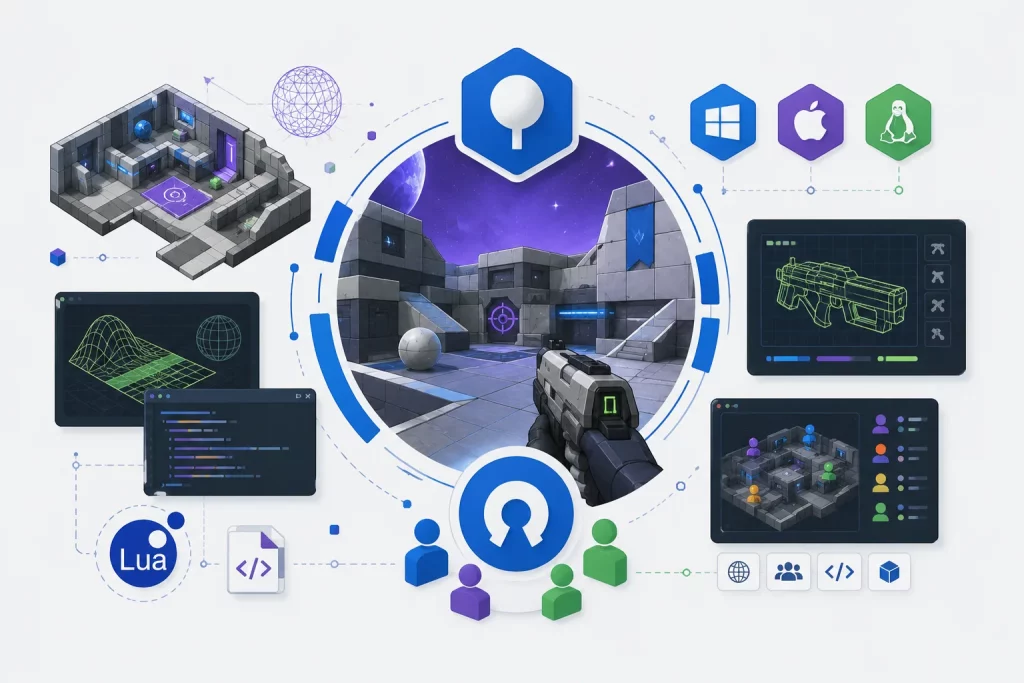
- A full editor suite — world editor, terrain sculpting and erosion brushes, forest painting, river and road tools, material editor, shape editor, particle editor and an asset browser, with a separate Project Manager for creating projects and pulling in modules.
- A modern renderer — physically based rendering, image-based lighting with reflection probes, IES light profiles, screen-space effects, and both DirectX and OpenGL paths.
- Bullet physics, plus a Recast-based navigation mesh system for AI pathfinding.
- TorqueScript, which now supports default argument values, alongside a C++ codebase standardised on C++17 and built with CMake.
- A module system — game modes, sub-scenes for streaming parts of a level, and drop-in modules for spawning, UI and gameplay kits.
- Genuine multiplayer heritage. The networking model descends directly from the technology built for Tribes 2, so client-server multiplayer sits in the engine’s architecture rather than being layered on later.
Games Built With Torque 3D
Torque’s most famous credits belong to the older TGE, not to Torque 3D. For current work, the engine’s own showcase is the honest source — these are projects listed in the Torque community’s showcase. Note that the showcase covers Torque generally rather than splitting entries by engine version, so treat it as “built with a Torque engine” unless the project says otherwise:
| Project | Notes |
|---|---|
| Visitors: First Contact | Commercial release; multiplayer added 2023 |
| Catographer | Community showcase project, used by the team to exercise editor features |
| Airship Dragoon | Commercial turn-based strategy |
| Rad Alert | In development, active devlog |
| Ghost Battalion | In development, active devlog |
| The ManFisher | Community showcase |
| Übergame | Open-source FPS |
| MegaMotion, Pirate Code, Johnny Trouble | Community showcase entries |
This is a smaller and less starry list than a page about Unreal would carry, and pretending otherwise helps nobody. Torque 3D’s realistic position is a capable free engine with a small, committed user base — not a commercial force.
Torque 3D vs the Engines You Would Otherwise Pick
| Name | Torque 3D | Godot | Unreal Engine 5 |
|---|---|---|---|
| Licence | MIT, no royalties | MIT, no royalties | Free to a revenue threshold, then royalties |
| Source access | Full | Full | Full, with registration |
| Scripting | TorqueScript, C++ | GDScript, C#, C++ | Blueprints, C++ |
| Multiplayer | Built in from the Tribes 2 lineage | Improving, high-level API | Mature, replication-based |
| Community size | Small | Very large | Very large |
| Best for | Networked 3D games where you want to own the whole stack | Most indie 3D and 2D projects | Photorealistic and large-team projects |
One caveat on that first row: Unreal’s commercial terms are set by Epic and have changed more than once. Check the current licence before you budget against it. Torque 3D’s and Godot’s MIT terms cannot change retroactively for code already released.
The honest recommendation: if you are starting a new project and have no attachment to Torque, Godot is the safer default — same licence terms, far more tutorials, far more people to ask. Torque 3D earns its place when you specifically want a lean C++ codebase you can read end to end, or when networked multiplayer is the core of your design rather than a feature you bolt on later. If the choice really comes down to language and tooling rather than engine brand, our guide to the best programming languages for game development frames that decision.
Key Takeaways
- Torque 3D is MIT-licensed, free, and actively developed — commits landed on 24 August 2026, and its lead maintainer reports around 200 merged pull requests in the current cycle.
- Clone
TorqueGameEngines/Torque3D, notGarageGames/Torque3D. The old repository has been effectively frozen since 2022. - The last tagged stable release is 4.0.3 (February 2023); 4.1 is in development with a release candidate expected.
- Tribes 2 did not run on Torque 3D. Torque descends from the Tribes 2 engine — via V12, TGE and TGEA — and Torque 3D itself arrived in 2009.
- TGE and Torque 3D are different products. Much older “Torque” documentation describes the 2001 engine.
- Torque 2D is also alive: 4.0 EA4 shipped in August 2026.
- For a new project with no Torque attachment, Godot is the safer default; Torque 3D wins on networked multiplayer and on owning a readable C++ stack.
Frequently Asked Questions
Conclusion
Torque is the counter-example to the usual open-source engine story. The company that sold it stopped selling it, then stopped existing as an engine vendor — and the engine kept going, because the MIT licence in 2012 meant nobody needed permission to keep working on it. Fourteen years later a volunteer team is merging hundreds of pull requests a cycle and grinding towards 4.1.
That does not make it the right pick for every project; a small community is a real cost when you are stuck at 2am. But it does make it something rarer than a nostalgic curiosity: a free, readable, genuinely maintained C++ engine with multiplayer in its bones. For where it sits among the alternatives, our directory of 100+ C and C++ game engines maps the field by category.