
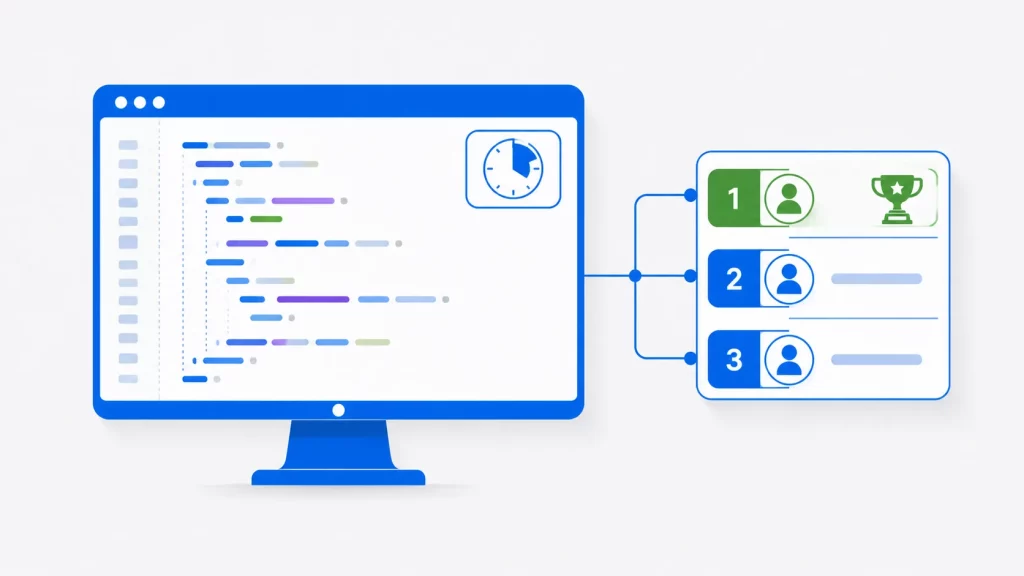
Programming contests are one of the fastest ways to grow as a developer. Whether you compete in weekly online rounds or prestigious annual championships, these competitions push you to solve real algorithmic problems under time pressure — sharpening the problem-solving skills that matter for technical interviews and serious software work alike.
This guide covers the best places to compete today, from modern platforms like Codeforces, LeetCode, and AtCoder to long-running contests such as ICPC and the TopCoder Open. Most are free to enter and open to any language — C, C++, Java, Python, or whichever you prefer — and they welcome everyone from complete beginners to world-class competitors. You’ll also find how to prepare, which contests suit students versus professionals, and how to take your first step.
The Best Competitive Programming Platforms in 2026
If you want to compete regularly — not just once a year — these are the platforms where the global competitive-programming community is most active today. Most run frequent online contests you can enter for free, from any country.
| Platform | Best for | Contest cadence | Difficulty |
|---|---|---|---|
| Codeforces | The core of competitive programming | Multiple “Rounds” weekly | Beginner → Advanced |
| LeetCode | Interview-focused contests | Weekly + Biweekly contests | Beginner → Intermediate |
| AtCoder | Clean, well-set problems (Japan-based, global) | Weekly (ABC/ARC/AGC) | Beginner → Advanced |
| CodeChef | Structured monthly contests + ratings | Weekly + monthly Long/Cook-off | Beginner → Advanced |
| HackerRank | Skill certification + beginner practice | Frequent, plus practice tracks | Beginner → Intermediate |
| HackerEarth | Hackathons + sponsored challenges | Regular hackathons | Beginner → Intermediate |
| TopCoder | The original online arena (SRMs) | Single Round Matches | Intermediate → Advanced |
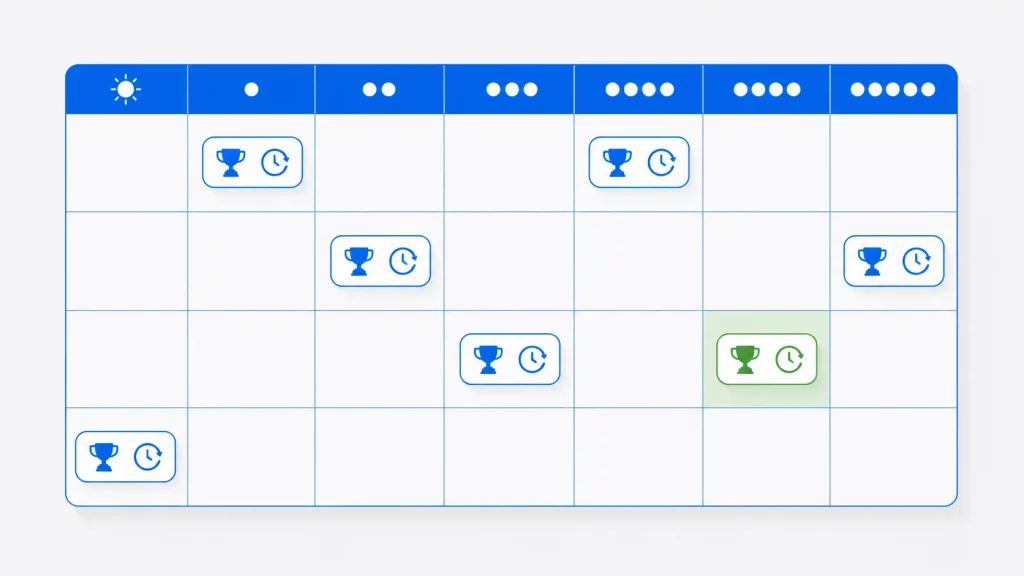
If you’re starting out, resist the urge to sign up for everything. Pick one platform — Codeforces or AtCoder — and enter its contests consistently for a couple of months. Spreading across five platforms early just means you never build a rating on any of them.
Codeforces
Codeforces is the heart of modern competitive programming. It hosts multiple Rounds each week, splits competitors into rating-based divisions (Div. 1–4) so you face people near your level, and uses a live “hacking” phase where you can challenge others’ solutions. Its problem archive (the “Problemset”) is the single most-used practice resource in the community.
LeetCode
LeetCode is the platform most people use to prepare for technical interviews. Its Weekly and Biweekly contests run timed problem sets that mirror interview difficulty, and your contest rating maps loosely to readiness for FAANG-style interviews. Start here if your goal is a job rather than competitive ranking.
AtCoder
AtCoder, based in Japan but fully global with English support, is known for exceptionally clean, well-tested problems. Its AtCoder Beginner Contest (ABC) is one of the best on-ramps in the entire space — approachable, weekly, and beginner-friendly without being trivial.
CodeChef
CodeChef offers a clear progression with weekly contests, the monthly Cook-off and Lunchtime, and a star-based rating system that’s motivating for newcomers. It also has strong communities in India and a large editorial archive explaining solutions.
Major Annual Programming Contests and Championships
Beyond the weekly online platforms, a number of prestigious annual contests have shaped competitive programming for decades. These are organized events — many team-based or student-focused — that are worth aspiring to as your skills grow. Each entry below notes who it’s best suited for and its difficulty level.
1. ICPC — International Collegiate Programming Contest
The ICPC traces its roots to a 1970 competition at Texas A&M University, hosted by the Alpha chapter of the UPE Computer Science Honor Society. It is the oldest, largest, and most prestigious programming contest in the world, pitting teams of university students against each other under intense time pressure. ICPC rewards creativity, teamwork, and the ability to perform when it counts — and participation is highly valued by employers.
Best for: university students (teams). Difficulty: Advanced.
2. TopCoder & the TopCoder Open
TopCoder is one of the original online competitive-programming arenas. Members compete weekly in Single Round Matches (SRMs), and the annual TopCoder Open (TCO) is its flagship championship, spanning both algorithm and design tracks. The TopCoder community has long taken on challenges from major brands including IBM, Google, and eBay, and its top-rated members are among the strongest competitive programmers anywhere.
Best for: intermediate to advanced programmers. Difficulty: Intermediate → Advanced.
3. Meta Hacker Cup
The Meta Hacker Cup (formerly Facebook Hacker Cup) is Meta’s annual open algorithmic programming contest. It runs online through several elimination rounds, open to anyone worldwide, culminating in a global final. It’s a well-respected, genuinely difficult algorithmic competition.
Best for: experienced competitive programmers. Difficulty: Advanced.
4. Microsoft Imagine Cup
Running for more than two decades, the Microsoft Imagine Cup is less a pure coding contest and more a global student innovation competition. Teams take on real-world problems — often submitted by NGOs and non-profits — and build technology solutions around them, with recent editions emphasizing AI, sustainability, and healthcare. It rewards product thinking and impact as much as raw coding skill.
Best for: student teams building real projects. Difficulty: Intermediate.
5. HPE Codewars
Hewlett Packard Enterprise (HPE) Codewars has run annually since 1999 and is aimed at high-school students. It pairs a wide range of programming challenges with the classic hackathon atmosphere — a high-tech environment, plenty of “programmer food,” and hardware and accessories gifted to participants. Recent events support C, C++, Java, and Python 3+.
Best for: high-school students. Difficulty: Beginner → Intermediate.
6. American Computer Science League (ACSL)
ACSL is a long-running computer-science competition for elementary, middle, and high-school students, organized as a season of contests that combine written problems on CS theory with hands-on programming. It’s one of the most established ways for younger students to get into competitive computing.
Best for: K-12 students. Difficulty: Beginner → Intermediate.
7. ICFP Programming Contest
Held each year a few months before the International Conference on Functional Programming, the ICFP Programming Contest is a fun, challenging, three-day open competition. There’s no entry fee and no need to pre-register; participants can work from anywhere, in teams of any size, using any language. It’s known for creative, open-ended problems.
Best for: programmers who enjoy open-ended, language-agnostic challenges. Difficulty: Intermediate → Advanced.
Historic and Niche Contests
These contests are either highly specialized, no longer running regularly, or notable mainly for their history. They’re worth knowing about, but they aren’t where most competitive programmers spend their time today.
8. International Obfuscated C Code Contest (IOCCC)
One of the most famous and eccentric contests in programming history, the IOCCC challenges entrants to write the most obscure, creative, and obfuscated valid C program possible within a tight character limit. Entries must compile and run on a Unix-like system. It’s less about problem-solving speed and more about deep, playful mastery of C’s quirks.
Best for: experienced C programmers. Difficulty: Advanced (and unusual).
9. BME International 24-Hour Programming Contest (Challenge 24)
Challenge 24 is a 24-hour international contest organized by the Electrical Engineering Students’ Association in Budapest. A distinctive feature is that participants use their own computers and environment, with no restrictions on OS or tooling. The top teams from the online qualifier are invited to the in-person final in Hungary.
Best for: advanced teams. Difficulty: Advanced.
10. Internet Problem Solving Contest (IPSC) and Other Legacy Contests
The IPSC was a long-running online team contest known for unusual, out-of-the-box problems that you could solve in any way — by program or even by hand — as long as you produced the correct output. It ran for many years but has not been held regularly recently. Other notable contests from this era include Google’s Code Jam, Hash Code, and Kick Start, which Google retired in 2023, and Facebook CTF, a capture-the-flag security competition that is now largely dormant.
Status: historic / dormant — included for completeness.
All contests and platforms listed were verified as active as of June 2026.
How to Prepare for Programming Contests
Competitive programming rewards consistent practice more than raw talent. A practical path:
- Pick one language and learn it well. Most competitors use C++ for its speed and its Standard Template Library (STL); Python and Java are also widely supported. C++ is the most common choice at the top level.
- Master the core data structures and algorithms. Arrays, strings, sorting, binary search, recursion, then graphs (such as Kruskal’s algorithm), dynamic programming and greedy techniques. These are the backbone of almost every contest problem.
- Practice on rated problems. Start with Codeforces Div. 3/4 rounds or AtCoder Beginner Contests, and solve past problems by topic.
- Compete regularly. Rating is built over months. Entering a contest every week, even when you don’t do well, is what drives progress.
The single highest-return habit is reading the editorial after every contest, especially for the one problem you almost solved. That’s where the real learning happens, not in the problems you already knew how to do.
Best Contests for Students vs Professionals
For students: ICPC is the goal — it’s university-team-based and hugely respected by employers. For weekly practice, AtCoder Beginner Contests and Codeforces Div. 3/4 are the friendliest entry points.
For working professionals: LeetCode Weekly Contests map most directly to interview preparation and career moves. If you compete for the challenge itself, Codeforces and AtCoder offer the deepest problem sets and the strongest global rankings.
Frequently Asked Questions
Conclusion
Programming contests are about far more than prizes. They’re one of the most effective ways to sharpen problem-solving skills, deepen your grasp of algorithms and data structures, and prepare for technical interviews. They also connect you to a global community, expose you to problem styles you’d never encounter in day-to-day work, and build the habit of performing under time pressure.
Whether you’re aiming for a job, a high rating, or simply the challenge, the key is consistency. The programmers who improve aren’t necessarily the most talented — they’re the ones who keep showing up, contest after contest, and learn from every problem they couldn’t solve.
Next Steps
Ready to start competing? Here’s a practical path from this guide to your first contest:
- Pick your first platform. For pure competitive practice, create an account on Codeforces or AtCoder. If your goal is interview preparation, start with LeetCode instead.
- Build the fundamentals. Most contest problems come down to a handful of core topics. Strengthen your data structures and algorithms before worrying about rating.
- Learn the contestants’ language. C++ is the most popular choice at the top level, largely because of the speed of its Standard Template Library (STL).
- Practice key algorithms by topic. Start with sorting and searching, then graph algorithms such as Kruskal’s algorithm, dynamic programming, and greedy techniques.
- Enter one contest this week. The single most important step is to stop preparing and actually compete. Enter a beginner-friendly round, see where you land, then read the editorial afterward.