
The G3D Innovation Engine is an open-source C++ 3D engine built for graphics research, teaching and fast prototyping. It was created by Morgan McGuire, a graphics researcher who has worked as a professor, at NVIDIA and at Roblox. It gives programmers a ready-made base for rendering experiments: a real-time renderer with ray tracing and post-processing effects, built-in debugging and capture tools, and a large math and geometry library. It has been used in university courses, research papers and tech demos, and its documentation links it closely to McGuire’s Graphics Codex teaching material.
This profile covers what G3D is, how it’s structured, what it offers, and where the project stands in 2026. It includes a math and geometry example we compiled and ran against G3D’s own source code. Facts were checked against G3D’s official website, its manual and a public mirror of its source code in November 2026.
What Is the G3D Innovation Engine?
The G3D Innovation Engine is an open-source C++ 3D engine for research, teaching and prototyping, created by Morgan McGuire. Its core libraries are under the 2-clause BSD licence. It supports real-time rendering with OpenGL, ray tracing on the CPU and GPU, VR and video capture, on Windows, macOS and Linux. Its latest version is G3D 10.01, built from source, and the project appears to have been inactive since about 2021.
G3D Innovation Engine at a glance
| Type | Open-source 3D engine for graphics research, teaching and prototyping |
|---|---|
| Creator | Morgan McGuire |
| Other maintainers | Michael Mara, Zander Majercik, Josef Spjut, Corey Taylor |
| First code | 2000 (per its copyright notices) |
| Latest version | 10.01 (manual last generated November 2021) |
| Status | Inactive as far as public sources show |
| Written in | C++ |
| Graphics | OpenGL 4.1+; ray tracing on GPU and CPU |
| Platforms | Windows, macOS, Linux |
| Licence | 2-clause BSD (core libraries); bundled libraries have their own |
Where G3D Came From
G3D’s own copyright notices date the engine from 2000, and McGuire maintained it through his academic and industry career. Its source code has lived in Subversion repositories on a Williams College server, where McGuire taught, and on SourceForge. The manual’s credits list dozens of contributors, from university students to industry engineers, including Roblox founders David Baszucki and Erik Cassel.
By version 10, the official website named the main maintainers as Morgan McGuire, Zander Majercik and Josef Spjut at NVIDIA, Corey Taylor, and Michael Mara at Stanford University and Oculus Research (the G3D website). The site asks academic users to cite G3D through a 2017 reference by McGuire, Mara and Majercik.
McGuire himself moved on. After about a dozen years at NVIDIA, where he led graphics research, he became Chief Scientist at Roblox, and his biography now describes him as a leadership strategist and coach for technology executives (Morgan McGuire’s biography).
How G3D Works
G3D isn’t a game engine with an editor-first workflow. It’s a set of C++ libraries you build programs on, with tools built into every program. Its website describes three core libraries:
- G3D-base: math, geometry, containers, file formats, networking and other non-graphics code. Vectors, matrices, rays, boxes, spheres and intersection tests all live here.
- G3D-gfx: the GPU layer over OpenGL, including textures, shaders and framebuffers. The current manual requires OpenGL 4.1 or later.
- G3D-app: the application framework. You subclass
GApp(orVRAppfor virtual reality) and get a window, a camera, a scene system and a GUI.
On top of these, G3D provides:
- Rendering: forward and deferred shading, real-time ray tracing on the GPU and CPU, path tracing, and cloud and remote rendering.
- Effects: ambient occlusion, temporal and FXAA antialiasing, motion blur, depth of field, bloom, tone mapping, screen-space radiosity and order-independent transparency.
- In-engine tools: a drag-and-drop scene editor, CPU and GPU profilers, a texture debugger, a model inspector, and video, screenshot and cube-map capture.
- Data import: models in FBX, glTF, OBJ, DAE, PLY and other formats, common image and video formats, and 12 GB of ready-to-use assets.
- VR: add VR to a program by subclassing
VRApp, with support for Vive, Rift and Windows Mixed Reality headsets.
G3D builds with Visual C++, Xcode or clang. The official instructions use the project’s own buildg3d script, and a Windows installer script downloads and sets up all the tools. There are no precompiled binaries.
Hello, G3D: Rays and Shapes with G3D-base
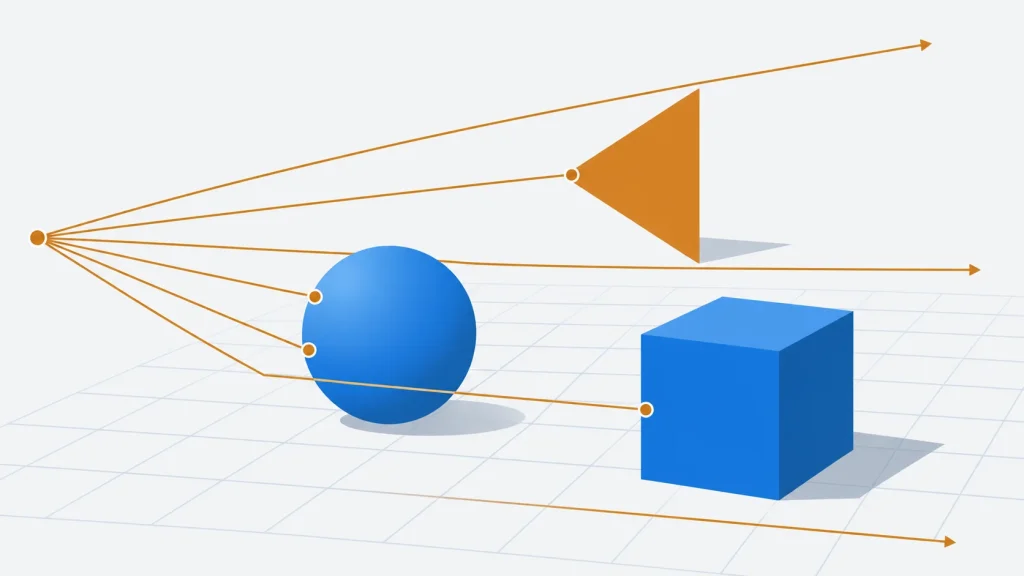
G3D’s math library is useful on its own, without a window. This program fires one ray through a triangle, a box and a sphere, and rotates a point with a coordinate frame:
// g3d-ray-test.cpp - G3D's base library (math and geometry) without a window
#include <G3D/Ray.h>
#include <G3D/AABox.h>
#include <G3D/Sphere.h>
#include <G3D/CoordinateFrame.h>
#include <G3D/Matrix3.h>
#include <cstdio>
using namespace G3D;

int main() {
    // A camera ray from 5 units back, pointing down -Z
    const Ray ray = Ray::fromOriginAndDirection(Point3(0.2f, 0.1f, 5.0f), Vector3(0, 0, -1));

    // One-sided triangle facing the camera at z = 0 (Moller-Trumbore test)
    const Point3 v0(-1, -1, 0), v1(1, -1, 0), v2(0, 1, 0);
    const float t = ray.intersectionTime(v0, v1, v2, v1 - v0, v2 - v0);
    const Point3 hit = ray.origin() + ray.direction() * t;
    printf("Ray hits triangle at t = %.3f, point = (%.2f, %.2f, %.2f)\n", t, hit.x, hit.y, hit.z);

    // The same test against a box and a sphere
    const AABox box(Point3(-2, -2, -3), Point3(2, 2, -1));
    printf("Ray hits box at t = %.3f\n", ray.intersectionTime(box));
    printf("Ray hits sphere at t = %.3f\n", ray.intersectionTime(Sphere(Point3(0, 0, -10), 1.0f)));

    // Rotate a point 90 degrees about Y with a coordinate frame
    const CFrame frame(Matrix3::fromAxisAngle(Vector3::unitY(), toRadians(90.0f)), Point3(0, 1, 0));
    const Point3 p = frame.pointToWorldSpace(Point3(1, 0, 0));
    printf("(1, 0, 0) in world space: (%.2f, %.2f, %.2f)\n", p.x, p.y, p.z);
    return 0;
}
The program printed:
Ray hits triangle at t = 5.000, point = (0.20, 0.10, 0.00)
Ray hits box at t = 6.000
Ray hits sphere at t = 14.025
(1, 0, 0) in world space: (-0.00, 1.00, -1.00)
Each intersectionTime call returns the distance along the ray to the hit, or infinity for a miss. The sphere hit is at 14.025, not 14, because the ray passes 0.22 units from the sphere’s centre and enters it slightly early. The rotation takes (1, 0, 0) to (0, 0, -1) and then adds the frame’s (0, 1, 0) position. “-0.00” is just floating-point rounding of a tiny negative number.
Tested: the official Subversion repository wasn’t reachable from our tools, so we used a public GitHub snapshot of G3D’s source code from December 2016, which identifies itself as version 10.01. With GCC 13 on Ubuntu 24.04, 110 of the 128 source files in G3D’s base library compiled unchanged. Most of the rest need generated files or optional libraries. To link the test, we also needed one small compiler setting for a file that mixes old and new C++ smart pointers. The program then printed the results above, which match hand calculations. We didn’t test G3D’s graphics or application layers, which need the full build.
G3D Innovation Engine in 2026
G3D is no longer actively developed, as far as public sources show:
- The hosted manual is frozen at version 10.01 (the G3D manual). The website says its documentation tracks the Subversion trunk and is “updated once a day”, but the manual’s own footer says it was generated on November 24, 2021, and its copyright line ends at 2018.
- No newer version appears anywhere. The public mirror we built from already identified itself as version 10.01 in December 2016.
- The maintainers have moved on. McGuire has left NVIDIA and Roblox, and the other listed maintainers’ affiliations are from G3D’s NVIDIA era.
We couldn’t check the official SourceForge repository’s latest commit, because SourceForge required a browser security check that we didn’t complete. If you want to try G3D today, the official instructions and installer still exist, but expect to fix build problems on current compilers yourself.
Is G3D a Game Engine?
Partly. G3D has been used for games and tech demos, and it includes what a game needs: rendering, audio through FMOD, networking, input and a GUI. But it was designed for graphics research and teaching. It favours fast experiments with rendering algorithms over shipping finished games. It has no asset store or visual game-logic tools, and nothing like a console publishing pipeline. If you want to make a game, a full game engine is a better fit. If you want to try a new shading or ray-tracing idea quickly, G3D was built for exactly that.
G3D Alternatives
- Falcor: NVIDIA’s open-source real-time rendering framework for research, a close modern equivalent to G3D’s role (Falcor on GitHub).
- Horde3D: a small open-source C++ graphics engine with a C-style API, still maintained in 2026. See our Horde3D profile.
- OGRE: a larger open-source C++ rendering engine with a long history. See our OGRE 3D profile.
- Godot: a complete open-source game engine, if you want to make games rather than graphics experiments. See our Godot engine profile.
For more open-source engines, see our directory of open-source C++ game engines.
Key Takeaways
- G3D is an open-source C++ 3D engine for graphics research and teaching, created by Morgan McGuire, with core libraries under the 2-clause BSD licence.
- It’s built from three libraries: G3D-base (math and utilities), G3D-gfx (OpenGL) and G3D-app (the application framework).
- It offers research-grade rendering: ray tracing and path tracing, modern post-processing, VR support and built-in profiling and capture tools.
- The latest version is 10.01, and its hosted manual was last generated in November 2021.
- The project appears inactive, and its creator has moved on to other work.
- Its math library still compiles and works: our ray test gave the expected distances for a triangle, a box and a sphere.
Conclusion
G3D was a quiet workhorse of graphics research and teaching. It gave students and researchers a solid base to try ideas on, without building an engine first. In 2026 it reads more like a well-documented archive than a living project. Its code, manual and design are still worth studying, and newer research frameworks have taken over its everyday role.
For more engines across every genre, browse our game development hub.