

Unreal Engine is a suite of real-time 3D creation tools developed by Epic Games, and one of the most powerful and widely used game engines in the world. Since its debut with the 1998 shooter Unreal, it has grown from a first-person-shooter engine into the technology behind blockbuster games, films, television, architecture, and automotive design. Its current generation, Unreal Engine 5, set a new standard for real-time graphics with breakthrough features like Nanite and Lumen.
In the past, there have been fiery debates (ign, Gamespot) dating back to the 2000s about which game was better, Quake III Arena or Unreal Tournament. I see that the topic is still hot among old-school FPS players (DoomWorld, Reddit). Look at this original Unreal Intro.
This guide covers what Unreal Engine is, its history from UE1 through UE5, the revolutionary UE5 features (Nanite, Lumen, MetaHuman), the games built with it, how it compares to Unity, its pricing and licensing, the languages you use to develop with it, and how to get started as a beginner.
What Is Unreal Engine?
Unreal Engine is a game engine — a complete framework of tools for building interactive 3D experiences, handling rendering, physics, animation, audio, and gameplay logic so developers don’t have to build those systems from scratch. Written primarily in C++, it was created by Epic Games co-founder Tim Sweeney and first released in 1998.
What sets Unreal apart is its focus on cutting-edge, photorealistic real-time graphics. Over more than 25 years and five major generations, it has repeatedly pushed the limits of what real-time rendering can achieve, which is why it’s used not only across the games industry but increasingly in film and TV production (via virtual production and LED volumes), architecture, automotive visualization, and simulation.
A Brief History of Unreal Engine
Unreal Engine has evolved through five major generations, each a significant leap — a history chronicled in Polygon’s history of Epic Games:
| Generation | Year | Landmark Feature | Notable Games |
|---|---|---|---|
| Unreal Engine 1 | 1998 | 3D rendering + UnrealScript | Unreal, Unreal Tournament, Deus Ex |
| Unreal Engine 2 | 2002 | New polygon pipeline, UnrealEd 2 | America’s Army, Splinter Cell |
| Unreal Engine 3 | 2004–06 | Programmable shaders, wide platform reach | Gears of War, Mass Effect, Batman: Arkham |
| Unreal Engine 4 | 2014 | Real-time global illumination, Blueprints | Fortnite, Star Wars Jedi: Fallen Order |
| Unreal Engine 5 | 2022 | Nanite, Lumen, MetaHuman | Fortnite, Clair Obscur: Expedition 33 |
(The detailed UE1, UE2, and UE3 sections below cover each generation’s features and games in depth.)
Unreal Engine 1
Unreal Engine 1 was released in 1998, developed over roughly three years by Tim Sweeney, and debuted with the first-person shooter Unreal. It was a landmark achievement for its time, integrating rendering, collision detection, AI, networking, and file-system management into a single, cohesive engine — something few engines did in one package back then.
Its rendering supported colored lighting, texture filtering, and early software and hardware-accelerated 3D, producing visuals well ahead of its contemporaries. UE1 also introduced UnrealScript, a built-in object-oriented scripting language that let developers create gameplay logic without touching the C++ core — an early ancestor of the Blueprints philosophy Unreal is known for today.
Notable games: Unreal (1998), Unreal Tournament (1999), Deus Ex (2000), and Harry Potter early titles. UE1’s flexibility and moddability made it a favorite for a wide range of studios beyond Epic.
Unreal Engine 2
Unreal Engine 2 arrived in 2002 and was a substantial rewrite, debuting with America’s Army and Unreal Championship. Epic rebuilt the rendering engine and overhauled the editor into UnrealEd 2, while adding a new physics system (integrating Karma physics) and expanding platform support to consoles including the PlayStation 2, Xbox, and GameCube.
UE2 significantly improved the engine’s polygon-handling pipeline and skeletal-animation system, enabling more detailed characters and environments. A specialized branch, UE2.5, added further rendering improvements, and UE2X was optimized specifically for the original Xbox.
Notable games: America’s Army, Unreal Tournament 2003/2004, Tom Clancy’s Splinter Cell series, Lineage II, and BioShock (which used a heavily modified UE2.5). Its wide console reach helped establish Unreal as a serious cross-platform engine.
Unreal Engine 3
Unreal Engine 3, revealed in 2004 and shipping in games from 2006, was the generation that made Unreal an industry standard. It was designed around programmable pixel and vertex shaders, moving lighting and shading calculations onto the GPU, and delivered gamma-correct high-dynamic-range (HDR) rendering that gave UE3 games their distinctive, richly lit look.
UE3 introduced a fully node-based material editor, a modular content pipeline, and broad multi-platform support across the Xbox 360, PlayStation 3, PC, and later mobile devices, including Android.. Its accessibility and quality made it the most licensed engine of its era, used by studios worldwide, and Epic’s own Gears of War became its flagship showcase.
Notable games: the Gears of War series, the Mass Effect trilogy, the Batman: Arkham series, BioShock Infinite, Borderlands, XCOM: Enemy Unknown, and hundreds more. UE3 also powered the original mobile Infinity Blade, demonstrating the engine’s reach onto touch devices
Unreal Engine 4
Released in 2014, Unreal Engine 4 was the generation that made Unreal accessible to everyone. Two changes defined it:
- Blueprints visual scripting. UE4 introduced Blueprints, a node-based visual scripting system that lets designers and artists build gameplay logic without writing C++. This dramatically lowered the barrier to entry and remains one of Unreal’s defining features.
- A free, source-available model. Epic made the full C++ source code available and shifted to a royalty model, opening the engine to indie developers and hobbyists worldwide.
Technically, UE4 delivered real-time global illumination, physically based rendering, the Chaos physics and destruction system (replacing NVIDIA PhysX in later versions), the Niagara visual effects system, and real-time ray tracing support. It became the most widely used AAA engine of its generation, powering everything from Fortnite to Star Wars Jedi: Fallen Order.
Unreal Engine 5 (UE5)
Unreal Engine 5 was revealed in May 2020, released in early access in 2021, and officially launched in April 2022. It represents the biggest leap in the engine’s history, built to deliver film-quality real-time graphics and vast open worlds. As of 2026 the engine is on version 5.6+, with regular updates continuing to expand it. Its defining features are:
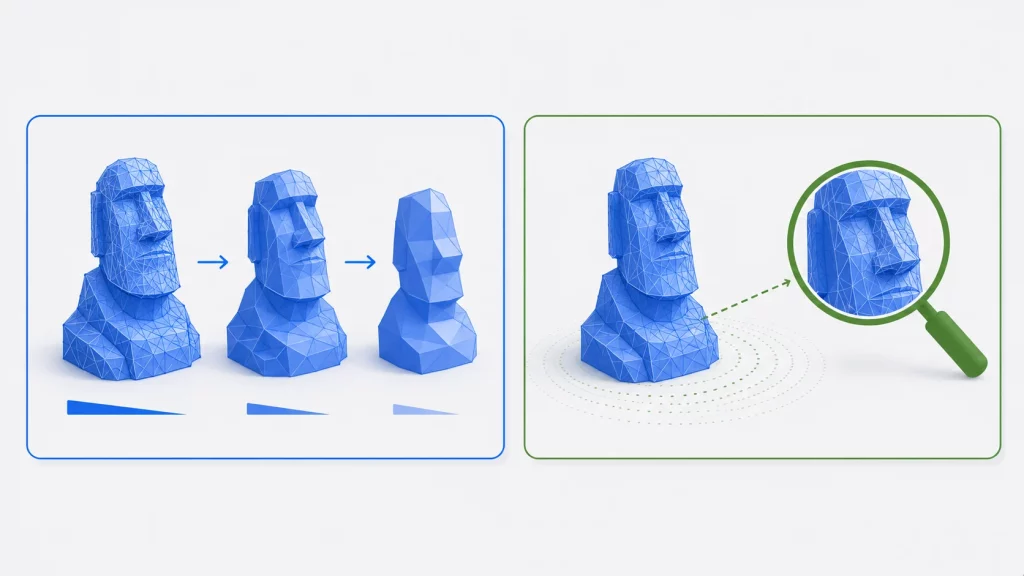
Nanite — virtualized geometry. Nanite is a virtualized micropolygon geometry system that lets developers import film-quality assets composed of millions of polygons — ZBrush sculpts, photogrammetry scans — and render them in real time without manually creating levels of detail (LODs) or baking normal maps. Nanite intelligently streams and renders only the detail the viewer can actually perceive, largely removing traditional polygon-count and draw-call limits.
Lumen — dynamic global illumination. Lumen is a fully dynamic global illumination and reflections system. It calculates how light bounces around a scene in real time, so lighting reacts instantly to changes — moving the sun or opening a door updates all indirect lighting automatically, with no pre-baked lightmaps. It uses both software and hardware ray tracing.
MetaHuman — realistic digital humans. MetaHuman is a framework for creating highly realistic, fully rigged digital human characters in minutes rather than months. Built on technology from Epic’s acquisitions (3Lateral, Cubic Motion, Quixel), it includes MetaHuman Creator and MetaHuman Animator for facial capture, and by UE 5.6 ships directly inside the engine.
Supporting UE5 systems include World Partition (which automatically divides huge levels into streamable chunks), Nanite Virtual Shadow Maps, MetaSounds (a fully controllable audio DSP system), and Chaos physics. Together these let small teams achieve visuals that previously required a large studio — as demonstrated when Clair Obscur: Expedition 33, a UE5 game from a small first-time studio, won Game of the Year in 2025.
One honest caveat worth knowing: UE5’s advanced features come with performance challenges. The engine has been associated with shader compilation stutter and traversal stutter in some titles, and its default temporal anti-aliasing can cause blur. Epic and major studios (including CD Projekt, building The Witcher IV on UE5) are actively working on these issues, but they’re a real consideration for developers targeting smooth performance.
Games Made with Unreal Engine
Unreal Engine powers an enormous range of games across every generation. Recent and notable titles include:
- Fortnite (Epic’s own game, migrated from UE4 to UE5)
- Clair Obscur: Expedition 33 (2025 Game of the Year, UE5)
- Remnant 2, Immortals of Aveum, Layers of Fear (early UE5 titles, 2023)
- Star Wars Jedi: Survivor, Lies of P, Robocop: Rogue City
- Black Myth: Wukong (2024, UE5)
- Senua’s Saga: Hellblade II (2024, UE5)
- Classic UE4/UE3 titles: Gears of War series, Mass Effect trilogy, Batman: Arkham series, Borderlands 3, Sea of Thieves
Upcoming UE5 titles include CD Projekt Red’s The Witcher IV and next-generation projects from studios across the industry — a sign of how thoroughly Unreal has become the default AAA engine.
Unreal Engine vs Unity
The two engines dominate game development, and “Unreal vs Unity” is the most common comparison developers research. Both are excellent; the right choice depends on your project.
| Factor | Unreal Engine | Unity |
|---|---|---|
| Primary language | C++ and Blueprints (visual scripting) | C# |
| Best known for | High-fidelity AAA graphics | Indie, mobile, cross-platform, 2D |
| Graphics out of the box | Industry-leading (Nanite, Lumen) | Very good, more manual setup |
| Learning curve | Steeper; Blueprints ease entry | Generally gentler for beginners |
| Pricing | Free until $1M revenue, then 5% royalty | Subscription tiers |
| Ideal for | Photorealistic 3D, large worlds, AAA | Mobile games, 2D, rapid prototyping |
In short: Unreal is the go-to for photorealistic, graphically ambitious 3D games and virtual production, while Unity is often preferred for mobile, 2D, and smaller cross-platform projects. Both are used successfully across the industry, and skills in either transfer conceptually to the other.
Pricing and Licensing
Unreal Engine’s licensing is genuinely generous, which is a big part of its popularity:
- Free to start. Unreal Engine is free to download and use, with access to the full C++ source code.
- 5% royalty above $1 million. For games, a 5% royalty applies only after a product earns over $1 million USD — see Epic’s Unreal Engine licensing terms for the full details.
- Free for non-games. Using Unreal for film, architecture, custom or internal projects is free if your organization’s annual gross revenue is under $1M; above that, Epic offers a separate seat-based license (Unreal Engine for other industries) rather than the royalty.
- Fortnite/UEFN content uses a different creator-payout model.
This “free until you succeed” model is why Unreal is accessible to hobbyists and indie studios while still generating revenue from major commercial hits.
What Languages Does Unreal Engine Use?
Unreal Engine development primarily uses two approaches, often together:
- C++ — the core engine is written in C++, and it’s the language for performance-critical gameplay code, engine extensions, and full control. Serious Unreal developers learn C++.
- Blueprints — a visual, node-based scripting system that lets you build gameplay logic without writing code. Designers and artists use Blueprints heavily, and many complete games are built largely or entirely in Blueprints.
A common professional workflow combines both: performance-sensitive systems in C++, with gameplay and rapid iteration in Blueprints. (Epic is also developing Verse, a new programming language currently used in Fortnite/UEFN, which is expected to expand across the engine in future.)
How to Get Started with Unreal Engine
If you’re new to Unreal, here’s a practical path:
- Download the Epic Games Launcher from unrealengine.com and install the latest Unreal Engine (5.6 or newer). It’s free.
- Start with a template. Unreal ships with project templates (first-person, third-person, top-down) that give you a working game to explore immediately.
- Learn Blueprints first. Even if you plan to learn C++, Blueprints teach you how the engine’s systems fit together without the friction of code. Epic’s free Unreal Learning portal and official documentation are excellent.
- Add C++ when ready. Once comfortable, learn C++ to unlock full control. A solid grounding in C++ fundamentals helps enormously here.
- Build small, finish projects. Complete tiny games rather than starting an ambitious one — finishing teaches more than any tutorial.
Frequently Asked Questions
Conclusion
Unreal Engine’s journey from a 1998 first-person shooter to the technology behind Game-of-the-Year winners reflects a consistent mission: pushing real-time graphics to their limit while making that power accessible. Unreal Engine 5, with Nanite, Lumen, and MetaHuman, gave even small teams the ability to produce visuals that once required a major studio — and with a “free until you earn $1 million” model, the barrier to entry has never been lower.
Whether you’re drawn by the photorealistic graphics, the C++ and Blueprints workflow, or simply curiosity about how modern games are made, Unreal Engine is one of the most rewarding tools in the industry to learn. To explore further, see our directory of the best C++ game engines and our guide to the best programming languages for game development.