
qfusion is what happens when someone spends fifteen years rebuilding id Software’s Quake II engine, substantially replacing and extending the original rendering path along the way. Victor Luchits started it, it grew into the engine behind the free arena shooter Warsow, and it is still GPLv2 — you can clone it this afternoon.
What almost nobody explains is that “qfusion” no longer means one repository. It means three, and they have diverged: the original upstream, Warsow’s own fork, and the fork behind Warfork, the Steam release that exists because people believed Warsow had died. This page sorts out which is which, when each was last touched, and which one you would actually build from.
What Is qfusion?
qfusion is a free, open-source 3D game engine written in C and C++, licensed under the GPLv2 and derived from id Tech 2 — the Quake II engine. It was developed principally by Victor Luchits and is best known for powering Warsow, the cel-shaded competitive arena shooter. Its renderer was rewritten far beyond the Quake II original, and it runs on Windows, Linux, macOS and Android. The code now exists as three separate maintained or semi-maintained forks.
| Lead developer | Victor Luchits (viciious) |
| Derived from | id Tech 2 — the Quake II engine |
| Written in | C and C++ |
| Licence | GPLv2 |
| Platforms | Windows, Linux, macOS, Android |
| Best known for | Warsow, and its fork Warfork |
| Upstream repository | Qfusion/qfusion — created June 2013, not archived |
| Upstream activity | Regular commits to July 2021; one merge commit in April 2026 |
Where qfusion Actually Lives Now
Checked directly against the repositories on 15 September 2026 — stars, branches, commit activity and archive status all change, so treat this as a snapshot:
Qfusion/qfusion — the upstream. Victor Luchits’ original. Created in June 2013, not archived. Its commit history runs steadily through 2020 and into July 2021, then stops — until a single merge commit on 5 April 2026 pulling in a downstream branch. On that history, “dormant” describes it better than either actively maintained or formally abandoned — an owner who still occasionally touches it, and long gaps in between.
Warsow/qfusion — Warsow’s fork. Not archived, and the fork with the clearest visible modernisation work: its codebase is roughly 90% C++ with a Qt and QML user interface layer, and its build instructions cover Warsow 2.6 and later. That version number matters — see below.
warfork/warfork-qfusion — Warfork’s fork. Not archived, with commits through May 2025, making it the most recently active of the three by commit date.
All three engine codebases remain GPLv2. Note the scope: that covers the engine source, not necessarily the games’ assets — Warsow’s artwork sat under separate terms, which is exactly why Warfork replaced it with CC0 assets. Check the licence on anything you intend to reuse, not just the repository’s headline licence.
If you want to build something on qfusion today, the Warsow and Warfork forks are the ones with recent work in them; the upstream is the historical reference.
Warsow, Warfork, and a Story That Got Reported Wrong
The standard version of this story is that Warsow died and Warfork took over. It is not that simple, and the page you are reading previously repeated the simple version.
In 2019, Phoronix reported that work on Warsow appeared to have ended, quoting the game’s former lead developer saying he had resigned some six months earlier and that what remained of the development team had disintegrated. Shortly afterwards, Warfork appeared on Steam — a fork of Warsow with CC0 art assets, presented as keeping the game alive.
But the “Warsow is over” reporting was contested at the time, by people pointing out that a Warsow 2.5 beta had been published within days of the article. And the evidence in the repositories supports the objectors: Warsow’s own qfusion fork carries build instructions for Warsow 2.6 and later — a version that postdates the obituary — along with a Qt/QML interface rewrite that is not in the upstream.
So the accurate summary is messier and more interesting than “Warsow died”: the original development effort did suffer a serious collapse — the lead developer resigned and, by his account, the remaining team broke up — but the codebase and its fork continued to receive work afterwards, and a version later than the supposed last one was built from it. Warfork’s own materials note that it is not affiliated with Warsow, the Warsow team, or Luchits.
What the Engine Does
From the project’s own documentation, with the contradictions in the old version of this page resolved:
- GPLv2 throughout, and built to be modded.
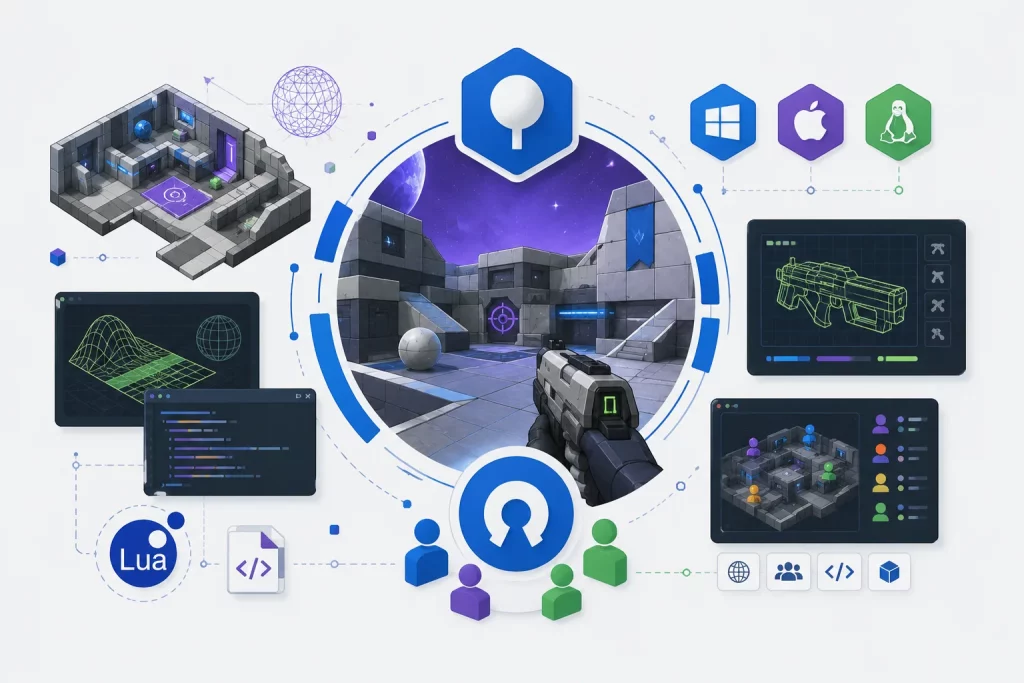
- OpenGL 3.0 and OpenGL ES 2.0 renderer — rewritten far past anything in Quake II, with GLSL shaders loaded from disk and Quake III-style shader commands executed on the GPU via vertex shaders rather than on the CPU.
- AngelScript bindings for scriptable gameplay and UI, using C++-style syntax.
- XHTML/CSS-based user interface with support for remote content, plus TrueType and OpenType font support.
- Vertex and skeletal animation; realtime lighting and shadows via omnidirectional and cascaded shadow maps.
- Multithreaded sound mixing, OpenAL support, and hardware-accelerated Ogg Theora video playback.
- Competitive multiplayer infrastructure: global stats, friend lists, IRC integration and a TV server — unusual for a hobbyist engine, and a direct consequence of Warsow’s esports ambitions.
- Support for foliage surfaces and instanced rendering; Quake 1 and Quake 2 map handling was dropped along the way.
The engine also ships ready-to-go FPS gametype scripts from Warsow, which makes it a more practical starting point than a bare renderer if an arena shooter is what you want.
Should You Use It?
qfusion occupies a narrow but real niche: a GPLv2, id Tech 2-derived engine with a modern renderer, a multiplayer networking stack proven across the Warsow and Warfork lineage, and a complete arena-shooter game already built on it. If you want to make a fast multiplayer FPS and you are comfortable in C and C++, there is genuinely less to build from scratch here than almost anywhere else.
The costs are equally real. The upstream is dormant, documentation is scattered across a wiki last substantially edited in 2019, and GPLv2 is copyleft — depending on how your code links to or incorporates the engine, distribution may trigger source-disclosure obligations that an MIT-licensed engine would not. Read the licence and take advice before a commercial release. For most projects, Godot is the more sensible free choice. qfusion earns its place when the Quake lineage and the ready-made shooter are the point.
Key Takeaways
- qfusion is a GPLv2 fork of id Tech 2 — the Quake II engine — developed principally by Victor Luchits and best known for powering Warsow.
- It is now three forks, not one project: the upstream, Warsow’s fork and Warfork’s fork.
- The upstream is dormant, with regular commits ending in July 2021 and a single merge in April 2026. It is not archived.
- Warfork’s fork is the most recently active, with commits through May 2025.
- Warsow’s story is not simply “it died”. The development team did break up, but its own fork carries build instructions for Warsow 2.6 and later — a version postdating the 2019 reports of its end.
- All three engine codebases are GPLv2 — copyleft, not permissive, which matters if you plan to distribute. Game assets are a separate question: Warsow’s art was licensed separately, and Warfork replaced it with CC0 content.
Frequently Asked Questions
Conclusion
qfusion is a good reminder that open-source engines do not die so much as split. The upstream has been quiet for years, but the code is in three places, all of it still licensed so that anyone can pick it up — which is exactly what happened when a fork launched on Steam under a different name.
If you are looking at it as a foundation, start from whichever fork has the game you want closest to it. If you are looking at it as history, it is one of the more thoroughly rebuilt Quake descendants there is. For engines with more active upstreams, our directory of 100+ C and C++ game engines sorts the field by licence and category.