
The C4 Engine is a commercial 3D game engine written in C++ by Eric Lengyel, founder of Terathon Software and author of well-known books on game-engine mathematics. It went on sale in 2005 and became popular with independent developers and universities in the late 2000s, prized for its clean code and its integrated World Editor. After a spell under the name Tombstone Engine, C4 returned with version 7 in 2023, and it’s sold today as a $100 source-code licence.
This profile covers C4’s history, how its architecture and tools work, the games made with it, the open file formats it gave the industry with a tested example, and where it stands in 2026. Facts were checked against the C4 website, its release notes and contemporary coverage in October and November 2026.
What Is the C4 Engine?
The C4 Engine is a commercial C++ game engine from Terathon Software, developed by Eric Lengyel since 1999 and first licensed in May 2005. It includes a World Editor, a graphical shader editor, voxel terrain and physics. It was sold as Tombstone in the late 2010s, returned as C4 7.0 in 2023, and now runs on 64-bit Windows, PlayStation 5 and 4, and Xbox Series X/S and One.
C4 Engine at a glance
| Developer | Terathon Software (Eric Lengyel) |
|---|---|
| In development since | 1999 |
| First licensed | May 2005 |
| Also known as | Tombstone Engine (late 2010s) |
| Latest version | 7.2, September 2024 |
| Written in | C++ |
| Licence | Commercial; source delivered through GitHub |
| Price | $100 desktop licence (2026) |
| Platforms | 64-bit Windows 10/11, PlayStation 5 and 4, Xbox Series X/S and One |
| Tools | World Editor, shader editor, script editor, panel editor |
| Open formats | OpenDDL and OpenGEX |
| Known for | Transvoxel terrain, Slug text rendering, clean C++ code |
A Short History of C4
Lengyel began the engine in 1999, after working as lead programmer on Sierra’s Quest for Glory V, and later joined Naughty Dog’s advanced technology group. Terathon Software first licensed C4 commercially in May 2005, and it was updated at a rapid pace, with more than 40 builds in its first three years.
C4 found an audience among indie developers and schools, and universities including MIT, Georgia Tech and WPI licensed it for teaching and research. It also reached consoles, first PlayStation 3 and then PlayStation 4. In a 2014 interview, Lengyel said the move to PS4 went smoothly because its x86 processor let the team reuse C4’s PC code (GamingBolt’s interview with Eric Lengyel).
Platform support then narrowed. C4 added Linux in 2012 but dropped it again with version 4.2 in January 2015, with Lengyel citing a “disproportionate cost” in time and money (Phoronix’s report). Later versions also left the Mac behind.
In 2015, Terathon retired C4 from sale, citing changing market conditions. Development continued, and the engine was offered from 2016 to 2020 as the Tombstone Engine, whose 2.9 update arrived in November 2018. The C4 name came back with version 7.0 at GDC in March 2023, the first update since 2018, free for existing owners (GameFromScratch on C4 version 7). Version 7.2 followed in September 2024.
How C4 Works
C4 is built in layers. The lowest layers talk to the hardware and operating system, and the higher layers provide platform-independent services that games are written against. Most of its code is devoted to graphics, with large components for audio, networking, physics, input and scripting. Its main features include:
- A World Editor for building levels, with plug-in tools including a graphical shader editor, a visual script editor and a panel editor for 2D interfaces inside the 3D world.
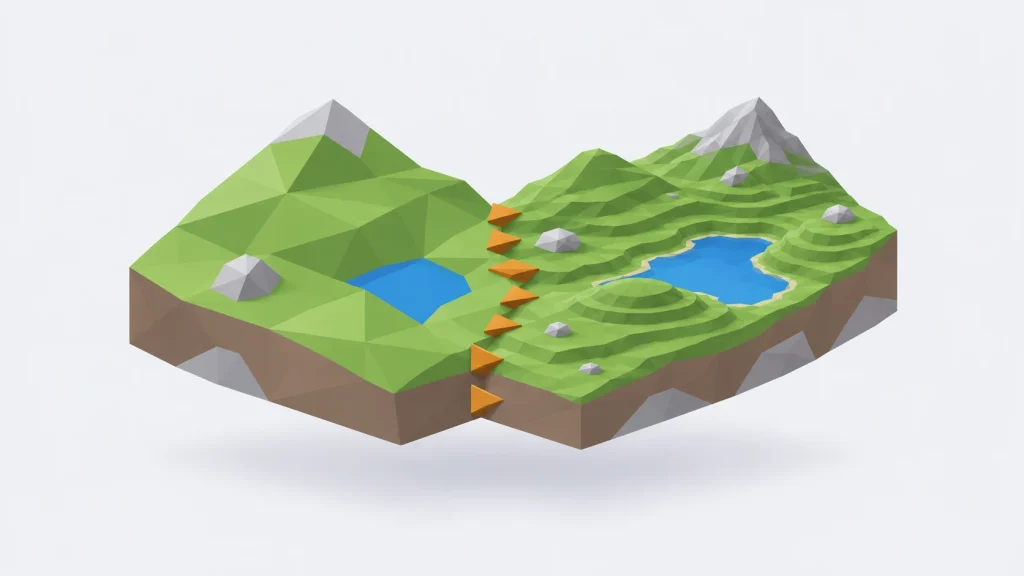
- Voxel terrain using Lengyel’s Transvoxel algorithm, which joins terrain meshes of different detail levels without cracks.
- Built-in physics, with the option to use a third-party physics engine.
- Lighting and effects including cascaded shadow maps, ambient occlusion, particles, procedural fire, volumetric fog and, in version 7, god rays and dual quaternion skinning.
- Text rendering with Slug, Lengyel’s GPU font-rendering technique, which draws glyphs directly from their outlines at any size.
- Scene import through OpenGEX and COLLADA.
C4’s renderer has been built on OpenGL. Version 7.0 included partial code for a move to Vulkan, which Terathon described as work in progress.
Games and Projects Made with C4
| Title | Type |
|---|---|
| World of Subways | Subway driving simulator series from TML-Studios |
| City Bus Simulator | Bus driving simulator series, including City Bus Simulator 2010 |
| Quest of Persia: Lotfali Khan Zand | Historical game from an Iranian studio |
| Lego Wolf3D | Independent game |
| Fat Princess Adventures | PlayStation 4 action RPG (2015), listed among C4 games |
| The 31st | Terathon’s own first-person shooter, in development |
Phoronix named the first four as C4 games when the engine came to Linux in 2012. Terathon now describes its own team as making The 31st, and sells C4 partly so other developers can “learn about engine development” by following that work.
OpenGEX and OpenDDL: C4’s Open File Formats
C4’s most widely used contribution may be two open formats Lengyel designed for it. OpenDDL (Open Data Description Language) is a general text format for structured data, with typed arrays, named structures and references between them. OpenGEX (Open Game Engine Exchange) is built on OpenDDL and describes 3D scenes: nodes, meshes, materials, lights, cameras and animation. C4’s World Editor imports OpenGEX, and Lengyel publishes MIT-licensed exporters for 3ds Max and Maya and a reference importer (OpenGEX reference code on GitHub). Other tools, such as the Assimp import library, read it too.
This complete OpenGEX file places a one-unit square, made of two triangles, two units along the x axis:
Metric (key = "distance") {float {1.0}}
Metric (key = "up") {string {"z"}}

GeometryNode $node1
{
	Name {string {"Floor Tile"}}
	ObjectRef {ref {$geometry1}}

	Transform
	{
		float[16]
		{
			{1.0, 0.0, 0.0, 0.0,
			 0.0, 1.0, 0.0, 0.0,
			 0.0, 0.0, 1.0, 0.0,
			 2.0, 0.0, 0.0, 1.0}
		}
	}
}

GeometryObject $geometry1
{
	Mesh (primitive = "triangles")
	{
		VertexArray (attrib = "position")
		{
			float[3] {{0.0, 0.0, 0.0}, {1.0, 0.0, 0.0}, {1.0, 1.0, 0.0}, {0.0, 1.0, 0.0}}
		}

		VertexArray (attrib = "normal")
		{
			float[3] {{0.0, 0.0, 1.0}, {0.0, 0.0, 1.0}, {0.0, 0.0, 1.0}, {0.0, 0.0, 1.0}}
		}

		IndexArray
		{
			unsigned_int32[3] {{0, 1, 2}, {0, 2, 3}}
		}
	}
}
The Transform is a 4×4 matrix stored in column order, so its last row, 2.0, 0.0, 0.0, 1.0, is the translation. Importing the file with Assimp’s command-line tool (assimp info c4-floor-tile.ogex) confirms that the transform was applied:
Meshes:             1
Vertices:           4
Faces:              2
Minimum point      (2.000000 0.000000 0.000000)
Maximum point      (3.000000 1.000000 0.000000)

Node hierarchy:
c4-floor-tile.ogex
└╴Floor Tile (mesh 0)
Tested: we built Eric Lengyel’s MIT-licensed OpenGEX reference importer on Ubuntu 24.04, replacing only its Windows entry point, and it parsed this file with no errors. Assimp 5.3 then imported it with the result shown above. We didn’t test it in C4 itself, which is a paid, Windows-only product.
Is the C4 Engine Still Available in 2026?
Yes, as a small, specialist product. The C4 website offers a desktop licence for $100, for 64-bit Windows 10 and 11, and buyers get access to the engine through their GitHub account. The site lists PlayStation 5, PlayStation 4, Xbox Series X/S and Xbox One as supported platforms, and there’s a Discord server for users. The latest version we could confirm is 7.2, released in September 2024.
The caveats are significant. C4 is a one-person-led engine with a small user base, the desktop editor is Windows-only, and documentation and community help are thin next to mainstream engines. It suits developers who want to study or build on a carefully written C++ engine. For most commercial projects, a larger engine is the safer choice.
Lengyel’s other work has spread further than the engine. He has written the Foundations of Game Engine Development book series, and in 2026 he published reference shaders for Slug and dedicated its patent to the public domain (Slug reference shaders on GitHub).
C4 Engine Alternatives
- Unreal Engine: full C++ source access with a far larger toolset and community. See our Unreal Engine profile.
- Godot: a free, open-source engine with a C++ core you can study and change. See our Godot engine profile.
- Unity: a large commercial ecosystem with console support, scripted in C#. See our Unity engine profile.
For more engines, browse our directory of C++ game engines.
Key Takeaways
- C4 is a commercial C++ game engine by Eric Lengyel of Terathon Software, in development since 1999 and first licensed in May 2005.
- It was retired in 2015, sold as Tombstone in the late 2010s, and returned as C4 7.0 in 2023; 7.2 followed in 2024.
- Today it’s a $100 desktop licence for 64-bit Windows, with PlayStation and Xbox listed as supported platforms; Linux and Mac support were dropped.
- Its tools include a World Editor, shader and script editors, Transvoxel terrain and Slug text rendering.
- Its open formats, OpenDDL and OpenGEX, outlived its market share, and a tested OpenGEX file imports cleanly into Assimp.
- It’s best for learning and small projects; Unreal, Godot and Unity are safer for most games.
Conclusion
C4 was one of the indie engines of the 2000s, and a showcase for how carefully engineered a one-person engine could be. Its market moved to Unity and Unreal, but the engine never stopped, and its ideas, from Transvoxel terrain to Slug fonts and OpenGEX, travelled far beyond the people who licensed it.
For more engines across every genre, browse our game development hub.