
In 2021, 4A Games did something almost no studio had been willing to do in a shipping commercial game: it removed the rasterised lighting path from Metro Exodus entirely. Every light in the Enhanced Edition — sunlight, muzzle flash, a candle, the flare on a gas mask — is ray traced, with no fallback. If your GPU cannot trace rays, the game will not run.
That is the clearest expression of what the 4A Engine has always been: a renderer built by people who would rather push a technique further than ship a safe version of it. This page covers what the engine is, the three rendering generations it has been through, the studio behind it — whose corporate story is more tangled than almost any coverage admits — and the question in the search box: no, you cannot download it.
What Is the 4A Engine?
The 4A Engine is a proprietary game engine ritten in C++ by 4A Games, shaped around atmospheric single-player first-person shooters and best known for the Metro series. Its authors previously built the X-Ray engine behind S.T.A.L.K.E.R. at GSC Game World. It has powered every 4A Games title since Metro 2033 in 2010, and in 2021 became the technology behind one of the first commercial games to compute all of its lighting by ray tracing, with the rasterised fallback removed entirely. It has never been licensed or released publicly.
| Developer | 4A Games Limited, Sliema, Malta — founded in Kyiv in 2006 |
| Founders | Andrew Prokhorov, Oles Shyshkovtsov and Alexander Maximchuk, from GSC Game World |
| Written in | C++ |
| Conceived | 2005, alongside the studio itself |
| Debut | Metro 2033, 2010 |
| Notable for | Ray-traced global illumination; the first fully ray-traced commercial game (2021) |
| Licence | Proprietary. No public SDK, no licensing programme |
| Owner | Embracer Group. Acquired via Saber Interactive in 2020 for about $36 million |
| Status | Checked September 2026: the engine has powered every 4A Games title to date, and a fourth Metro game is in development. 4A has not publicly confirmed which engine version it uses |
The Engine’s Real Lineage: X-Ray, Then 4A
The 4A Engine did not appear from nowhere. Its founders — Andrew Prokhorov, Oles Shyshkovtsov and Alexander Maximchuk — were part of the core team behind S.T.A.L.K.E.R.: Shadow of Chernobyl at GSC Game World, and Shyshkovtsov and Maximchuk worked on the X-Ray engine that powered it.
They left GSC around 2005, founded 4A Games in Kyiv, and began building a new engine the following year for what became Metro 2033. So the two most distinctive Eastern European FPS engines of the era — X-Ray and 4A — share authorship. That shared DNA is visible in what both are good at: dense interiors, volumetric atmosphere, and lighting that carries the mood rather than just illuminating the geometry.
Three Generations of Rendering
These are the article’s groupings of the engine’s publicly visible rendering history, not official 4A version numbers — the studio has never published a version taxonomy.
Metro 2033 (2010) arrived as a technical showcase for its era, using DirectX 11 tessellation and GPU-accelerated PhysX at a time when both were novel. Lighting was rasterised, with the engine’s deferred shading handling large numbers of lights per frame, plus HDR rendering with exposure adaptation and tone mapping, volumetric fog, and parallax occlusion mapping.
Metro: Last Light (2013) refined rather than reinvented, with significant work on environmental destruction, post-processing and particle effects. Metro Redux (2014) brought both games onto the updated engine.
Metro Exodus (2019) was the jump. It was among the first games to ship real-time ray tracing at all, using ray-traced global illumination for natural lighting and ray-traced ambient occlusion for contact shadows — and among the first to implement NVIDIA DLSS. It also moved the series to an open-world structure, which the engine had not previously been asked to support.
Metro Exodus PC Enhanced Edition (6 May 2021) is the one worth understanding properly, because it is more radical than a remaster.
4A’s own technical account frames the problem in path-tracing terms: they had always had an efficient way of handling the first and last steps — the paths bouncing directly from a light into the camera — but no effective way of calculating what happened to rays after that first scatter, or what those later bounces contributed to the scene’s global illumination. RTX-era hardware made modelling those interactions practical.
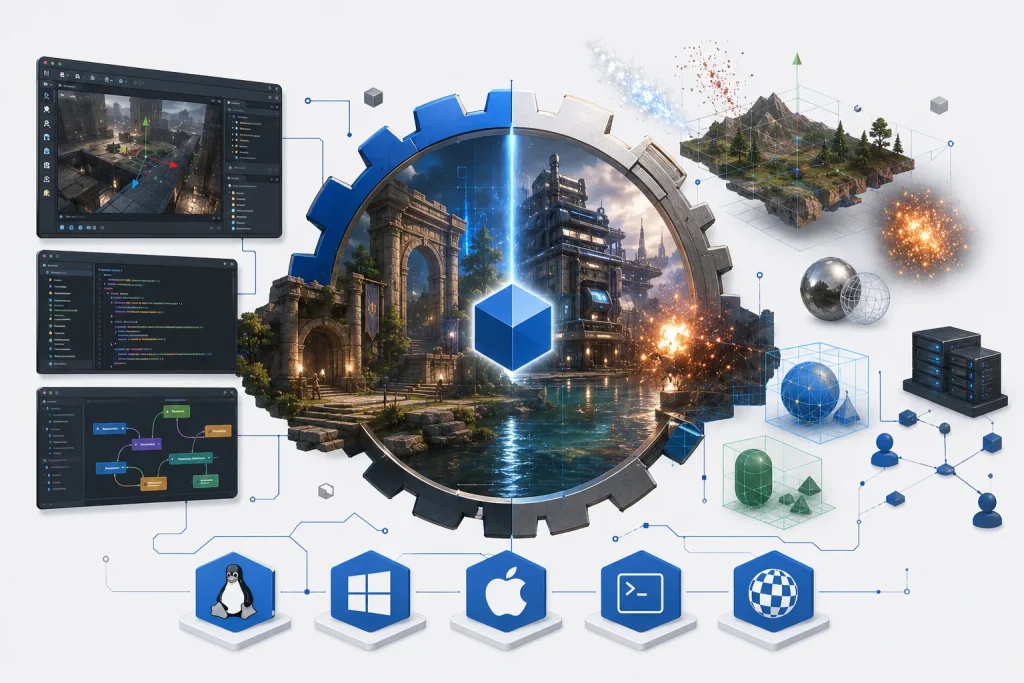
So the Enhanced Edition removed the rasterised lighting fallbacks entirely. All lighting is computed in real time by ray tracing, including emissive sources such as candles, fire and flashlights — previously only implemented in The Two Colonels DLC. 4A also added ray-traced reflections alongside the existing screen-space system, plus DLSS 2.0 and field-of-view options.
The consequences are unusually honest for a “free upgrade”: it runs only on ray-tracing-capable GPUs, and it was not released for Linux, macOS or Stadia. It shipped as a separate free entitlement to everyone who already owned the game, with saves carrying over by chapter.
What the Engine Does
Beyond the ray-tracing work, and drawing across 4A’s technical material and its publishers’ descriptions, the engine is associated with the things atmospheric shooters need:
- Deferred shading built to handle hundreds of lights in a single complex scene.
- HDR rendering with exposure adaptation, tone mapping and blue shift, using floating-point buffers to approximate how an eye or camera actually responds to light.
- Volumetric fog and lighting, real-time reflective lights, and penumbra-accurate shadowing.
- Physically based rendering, geometric displacement mapping, parallax occlusion mapping and deferred reflections.
- Dynamic weather and day/night systems.
- Open-world streaming, added for Metro Exodus.
Embracer’s own description on acquiring the studio is a fair summary of its position: an engine conceived in 2005 that has powered every 4A Games title to date, is constantly improved in-house, and is natively multi-platform and scalable — built specifically for single-player FPS development.
Can You Download the 4A Engine?
No. The 4A Engine is proprietary technology built for one studio’s own games. 4A Games has never published an SDK, pricing model or licensing programme for it, and no public route exists for an independent developer to obtain it.
That is worth stating plainly because “4A engine download” is one of the most common searches on this topic, and the answer does not change with persistence. Unlike Unreal or Unity, there is no free tier, no student edition and no public commercial licence to negotiate. Access is controlled by 4A Games and whoever it chooses to work with.
If what appeals is the look — volumetric atmosphere, heavy lighting, dense interiors — the practical routes are Unreal Engine, whose Lumen system covers similar ground in real-time global illumination, or Godot if you want no royalties and are willing to do more of the lighting work yourself.
The Studio: Kyiv, Malta, and a Split Nobody Explains Properly
4A Games’ corporate history is genuinely confusing, and most write-ups get it wrong. The sequence matters if you want to know who maintains this engine now.
2006 — founded in Kyiv by three ex-GSC developers.
May 2014 — the Malta move. Amid the Russo-Ukrainian war, 4A Games opened a studio in Sliema, Malta and relocated its headquarters there with roughly fifty staff, for easier operation inside the EU. The Kyiv studio remained, separately owned, operating under the same name. Both studios could use the 4A Games trademark, shared the engine, and built Metro Exodus together.
August 2020 — acquisition. Embracer Group, through its Saber Interactive subsidiary, acquired 4A Games for approximately $36 million. Embracer already owned the Metro publisher, Deep Silver, which is what made the deal straightforward.
March 2024 — the sale that did not include them. Embracer sold Saber Interactive to Beacon Interactive, a company formed by Saber co-founder Matthew Karch. 4A Games was not part of that sale. Embracer retained the studio and the Metro rights.
February 2025 — the rebrand. The Kyiv studio, which had been operating as 4A Games Ukraine, rebranded as Reburn and is working on its own new IP. The 4A Games name and trademark stayed with the Malta company.
So: 4A Games Limited, in Malta, owned by Embracer, is the company that carries the 4A Games name and the Metro development lineage today. Reburn is a separate company with shared origins. The precise allocation of trademark and engine rights between the two is not something either has published in detail. That distinction is missed almost everywhere, including in coverage that treats the rebrand as 4A Games renaming itself.
Is It Still Being Used?
Yes. A fourth Metro game has been in development since at least 2023 and has been described as well advanced, despite the disruption of the Russian invasion of Ukraine — which affected the studio directly, with staff at the Kyiv office offered relocation to other Saber-owned locations before the invasion began.
4A has also stated intentions for a multiplayer experience set in the Metro universe and has not ruled out an entirely new IP. The studio reported over 200 staff across two locations in 2025.
Key Takeaways
- The 4A Engine is proprietary C++ technology built by 4A Games for the Metro series, and has powered every one of the studio’s games since 2010.
- Its authors built X-Ray first — the engine behind S.T.A.L.K.E.R. — before leaving GSC Game World to found 4A.
- Metro Exodus (2019) was among the first games with real-time ray tracing, using ray-traced global illumination and ambient occlusion.
- Metro Exodus Enhanced Edition (2021) removed rasterised lighting entirely. Every light source is ray traced, and the game requires a ray-tracing-capable GPU.
- There is no public way to obtain it. 4A Games publishes no SDK, documentation or licensing programme, and no public route exists for independent developers.
- 4A Games is owned by Embracer — acquired via Saber Interactive in 2020 for about $36 million, and not included when Saber was sold in 2024.
- The Kyiv studio became Reburn in February 2025. The 4A Games name, and the Metro development lineage, stayed with the Malta company.
Frequently Asked Questions
Conclusion
Most in-house engines are pragmatic: built to ship a specific kind of game efficiently, then maintained conservatively. The 4A Engine has consistently done the opposite. It shipped DirectX 11 tessellation when almost nothing used it, ray tracing when the hardware was one generation old, and then took the unusual step of removing the safe rendering path altogether rather than maintaining two.
That approach has a cost — Enhanced Edition owners without an RTX-class card simply cannot play it — and 4A took it anyway. For an engine you can actually build on, our directory of 100+ C and C++ game engines sorts the field by licence and category.