

Adventure Game Studio (AGS) Engine – written in C/C++
Adventure Game Studio (AGS) is a specialized game engine designed for creating point-and-click adventure games. Written primarily in C/C++, AGS provides a user-friendly […]
Adventure Game Studio (AGS) is a specialized game engine designed for creating point-and-click adventure games. Written primarily in C/C++, AGS provides a user-friendly […]

4A Engine is a proprietary game engine written in C++, developed by 4A Games, a Ukrainian game development studio. It
A game engine is the backbone of every modern video game. It’s the software framework that handles: Graphics rendering, Physics simulation, Artificial intelligence, Audio systems, Animation, Networking and multiplayer and Asset management.
This C program is a simple console-based implementation of a number-shuffling game. The game presents a grid of numbers, and the objective is to rearrange them in ascending order. The player can move the numbers by pressing the corresponding number keys, and the game tracks the number of moves taken to complete the puzzle.
This is a console version of Tic Tac Toe computer game written in c programming language. The game runs in text mode of command prompt and users can play the game in text mode. The game has many options to choose from, like playing with computer, friend. While playing with computer use can select either novice mode or advance mode.
Over here I’ll shove in some basics, like coordinate systems, world and object coordinate systems, etc. For now I’ll assume you’re at least a little familiar with 3D programming. Blah blah blah, differences between immediate and retained mode, etc etc.
This is a very simple DirectDraw sample using Microsoft DirectX under Visual C++.
Screen modes come in several flavours, based on how many bits are used to store the color of each pixel on the screen. Naturally, the more bits you use per pixel, the more colours you can display at once; but there is more data to move into graphics memory to update the screen.
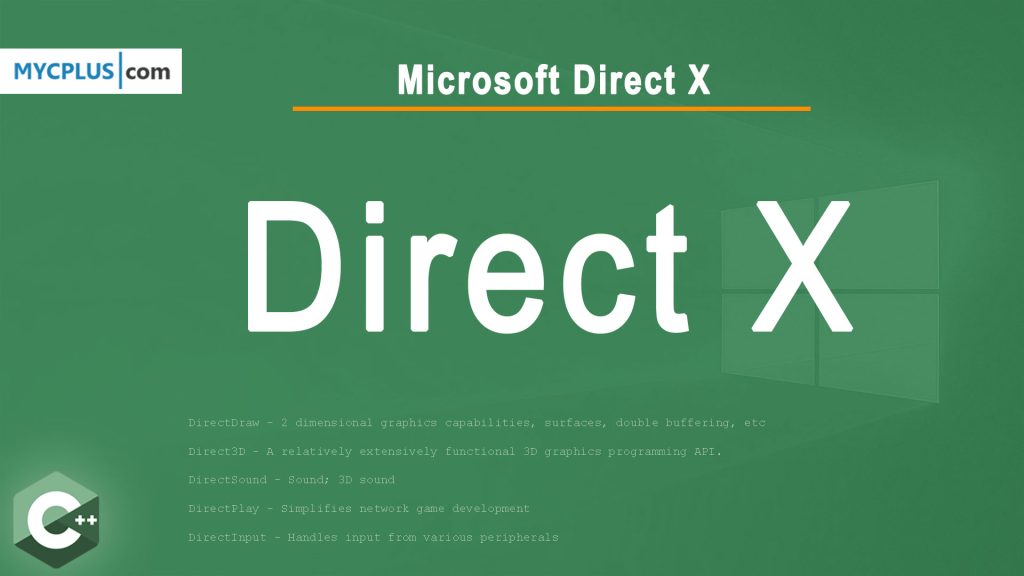
One of the main purposes of DirectX is to provide a standard way of accessing many different proprietary hardware devices. DirectX is comprised of application programming interfaces (APIs) that are grouped into two classes: The DirectX Foundation layer and The DirectX Media layer. These APIs enable programs to directly access many of your computer”s hardware devices.