
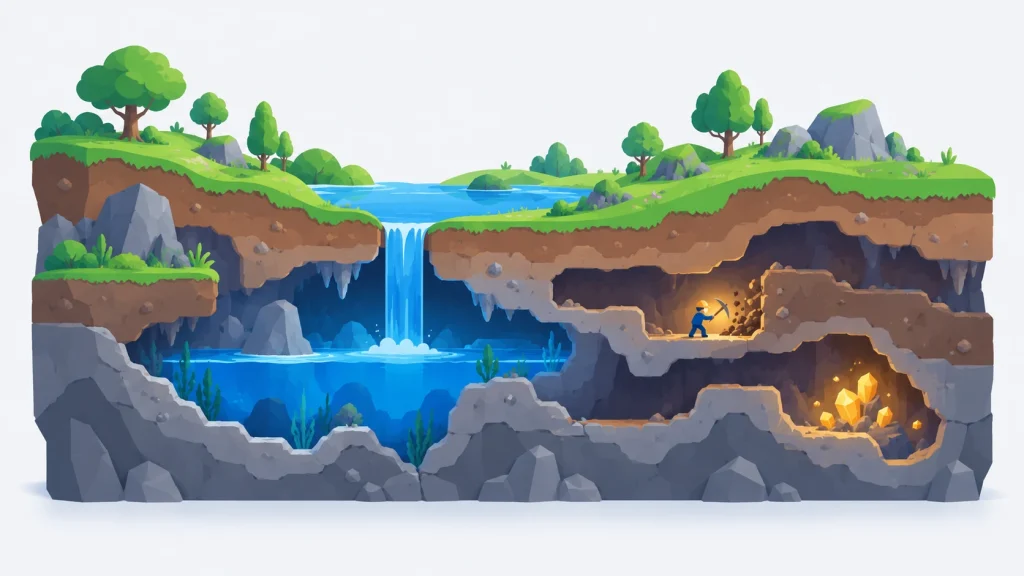
OpenClonk is a free, open-source 2D action game and the engine it runs on. You control small, nimble humanoids called clonks in a fully destructible pixel landscape: mining, building, settling and fighting, alone or with friends. It’s the community continuation of Clonk, the German game series Matthes Bender started in 1994. The C++ engine is released under the permissive ISC licence, and everything you play is built from C4Script, the engine’s own scripting language.
This profile covers where OpenClonk came from, how its engine and content packs work, a tested C4Script example, its releases, and whether it’s still developed in 2026. Facts were checked against the project’s repository and website in October 2026, and the example was run on OpenClonk 8.1.
What Is OpenClonk?
OpenClonk is a free, open-source 2D game and game engine for Windows, Linux and macOS, written in C++ and released under the ISC licence. It continues the Clonk series by Matthes Bender, with games and mods written in its own C4Script language and a built-in editor. The latest release is 8.1 (March 2018), and development has been largely quiet since.
OpenClonk at a glance
| Based on | Clonk by Matthes Bender and RedWolf Design (1994–2014) |
|---|---|
| Developer | The OpenClonk Team and community, since 2009 |
| First release | 5.1.0, December 2010 |
| Latest release | 8.1, March 2018 (development branch: 9.0 alpha, unreleased) |
| Engine written in | C++ (C++14; Qt 5 for the editor) |
| Scripting | C4Script |
| Licence | ISC for the code; Creative Commons for game content |
| Trademark | “Clonk” is a registered trademark of Matthes Bender, used with permission |
| Runs on | Windows, Linux and macOS |
| Key features | Destructible pixel landscape, multiplayer, built-in editor, 3D objects in a 2D world |
| Status | Occasional maintenance commits; no release since 2018 |
From Clonk to OpenClonk
Clonk was created by Matthes Bender and developed by RedWolf Design from 1994 to 2014. It mixed action, real-time strategy and platforming in a 2D landscape that could be dug, blasted and rebuilt, with split-screen, LAN and online multiplayer. The series moved from MS-DOS games in the 1990s to Windows with Clonk 4 and Clonk Planet, then to Clonk Endeavour and Clonk Rage (2008), the last official version (Wikipedia’s Clonk article).
In 2009 the community began OpenClonk, a new open-source game built on the Clonk Rage engine and not developed by RedWolf Design. The engine’s copyright notice reflects that handover: RedWolf Design from 2001 to 2009, and the OpenClonk Team and contributors from 2009 onward (OpenClonk on GitHub). The first public release, version 5.1.0, followed in December 2010, continuing the Clonk series’ version numbering.
The name “Clonk” is still a registered trademark of Matthes Bender. OpenClonk uses it with permission, and the project’s trademark terms require any other product using the word to add its own prefix, such as “MyClonk”.
How OpenClonk Works
OpenClonk splits cleanly into a generic engine and the content that runs on it:
- The C++ engine handles the pixel landscape and its materials (earth, rock, water, lava and more), physics, rendering, networking, the built-in editor, and the C4Script interpreter. It has 3D-rendered objects and characters in a 2D world.
- Content packs are packed folders the engine loads. Definition packs (
.ocd), such asObjects.ocd, hold object types: the Clonk itself, animals, trees, tools, buildings and vehicles. Scenario folders (.ocf) hold scenarios (.ocs), each with its settings, landscape images and script. - C4Script, a C-like scripting language, defines how every object behaves and what happens in each scenario. When OpenClonk 8.1 starts, it reports linking about 88,000 lines of C4Script from its standard content, which shows how much of the game lives in script rather than in the engine.
Because the game is mostly script, players can change almost anything, and OpenClonk ships with an integrated editor and developer mode for building scenarios and mods inside the game.
Hello, C4Script: A Minimal Scenario Script
A scenario’s Script.c runs when the level starts. This one logs a message, places a fir tree and a wipf (a small animal from the standard objects), and counts the wipfs in the world:
/* Hello, OpenClonk: a minimal scenario script in C4Script */

func Initialize()
{
	Log("Hello from C4Script!");
	// Place a tree and a wipf (a small animal) on the landscape.
	var tree = CreateObject(Tree_Coniferous, 300, 300);
	var wipf = CreateObject(Wipf, 340, 300);
	Log("Created %s and %s", tree->GetName(), wipf->GetName());
	// Count every wipf in the world.
	Log("Wipfs in the world: %d", ObjectCount(Find_ID(Wipf)));
	return true;
}
CreateObject takes an object definition and a position, -> calls a function on an object, and ObjectCount(Find_ID(Wipf)) uses OpenClonk’s object-search criteria to count matching objects.
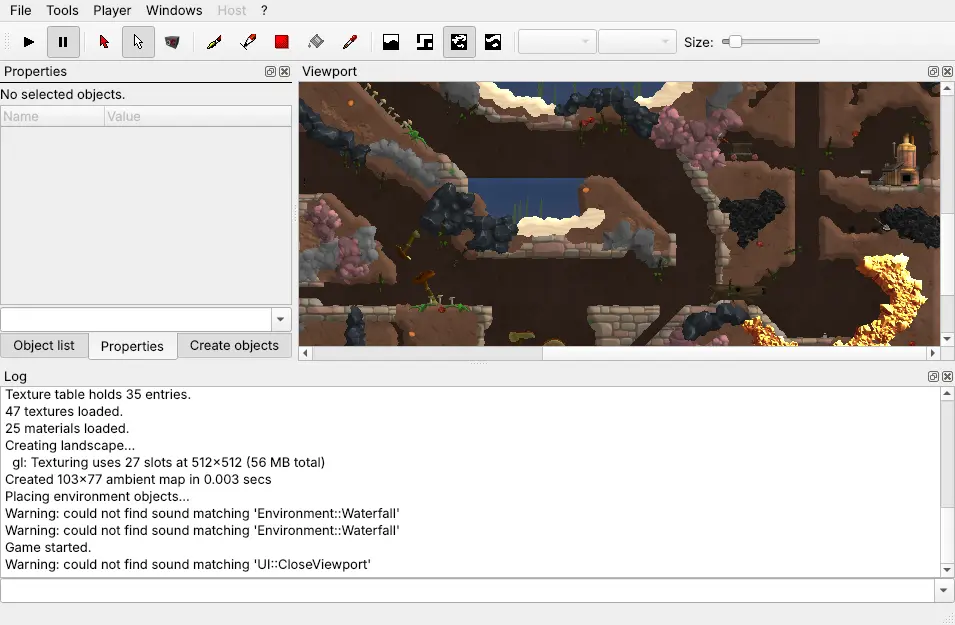
We ran this script in OpenClonk 8.1 (the Ubuntu 24.04 package) by placing it in a small test scenario. The engine reported “0 warnings, 0 errors” when linking the scripts, and the log showed “Hello from C4Script!”, “Created Fir and Wipf” and “Wipfs in the world: 1”. The screenshot below shows OpenClonk 8.1’s built-in editor with the game’s first tutorial loaded.
OpenClonk Releases
| Version | Released | Notes |
|---|---|---|
| 5.1.0 | December 2010 | First public OpenClonk release |
| 6.0 | March 2015 | Major release |
| 7.0 | January 2016 | Major release |
| 8.0 | February 2018 | Released after more than two years of development, with a new editor |
| 8.1 | March 2018 | Fix release, mainly for the editor on Windows |
The project’s goal was a major release about once a year, with fix releases in between (OpenClonk press kit). The development branch is marked as version 9.0 alpha, but it has never been released.
Is OpenClonk Still Developed in 2026?
Barely. The last release, 8.1, is from March 2018, and the website’s news stops in the same month. The repository has received only a handful of commits since 2024, the latest in April 2026, mostly small maintenance fixes. There’s no announced date for a 9.0 release.
The game is still easy to get and play. It’s available from the official website, packaged by Linux distributions (Ubuntu ships 8.1) and on Flathub (OpenClonk on Flathub). Its code remains a complete, readable example of a 2D game engine with destructible terrain, scripting and multiplayer, under one of the most permissive licences there is.
OpenClonk Alternatives
- Godot: if you want to build your own 2D game with a modern, actively developed open-source engine. See our Godot engine profile.
- Cube and Sauerbraten: another long-running open-source game that doubles as an engine, with in-game map editing. See our Cube engine profile.
- The OpenClonk source itself: if destructible pixel terrain and a C-like scripting layer are what interest you, the code is ISC-licensed and free to build on.
For more open-source engines, see our directory of open-source C++ game engines.
Key Takeaways
- OpenClonk is a free, open-source 2D game and engine, the community continuation of Matthes Bender’s Clonk series (1994–2014).
- The engine is C++ under the ISC licence; game content is under Creative Commons licences, and “Clonk” remains Bender’s trademark.
- Almost everything you play is C4Script, loaded from definition packs and scenario folders, with a built-in editor for mods.
- The latest release is 8.1 (March 2018); the repository has seen only occasional maintenance since.
- It still runs today on Windows, Linux and macOS, and a minimal C4Script scenario takes about a dozen lines.
Conclusion
OpenClonk kept a beloved German game series alive by handing it to its community, and it turned the Clonk engine into open-source code anyone can study. Development has slowed to a trickle since 2018, but the game is still playable, still moddable, and still one of the clearest examples of how a scriptable 2D engine with destructible terrain fits together.
For more engines across every genre, browse our game development hub.