
Esenthel is a cross-platform 2D and 3D game engine written in C++, developed by programmer Grzegorz Slazinski since 2000 and now sold under the name Titan Engine. It combines a full editor with C++ programming: you build worlds, import models and write game code in one tool, then publish to Windows, Mac, Linux, Android, iOS and consoles. The engine is free to download, but it isn’t open source, and games made with it pay a 5% royalty.
This profile covers where Esenthel came from, how it works, how its C++ Code Editor differs from standard C++, its licence and business model, the games made with it, and where it stands in 2026. Facts were checked against Esenthel’s own website, store, licence and forum, its Steam page, and news coverage in November 2026.
What Is Esenthel?
Esenthel, now branded Titan Engine, is a commercial-grade 2D and 3D game engine written in C++ and developed since 2000. It includes an editor for worlds, models and animation, a built-in C++ Code Editor, Nvidia PhysX and Bullet physics, and collaborative team tools. It’s free to download and use, with a 5% royalty on game income, and its source code is available to paying supporters.
Esenthel at a glance
| Current name | Titan Engine (by Esenthel) |
|---|---|
| Creator | Grzegorz Slazinski |
| In development | Since 2000 |
| Written in | C++ (game code is C++ too) |
| Physics | Nvidia PhysX or Bullet |
| Platforms | Windows, Xbox, Mac, iOS, Android, Nintendo Switch, Linux |
| Pricing | Free to download; 5% royalty on game income |
| Source code | Proprietary; available to supporters on GitHub |
| Updates | Monthly (latest notes: October 2026) |
| Best-known game | Lucius (Shiver Games, 2012) |
A Short History of Esenthel
The name “Esenthel” is a mix of the words essential and essence, “with a touch of magic”, as the website puts it. The engine has been in development since 2000, and for most of its life its business model has kept changing:
- Early years: the engine was sold under paid licences.
- April 2014: Esenthel moved to a subscription, at $14.99 a month, with read-only source code access for $499.99 a year (GamingOnLinux on the 2014 subscription).
- March 2019: the engine became free, supported by donations, and its source code was published on GitHub under Esenthel’s own licence, which banned using the code to build other game engines (GameDev.net on the free release).
- Titan Engine: in February 2022 Esenthel ran a forum poll on a new name and logo, and the engine is now marketed as Titan Engine, while the company, forum and documentation keep the Esenthel name.
- Today: the engine is free to download, games pay a 5% royalty on their income, and the source code is available to supporters through a private GitHub repository.
Esenthel is also on Steam, as a free download listed by the developer (Esenthel Engine on Steam). The engine is still largely the work of its creator, who posts monthly update notes on the Esenthel forum.
How Esenthel Works
The editor
The Esenthel editor is where most work happens, and it looks and works the same on every desktop platform:
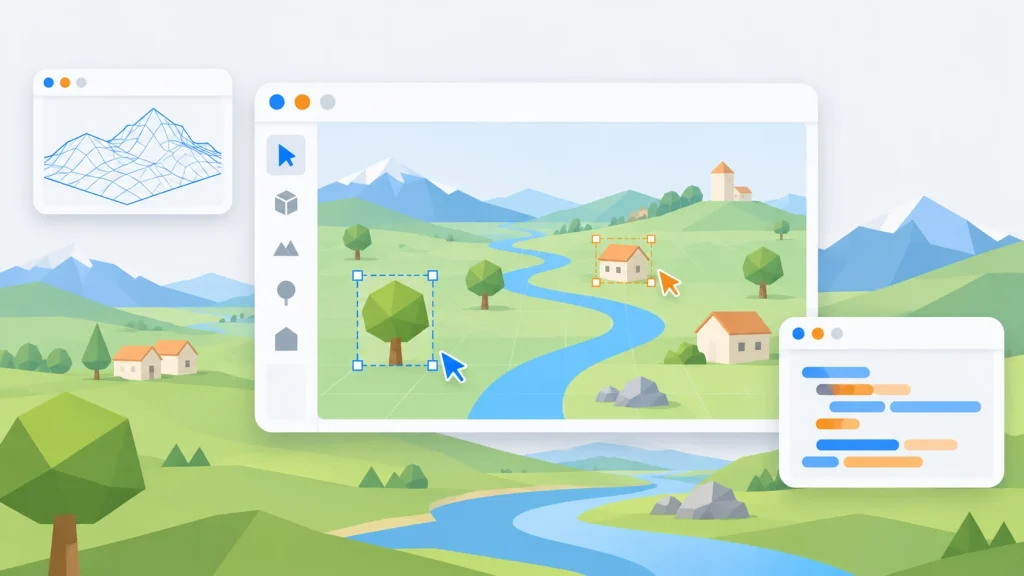
- Worlds and terrain. You paint, import or generate terrain, place objects, and build huge worlds that stream in the background without loading pauses.
- Models and animation. Mesh, bones, skinning and animation editors are built in, and you can drag and drop assets in formats such as FBX, Collada and OBJ.
- Collaborative development. Team members work on the same project at once, with real-time background synchronisation of every project element, including worlds, and per-member accounts and permissions.
- Auto publishing. The editor compiles your code, packages and compresses assets, optimises them for mobile, and can encrypt them.
The engine
Under the editor is a C++ engine with:
- Rendering: DirectX 11 and 10 on Windows, OpenGL, OpenGL ES and WebGL, with deferred and forward renderers, physically based rendering, cascaded shadow maps, screen-space reflections, temporal anti-aliasing and upscaling with AMD FSR.
- Physics: a choice of Nvidia PhysX or Bullet, with ragdolls, vehicles, character controllers and destructible objects.
- Networking: TCP/UDP, HTTP, SQL databases and MMO tutorials, plus Steam, Xbox Live and app-store integration.
- Application states: your game is a set of states, such as intro, menu and game, each with its own init, update, draw and shut-down functions.
Programming in Esenthel: C++ with Shortcuts
Esenthel games are written in C++, not a separate scripting language. You can use Visual Studio, Xcode or NetBeans, but the engine also has its own Code Editor, with auto-complete and links to your project’s assets, that accepts a slightly simplified C++ and converts it for the compiler. The documentation lists the differences:
// Code A: no header file needed
Str GetText()
{
   return "Text";
}

// Code B: uses GetText() without any #include
void Func()
{
   Str text=GetText();
}

// '.' works for namespaces, classes and pointers
namespace Helper
{
   class TheClass
   {
      static int Func() {return 5;}
      int member;
   }
}
int Global=Helper.TheClass.Func(); // instead of Helper::TheClass::Func()

// default member values and the 'super' keyword
class Base
{
   int value=0;    // no constructor needed
   void func() {}
}
class Ext : Base
{
   void func() {super.func();} // instead of Base::func()
}- No headers. You write each function or class once, and it’s usable from every other file, with no
#include, forward declarations or class reordering. - One operator.
.works where standard C++ needs::or->. - Fixed sizes.
intis always 32-bit andlongalways 64-bit;charis a 16-bit character. - Conveniences. Members can have default values, templates have a shorter syntax, and
supercalls the base class on every platform.
About this example: it’s assembled from the examples on Esenthel’s “C++ Improvements” documentation page, with our comments added. It only compiles in Esenthel’s Code Editor, which converts it to standard C++; we couldn’t run the engine, because its downloads weren’t reachable from our test environment and its source code is private. Everything else in this article was checked against Esenthel’s website, licence, documentation and forum in November 2026.
Games Made with Esenthel
Esenthel is used mostly by independent developers, and its best-known commercial release is still more than a decade old:
| Game | Year | Notes |
|---|---|---|
| Lucius | 2012 | A horror game by Shiver Games for Windows, built on the Esenthel Engine (Lucius on Wikipedia) |
| Esenthel RTS, Esenthel RPG 2, Esenthel MMO, Ineisis Online | Various | Sample games by Esenthel, sold as source code in the Esenthel Store for developers to learn from |
| Community projects | Ongoing | The Showcase section of the Esenthel forum lists projects in development |
Esenthel in 2026
- It’s still updated every month. The October 2026 version notes, posted on October 31, list pathfinding optimisations, new GUI and image functions and new container features.
- The website calls it “The Most Powerful Game Engine in the World”. That’s the developer’s own marketing claim; we haven’t seen independent benchmarks to support it.
- Platforms: Windows, Xbox, Mac, iOS, Android, Nintendo Switch and Linux, according to Esenthel’s website. The Windows editor also builds for Android and the web, and the Mac editor builds for iOS.
- The source code isn’t public. The download page still links to
github.com/Esenthel/EsenthelEngine, but as of November 2026 that repository returns “page not found” to visitors who aren’t logged in, and Esenthel’s GitHub organisation shows no public repositories. The documentation explains why: source access is given to supporters who link their GitHub account to their licence. - Support: an English-language forum and a Discord server, with more than 100 tutorials and 90 documentation pages.
Common Misconceptions About Esenthel
- “Esenthel is open source.” It isn’t. Its source code has been available at times, publicly from 2019 and now to supporters, but always under Esenthel’s own proprietary licence, which forbids redistributing the code or using it in other engines.
- “Esenthel is free.” It’s free to download and develop with, but games pay a 5% royalty on all income, including sales, donations and in-app purchases.
- “Esenthel has its own scripting language.” Game code is C++. The Code Editor adds conveniences such as headerless code, but it’s still C++.
Esenthel Alternatives
- Godot: a free, MIT-licensed open-source engine with no royalties, if you want a large community and full source access. See our Godot engine profile.
- Unreal Engine: the industry-standard C++ engine, with source access on GitHub and a 5% royalty above a revenue threshold. See our Unreal Engine profile.
- O3DE: an Apache-licensed open-source C++ engine descended from Amazon Lumberyard, if you want large 3D worlds without a royalty. See our Amazon Lumberyard profile.
For more engines, browse our directory of C++ game engines.
Key Takeaways
- Esenthel, now Titan Engine, is a C++ 2D and 3D engine developed by Grzegorz Slazinski since 2000.
- It’s free to download, but not open source: games pay a 5% royalty, and the source code is available to supporters only.
- It has a full editor with huge streaming worlds, model and animation tools, collaborative development and auto publishing.
- Game code is C++, with an optional Code Editor that removes headers and simplifies syntax.
- It targets Windows, Xbox, Mac, iOS, Android, Switch and Linux, with physics from Nvidia PhysX or Bullet.
- It’s still updated monthly in 2026, but its community and list of shipped games are small.
Conclusion
Esenthel is a remarkable one-developer engine: more than twenty-five years of work have produced an editor, a renderer and a toolset that cover most of what a 3D game needs. Its trade-offs are its licence, a 5% royalty and source code only for supporters, and its small community. For C++ developers who like an all-in-one editor and a direct line to the engine’s author, it’s worth a look; for most teams, an open-source or larger engine is the safer choice.
For more engines across every genre, browse our game development hub.