
For a few years in the mid-2000s, dim3 was one of the friendliest ways to build a 3D game on a Mac. It was free, it was open source, it came with a level editor and a skeletal animator in the box, and you scripted your game in JavaScript rather than C. Apple featured it. One person wrote it.
That person, Brian Barnes, stopped shipping releases after 2014, and the engine’s official website now serves nothing but a placeholder logo. This article does three things no other page on dim3 does: it says plainly whether the project is alive, it shows you where the MIT-licensed source actually lives today, and it corrects a misattribution that has been copied across engine directories for years — including, until this update, ours.
What Is the dim3 Engine?
dim3 (short for Dimension 3) is a free, open-source 3D game engine written in C by Brian Barnes of Klink! Software. Released under the MIT licence, it bundles four tools — Engine, Editor, Animator and Setup — and uses OpenGL for rendering, JavaScript for scripting, XML for data and SDL for input and sound. It ran on macOS, Windows and iOS, and could be compiled on Linux. Its last release was version 24 in July 2014.
Looking for
dim3in CUDA? Different thing entirely. In CUDA and HIP,dim3is a three-component integer vector type used to set grid and block dimensions when launching a GPU kernel —dim3 block(16, 16, 1);. It has no connection to the game engine on this page. NVIDIA’s CUDA C++ Programming Guide is the reference you want.
| Developer | Brian Barnes / Klink! Software (Roanoke, Virginia) |
| Written in | C — with JavaScript for game scripting |
| Rendering | OpenGL; SDL for input, sound and resolution switching; XML for data files |
| License | MIT — free and open source |
| Platforms | macOS, Windows, iOS; Linux by compiling from source |
| First public release | 2004 |
| Latest release | v24, 2 July 2014 |
| Status | Dormant. No releases in over a decade; the official site is now a placeholder |
| Successor | WSJS, the author’s JavaScript 3D engine |
Is dim3 Still Maintained?
No. dim3 is dormant, and has been for over a decade. The evidence is unambiguous rather than a matter of opinion:
- The last release, v24, shipped on 2 July 2014.
- klinksoftware.com, the engine’s official home, now serves a single logo image and nothing else — no downloads, no documentation, no forum.
- When Barnes reposted the code to his own GitHub account in 2022, he labelled it “Old C Based 3D Game Development Suite.” The author’s own description is the clearest status statement available.
- His pinned, active work is a different engine in a different language (see below).
None of that makes dim3 worthless — MIT-licensed C source with a working editor and animator is a genuinely interesting thing to read. It just means nobody is coming to fix bugs, and you should not start a 2026 project on it.
Can You Still Download dim3?
Yes, but not from the official site. The source survives in several archived copies, all free under the MIT licence:
- The author’s own repository — Barnes’s GitHub copy, the closest thing to a canonical archive.
- Google Code exports — when Google Code wound down, several users mirrored the project to GitHub in 2015; these repos are labelled as automatic exports and are unmaintained.
- The Google Code archive itself — read-only, and superseded by the GitHub copies.
Expect to build from source. The prebuilt binaries date from the era before Apple dropped 32-bit app support in macOS Catalina and moved rendering to Metal, so treat old Mac downloads as historical artefacts rather than working software. On macOS you would also be building against an OpenGL implementation Apple deprecated in 10.14; on Windows and Linux OpenGL is still supported, and the friction there is simply the age of the codebase. We found no published report of a clean 2026 build, and did not attempt one ourselves.
What dim3 Actually Did
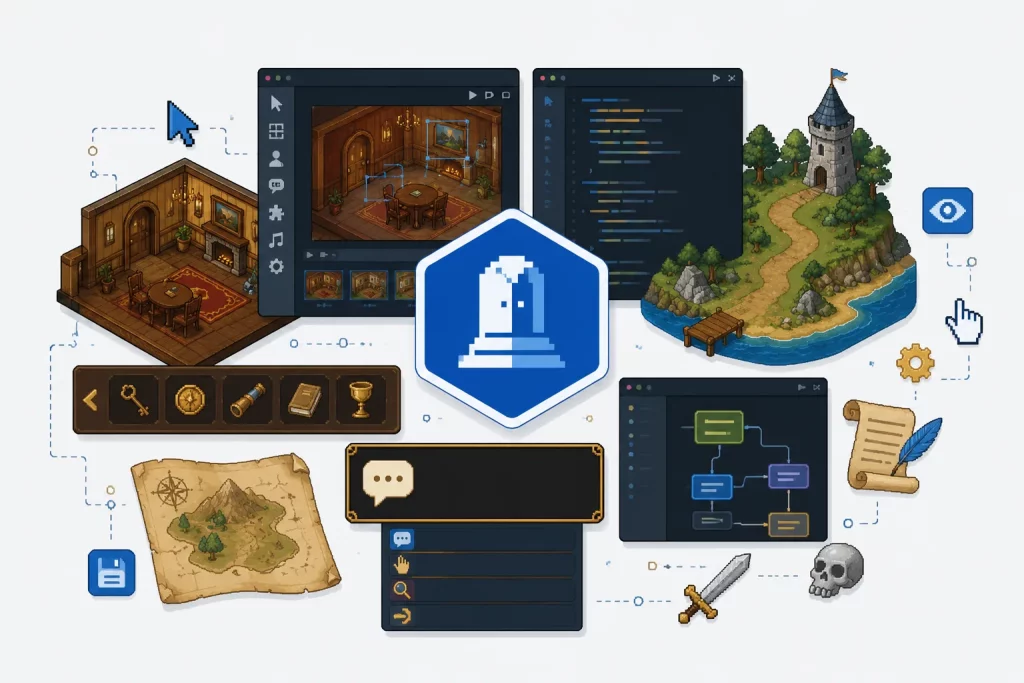
dim3’s defining idea was that a game engine should ship as a small suite of focused applications rather than one monolithic editor:
- Engine — the runtime that plays a dim3 project. By design, projects were cross-platform: ship the data, and the matching platform build runs it, with network games playable between platforms — that is how the engine’s own documentation described it.
- Editor — level construction by importing 3D models, with per-pixel lighting, bump and specular mapping, real-time or baked lighting, particles and other effects, plus JavaScript customisation.
- Animator — a skeletal animation tool. You added bones, set up poses, and combined poses into loops, which was unusually approachable for a free engine in 2007.
- Setup — a utility for project-level configuration: HUD, networking, particle settings.
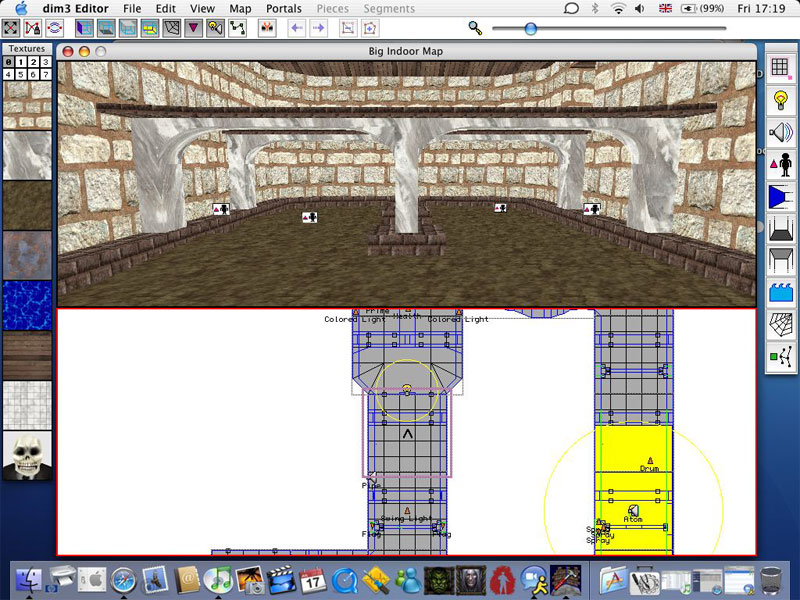
Everything a game needed lived in a data folder using ordinary formats — PNG, WAV, MP3 — and a demonstration game shipped with the engine to show the pieces working together. The scripting decision is the one that still reads well today: gameplay in JavaScript, engine in C, so designers never had to touch a compiler.
That package is what got it noticed. In 2007, Apple’s Mac downloads listing carried dim3 as a staff pick for OS X development software, and the engine turned up the same year in Mac press coverage of game-building tools. Both records now survive only as 2007 web-archive captures — which is the honest weight to give the endorsement: a period footnote, not a credential.
That design also sets dim3 apart from several of the better-known open-source Mac engines of its era. Aleph One, for instance, began life as a released commercial game whose source was later opened up; dim3 was built as a toolset first, with the demo game as an afterthought.
Was Beats of Rage Made With dim3?
No. This is the most widely copied error about dim3, and it is worth stating plainly.
Beats of Rage is a 2D beat-’em-up released by Senile Team in 2003 as a tribute to Sega’s Streets of Rage, using sprites from SNK’s The King of Fighters. Its own engine was later opened up and became the OpenBOR project, which is still developed today. It is a sprite-based 2D engine on an entirely different technical lineage. dim3 is a 3D OpenGL engine. They are separate projects by different authors, sharing no code and no common ancestry.
The error spread the way engine-directory errors usually do: one list assigned the wrong game to the wrong engine, and the rest of the web copied the row. Some directories also list Crystal Space as a dim3 game — Crystal Space is not a game at all, it is a separate open-source 3D engine. Earlier versions of this page carried the Beats of Rage claim too, complete with a plot summary lifted from the game’s own encyclopedia entry. It has been removed.
So What Games Were Made With dim3?
Honestly: no commercial hit, and the public record is thin. dim3 shipped with a demonstration game, and Klink! Software’s own catalogue — Scruffy, Scruffy 2, Tanks of Terror and the long-promised Scruffy 3 — sat alongside the engine, though the engine’s own documentation trail is not clear enough to state which of those titles were built in it. A small community posted projects and screenshots to ModDB and IndieDB during the engine’s active years.
That is the accurate picture, and it is worth saying rather than padding the page with games that were never made in it. dim3’s significance is as a well-built, single-author, free Mac engine in an era with very few of them — not as the technology behind a famous title.
What Its Creator Builds Now: WSJS
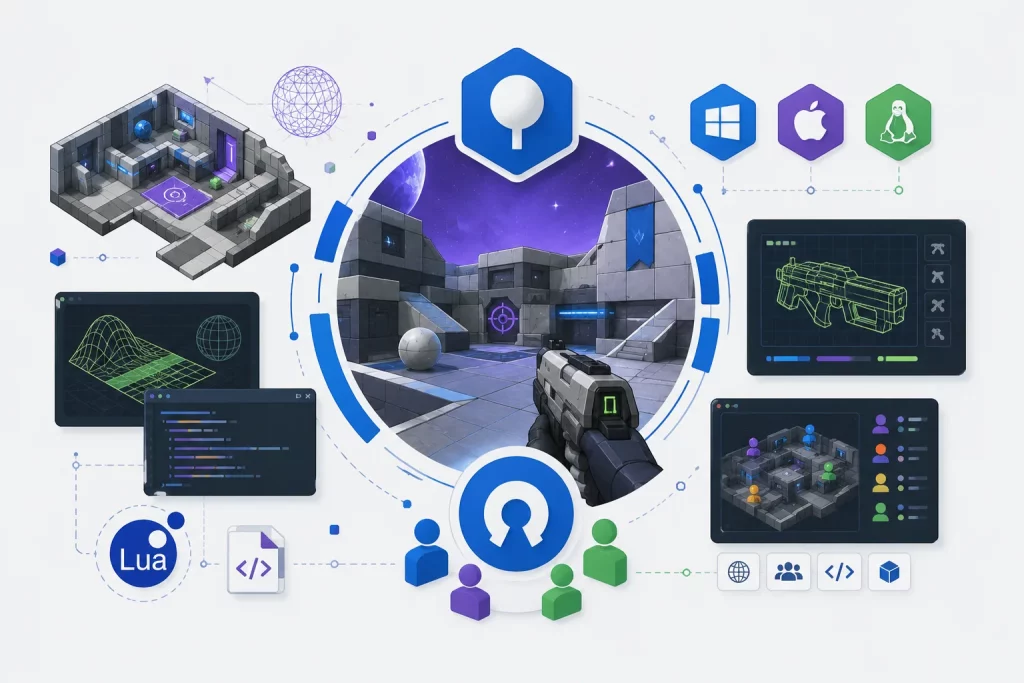
The most interesting thing about dim3 in 2026 is what replaced it. As of August 2026, Barnes’s active project is WSJS, described in its own documentation as “a javascript-based 3D game development engine” that runs from any web host or locally, with an included Java server for multiplayer. It is also MIT-licensed, ships demonstration projects for an FPS, a kart racer and a platformer, and its repository showed more than 800 commits when we checked.
The through-line is clear once you see both projects side by side. dim3 put JavaScript on top of a C engine so designers could work without compiling; WSJS drops the C layer entirely and runs the whole thing in the browser. Same instinct, twenty years of platform change in between.
What to Use Instead
If dim3 appealed to you — free, small, editor included, scriptable — these are the live equivalents:
- Godot — the closest match in spirit. Free, MIT-licensed, editor and animation tools built in, scriptable in GDScript or C#, and actively developed.
- OGRE — if what you actually want is the rendering layer to build your own engine around, not a finished toolset.
- Torque 3D — another open-sourced commercial-era 3D engine with an editor, useful if you like reading a full engine codebase.
- raylib — if dim3’s appeal was its simplicity and you are comfortable in C, this is the modern answer to that impulse.
Key Takeaways
- dim3 is a free, MIT-licensed 3D game engine written in C — not C++, as most directory listings claim — with JavaScript scripting and an OpenGL renderer.
- It is dormant. The last release was v24 on 2 July 2014, and the official website now serves nothing but a placeholder logo.
- Beats of Rage was never a dim3 game. It is Senile Team’s 2D beat-’em-up, and its engine became OpenBOR.
- The source is still freely available on GitHub under the MIT licence, but expect to compile it yourself.
- Its four-tool design — Engine, Editor, Animator, Setup — was unusually complete for a free single-author engine in 2007, and Apple featured it as a staff pick.
- Its creator now builds WSJS, a JavaScript 3D engine, carrying the same design instinct onto the web.
- If you searched for
dim3expecting CUDA’s grid and block type, that is a different thing entirely.
Frequently Asked Questions
Conclusion
dim3 belongs to a category worth remembering: the free, one-person engine that shipped as a complete toolset, built before engine choice narrowed to a handful of names. It gave Mac hobbyists a level editor, a skeletal animator and JavaScript scripting at a time when the alternatives were expensive, Windows-only, or both — and it earned an Apple staff pick for the trouble.
It is dormant now, and pretending otherwise helps nobody. The right way to use dim3 in 2026 is as a readable, self-contained C codebase you can learn engine architecture from, and then to build your actual game in something maintained. For a survey of what is still active, our directory of 100+ C and C++ game engines covers the alternatives by category.