
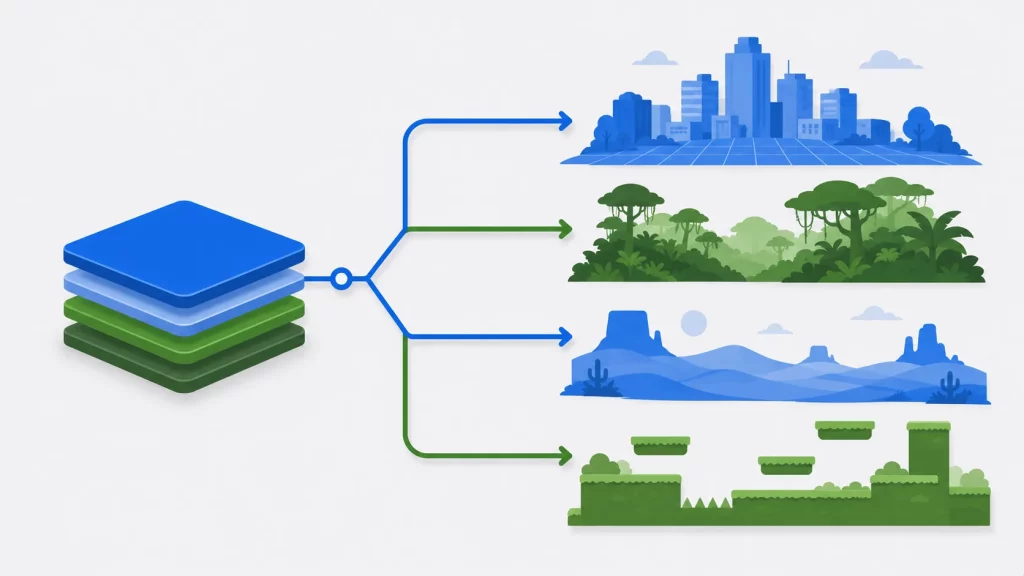
Ubisoft ships two engines of its own at scale: Ubisoft Anvil, which runs Assassin’s Creed, and Snowdrop, which runs almost everything else the company treats as a technical showpiece — The Division, Avatar: Frontiers of Pandora, Star Wars Outlaws, and a Rayman remake due this October. It was built by a studio of a few hundred people in Malmö, not by a middleware vendor, and it has quietly become the engine Ubisoft moves its biggest franchises onto rather than away from.
Most pages about Snowdrop stop at The Division 2 in 2019 and never answer the question people actually type into Google: can you download it? This one does, up front — and it also corrects a mix-up that has spread through fan wikis, namely the assumption that every game with “The Division” in the title runs on Snowdrop. One of them does not.
What Is the Snowdrop Engine?
Snowdrop is a proprietary game engine written mainly in C++, created by Massive Entertainment — a Ubisoft studio in Malmö, Sweden — and first shipped with Tom Clancy’s The Division in 2016. Built around a node-based, data-driven authoring system so that artists and designers can change gameplay without programmer time, it is now one of Ubisoft’s two flagship in-house engines and is used by Ubisoft studios worldwide. It is not licensed or sold to anyone outside Ubisoft.
| Developer | Massive Entertainment (Ubisoft), Malmö, Sweden — with engine teams at Ubisoft Winnipeg, Bucharest and other sites |
| Written in | C++, with a node-graph system for content and gameplay authoring |
| License | Proprietary — Ubisoft internal use only. No SDK, no public licence, no download |
| Platforms | Windows, PS4, PS5, Xbox One, Xbox Series X|S, Nintendo Switch, Nintendo Switch 2 (historically Stadia and Amazon Luna) |
| First release | Revealed at E3 2013; shipped with Tom Clancy’s The Division, March 2016 |
| Most recent release | Star Wars Outlaws on Nintendo Switch 2, 4 September 2025 |
| Next release | Rayman Legends Retold, 1 October 2026 |
| Status | Actively developed. Massive named Snowdrop a core focus in its 2025 and 2026 restructures |
Can You Download the Snowdrop Engine?
No. Snowdrop is not available to the public in any form — there is no free version, no trial, no student edition, and no commercial licence. Ubisoft develops it for its own studios and has not made it available to developers outside the company, unlike Unreal Engine (free until a revenue threshold), Unity (free and paid tiers) or CryEngine (subscription).
That matters because “snowdrop engine download” is one of the most common searches on this topic, and the results are misleading. Pages that appear to offer a download are not distributing Ubisoft’s engine: they are either mirroring Ubisoft’s public showcase videos, or they are junk domains harvesting the search term. There is nothing legitimate to install. Ubisoft has never published a Snowdrop SDK or source release
If you want to build in something comparable, the practical routes are:
- Unreal Engine 5 — the closest match for large, ray-traced open worlds, and the engine most Snowdrop-style job skills transfer to.
- Unity — broader platform reach and a gentler start, especially for smaller teams.
- Godot — free, open source, no royalties; the best choice for learning engine architecture with source access.
- CryEngine — worth a look if the specific thing you want is dense foliage and long-range outdoor rendering.
The realistic way to work in Snowdrop is to be hired into a studio that uses it. Massive lists engine roles on its own careers site, and Ubisoft posts Snowdrop engine-programmer positions at other studios; the job specs describe C++ work across multiple hardware platforms on an in-house R&D team.
A Short History of Snowdrop
Ubisoft acquired Massive Entertainment in 2008, and work on what became Snowdrop began the following year. The team’s stated goal, repeated in Ubisoft material ever since, was to “do things better not bigger” — a deliberate rejection of brute-force scaling in favour of fast iteration. The engine stayed unannounced for roughly four years, surfacing at E3 2013 alongside the game it was built for.
Unlike id Tech or Unreal, Snowdrop has no public version numbering. Ubisoft has never published a ‘Snowdrop 2’, despite the phrase circulating in forum posts. Ubisoft treats it as a single, continuously updated engine, and describes generational leaps by the game that drove them rather than by a number:
- 2016 — The Division. The debut: a seamless open-world Manhattan with dynamic global illumination, volumetric lighting, procedural destruction and a day/night cycle that changed how the city played.
- 2017–2019 — the genre-agnostic phase. South Park: The Fractured but Whole, Mario + Rabbids Kingdom Battle, Starlink: Battle for Atlas and The Division 2 proved the engine could serve turn-based strategy and cartoon rendering as readily as a looter shooter. This was the point at which Ubisoft opened Snowdrop to studios beyond Massive.
- 2023 — Avatar: Frontiers of Pandora. Ubisoft confirmed a major upgrade for the Avatar project in 2021, aimed at dense procedural vegetation, real-time ray tracing and unified volumetric rendering. Massive’s senior technical artist described propagating thousands of assets per frame to build Pandora’s foliage.
- 2024–2025 — Star Wars Outlaws. Ray-traced direct illumination and DLSS ray reconstruction on PC and current-gen consoles, then a Switch 2 port a year later that a number of technical reviewers rated among the platform’s best.
- 2026 — Rayman Legends Retold. A 2D side-scroller rebuilt in 3D on Snowdrop, targeting 60 fps with ray tracing on Switch 2 — the furthest the engine has travelled from its open-world origins.
Games Built on the Snowdrop Engine
This list follows Ubisoft’s own published games list for the engine, cross-checked against each game’s release record.
| Game | Year | Studio |
|---|---|---|
| Tom Clancy’s The Division | 2016 | Massive Entertainment |
| South Park: The Fractured but Whole | 2017 | Ubisoft San Francisco |
| Mario + Rabbids Kingdom Battle | 2017 | Ubisoft Milan |
| Starlink: Battle for Atlas | 2018 | Ubisoft Toronto |
| Tom Clancy’s The Division 2 | 2019 | Massive Entertainment |
| Rocksmith+ | — | Ubisoft San Francisco |
| Mario + Rabbids Sparks of Hope | 2022 | Ubisoft Milan |
| The Settlers: New Allies | 2023 | Ubisoft Düsseldorf |
| Avatar: Frontiers of Pandora | 2023 | Massive Entertainment |
| Star Wars Outlaws | 2024 (Switch 2, 2025) | Massive Entertainment |
| XDefiant | 2024 — servers closed 3 June 2025 | Ubisoft San Francisco |
| Rayman Legends Retold | Due 1 October 2026 | Ubisoft Montpellier and Ubisoft Milan |
| Splinter Cell remake | In development | Ubisoft Toronto |
| Tom Clancy’s The Division 3 | In development | Massive Entertainment |
One Snowdrop project did not survive: The Division Heartland, announced in May 2021, was cancelled by Ubisoft on 15 May 2024.
Was The Division Resurgence Built on Snowdrop?
No — and this isa recurring factual error in pages about the engine. The Division Resurgence, the free-to-play entry released on mobile in March 2026 and on PC that August, runs on Unreal Engine 4, not Snowdrop.
The correction comes from the game’s own producer, Pierre-Hugues Puechlong, who told mobilegamer.biz in April 2026 that the game is built in Unreal Engine 4 and explained that the choice of Unreal over Unity came down to technical constraints. Ubisoft said the same thing to press during the 2023 preview tour, and the game is catalogued as an Unreal Engine 4 title by Wikipedia and PCGamingWiki. Ubisoft’s own official Snowdrop games list does not include it.
The myth propagates for two understandable reasons. Fan-run and SEO-built wikis have published confident-sounding claims about a “mobile-optimised Snowdrop” powering the game, and the inference that anything branded The Division must use Massive’s engine is a reasonable guess — it is just wrong. Ubisoft runs several engines at once, and its mobile titles are a separate technology track.
Is Snowdrop Still Used in 2026?
Yes, and there is a dated answer rather than a vague one: the next Snowdrop game, Rayman Legends Retold, launches on 1 October 2026 for PS5, Xbox Series X|S, Switch 2 and PC. Ubisoft revealed it during a PlayStation State of Play on 2 June 2026, and brand director Guillaume Cerda described the team as “using our Snowdrop engine to deliver a more expressive Rayman experience.”
Beyond that release, three things keep the engine current:
- The Division 2 is still being updated, with a Survivors extraction mode announced at Gamescom 2025 for a 2026 launch.
- The Division 3 is in production at Massive and staying on Snowdrop rather than moving to Unreal, according to the studio’s own recruitment listings.
- The Splinter Cell remake at Ubisoft Toronto is being rebuilt from scratch on Snowdrop. Ubisoft announced it in December 2021 and the studio’s site still lists it, but there is no release date, and reporting through 2026 has repeatedly pushed expectations later. Treat any date you see for it as unconfirmed.
There is also a reported migration worth flagging carefully: multiple outlets, including Kotaku citing several current and former Ubisoft developers, have reported that the next mainline Far Cry is moving off the ageing Dunia engine and onto Snowdrop. Ubisoft has not announced the game or confirmed its technology, so this belongs in the “reported, not official” column.
What Snowdrop Is Known For Technically
- A node-based, data-driven pipeline. Mission scripting, AI, rendering and UI are all Game logic and content are authored as node graphs rather than as code, which is why designers and artists can build and test ideas without waiting on engineering. Massive’s production leadership has explicitly framed this as reducing the programming skill needed to try something.
- Dynamic global illumination and volumetric lighting, the engine’s signature since 2016, extended to real-time ray tracing on current-generation hardware.
- Procedural destruction and material systems built for environments that degrade as they are fought over.
- Heavy reliance on streaming. Explaining why Star Wars Outlaws shipped on Switch 2 as a game-key card rather than a full cartridge, Ubisoft said the engine “relies heavily on disk streaming for its open-world environments” and that the cards did not hit the performance target — a rare, concrete public detail about how Snowdrop loads a world.
- Wide scalability. The same engine runs a 60 fps ray-traced platformer on Switch 2 and a ray-traced open world on PC.
What’s Happening to Massive Entertainment
Snowdrop’s future is tied to a studio in the middle of a difficult stretch. Massive restructured in October 2025 with a voluntary redundancy programme, and in January 2026 Ubisoft proposed a further restructure putting roughly 55 roles at risk across its Malmö and Stockholm studios.
In both cases the engine was named as a protected priority rather than a casualty: Ubisoft’s statement said the studios would continue to “play a central role in the development of Snowdrop and Ubisoft Connect.” The wider context is Ubisoft’s reorganisation into franchise-focused “Creative Houses” — the first, Vantage Studios, took a $1.2 billion Tencent investment and holds Assassin’s Creed, Far Cry and Rainbow Six, while The Division sits in a separate house. For a proprietary engine, that structure is a real question mark: engines survive when the studios that fund them do.
Key Takeaways
- Snowdrop is a proprietary C++ engine from Massive Entertainment (Ubisoft), first shipped with The Division in 2016.
- There is no public download, licence or SDK — no legitimate site offers one, and there never has been a public release.
- The Division Resurgence is not a Snowdrop game. It runs on Unreal Engine 4, per its own producer and Ubisoft’s press statements.
- The engine is genre-agnostic in practice: a looter shooter, a turn-based Mario crossover, an RTS revival, a Star Wars open world and a Rayman platformer all run on it.
- It is active in 2026: Rayman Legends Retold lands 1 October 2026, with The Division 3 and the Splinter Cell remake in production.
- There is no “Snowdrop 2” — Ubisoft ships one continuously updated engine with no public version numbers.
- Massive has been through two rounds of restructuring since late 2025, and Ubisoft has named Snowdrop a protected priority through both.
Frequently Asked Questions
Conclusion
Snowdrop is a good argument for why some studios still build their own technology. It started as an R&D project at a studio Ubisoft had just bought, spent four years unannounced, and ended up as the engine a publisher moves its biggest franchises onto — Splinter Cell, reportedly Far Cry, and a Rayman remake that asks it to do something it was never designed for. What it cannot do is leave the building, and no amount of searching will turn up a download.
The open question is not technical but structural. Ubisoft is reorganising into semi-independent franchise houses while cutting headcount at the studio that owns the engine, and in-house engines live or die with that funding. For now the roadmap is real and dated. If you want to see how Snowdrop compares with the engines you can use, our directory of 100+ C and C++ game engines maps the alternatives side by side.