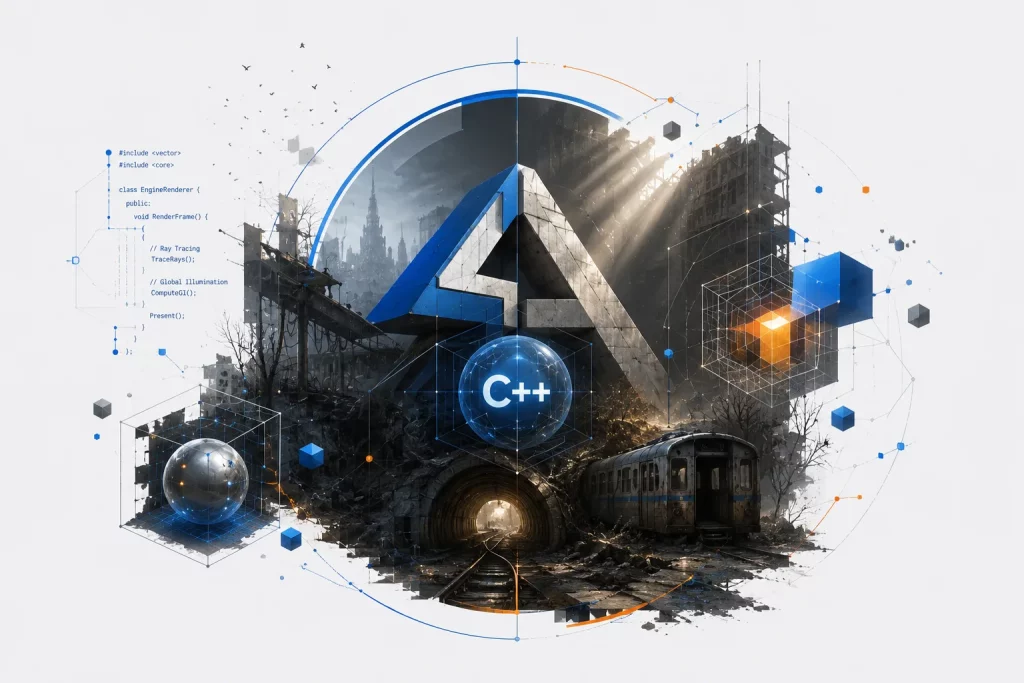


The Anvil engine (now officially Ubisoft Anvil) is a proprietary game engine developed by Ubisoft Montreal, best known as the technology behind the Assassin’s Creed series. First built in 2007 for the original Assassin’s Creed, it has powered nearly every entry in the franchise across four major versions — from Scimitar through AnvilNext 2.0 to today’s Ubisoft Anvil — and remains one of Ubisoft’s two flagship engines alongside Snowdrop.
This guide covers what the Anvil engine is, its full version history, the complete list of games built with it (Assassin’s Creed and beyond), its standout technical features, and the major upgrades that power the latest titles like Assassin’s Creed Shadows.
What Is the Anvil Engine?
Anvil is a proprietary 3D game engine developed by Ubisoft Montreal for creating large, detailed open-world games. Written primarily in C++ (with C# used for tools and gameplay scripting), it was designed from the ground up in 2007 specifically for the first Assassin’s Creed, and has been continuously evolved ever since.
The engine is purpose-built for the things Assassin’s Creed is known for: dense, historically detailed cities, large crowds of non-playable characters, fluid parkour and climbing animation, and sprawling open worlds. A signature piece of technology is Autodesk’s HumanIK middleware, which the engine uses to correctly position a character’s hands and feet in real time during climbing and pushing animations — a key part of what makes Assassin’s Creed traversal feel natural.
Alongside Snowdrop, Ubisoft Anvil is one of the publisher’s two primary in-house engines following a consolidation of its engine lineup.
Anvil Engine Version History
The engine has evolved through four named generations over nearly two decades:
| Version | Years | Debut Game | Key Additions |
|---|---|---|---|
| Scimitar / Anvil | 2007 | Assassin’s Creed (2007) | HumanIK animation, crowd rendering, open-world cities |
| AnvilNext | 2012 | Assassin’s Creed III | Weather system, rewritten renderer, up to ~2,000 NPCs |
| AnvilNext 2.0 | 2014 | Assassin’s Creed Unity | Procedural building generation, global illumination, PBR |
| Ubisoft Anvil | 2020 | Assassin’s Creed Valhalla | Rebrand, next-gen rendering, ongoing RTGI and weather upgrades |
Scimitar / Anvil (2007)
The original engine was known as Scimitar until 2009, when it was renamed Anvil. Ubisoft Montreal creative director Patrice Désilets said it was written from the ground up for Assassin’s Creed in 2007. Characters were modeled in ZBrush and environments in Autodesk 3ds Max. The engine was improved for Assassin’s Creed II to add a full day/night cycle, enhanced draw distance, better lighting and reflections, improved AI, and NPC navigation. Assassin’s Creed: Revelations (2011) was the last game built on this first-generation Anvil.
AnvilNext (2012)
AnvilNext debuted with Assassin’s Creed III in 2012 and was a major upgrade. Its renderer was completely rewritten for higher efficiency, and it introduced a dynamic weather system with automatic cycling (showcased in Black Flag‘s naval settings), deferred lighting, ambient occlusion, and improved crowd AI. A headline achievement was rendering up to around 2,000 NPCs in real time — roughly ten times the previous engine’s few hundred. Assassin’s Creed Rogue (2014) was the last game on AnvilNext.
“Most of the engine and tools used for Assassin’s Creed were built from scratch… the entire pipeline was built from the ground up with next-gen architectures and reusability in mind.” — Claude Langlais, technical director at Ubisoft
AnvilNext 2.0 (2014)
AnvilNext 2.0 launched with Assassin’s Creed Unity in 2014, bringing physically based rendering and the ability to procedurally generate buildings and urban environments following design rules and templates — which let Ubisoft recreate landmarks like Notre-Dame de Paris at nearly 1:1 scale. It was refined across Syndicate, Origins, and Odyssey, and also powered many non-Assassin’s-Creed Ubisoft games.
As a measure of the engine’s scale, a CppCon talk by Ubisoft’s Nicolas Fleury noted that Assassin’s Creed Unity was written in a combination of C++ and C#, totaling an estimated 15.5 million lines of C++ and 5 million lines of C#.
Ubisoft Anvil (2020)
Beginning with Assassin’s Creed Valhalla in 2020, the engine was rebranded Ubisoft Anvil. This modern generation continues to receive major upgrades — most notably the version powering Assassin’s Creed Shadows (2025), which added ray-traced global illumination, a new weather simulation system, and virtualized geometry (covered below).
Games Made with the Anvil Engine
Anvil has powered the vast majority of the Assassin’s Creed series, plus a number of other major Ubisoft titles.
Assassin’s Creed series:
- Assassin’s Creed (2007) — the engine’s debut
- Assassin’s Creed II (2009), Brotherhood (2010), Revelations (2011) — first-generation Anvil
- Assassin’s Creed III (2012), IV: Black Flag (2013), Rogue (2014) — AnvilNext
- Assassin’s Creed Unity (2014), Syndicate (2015), Origins (2017), Odyssey (2018) — AnvilNext 2.0
- Assassin’s Creed Valhalla (2020), Mirage (2023), Shadows (2025) — Ubisoft Anvil
Other Ubisoft games on Anvil / AnvilNext 2.0:
- Prince of Persia: The Forgotten Sands (2010)
- Tom Clancy’s Rainbow Six Siege (2015)
- For Honor (2017)
- Tom Clancy’s Ghost Recon Wildlands (2017) and Breakpoint (2019)
- Immortals Fenyx Rising (2020)
Key Features of the Anvil Engine
Across its versions, Anvil has become known for a set of technologies suited to large, living open worlds:
- Crowd simulation — rendering thousands of individually behaving NPCs, central to Assassin’s Creed’s bustling historical cities.
- HumanIK animation — Autodesk middleware for natural, real-time limb placement during climbing and parkour.
- Dynamic weather and day/night cycles — introduced in AnvilNext and vastly expanded since.
- Procedural environment generation — building intricate cities from design rules (AnvilNext 2.0 onward).
- Physically based rendering (PBR) and advanced global illumination.
- Enhanced draw distance and vegetation technology — the vegetation tech was famously shared with Far Cry 2‘s Dunia Engine.
- Broad platform support — Windows, macOS, PlayStation 3/4/5, Xbox 360/One/Series X|S, Wii U, Switch and Switch 2, PS Vita, and Stadia across its lifetime.
The Modern Anvil: Assassin’s Creed Shadows (2025)
The version of Ubisoft Anvil powering Assassin’s Creed Shadows (released March 2025) represents the biggest technical leap for the engine since Unity. Three upgrades stand out:
- Atmos weather simulation. A group of systems that simulate weather in real time — controlling rainfall, wind speed and direction, cloud cover, and seasonal change, with elements interacting (wind blowing rain off rooftops, sun drying puddles). It gives each location a character that changes with the seasons.
- Ray-traced global illumination (RTGI). Shadows is the first Assassin’s Creed with ray tracing. Lighting is fully dynamic — it reacts to time of day, season, and gameplay, and even simulates light scattering through Japanese paper doors. According to lead technical architect Nicolas Lopez, ray-traced global illumination makes the lighting fully reactive to gameplay. Ubisoft’s engineers presented the technical details at SIGGRAPH 2025.
- Micropolygon virtualized geometry. Anvil’s answer to the level-of-detail problem — a virtual geometry system that combines continuous levels of detail with massive instancing, largely eliminating LOD “popping” and removing polygon count as a limiting factor. It’s a direct parallel to Unreal Engine 5’s Nanite.
These upgrades came with the usual trade-offs of ray tracing (higher hardware demands and some image-noise challenges), but Ubisoft has confirmed that ray-traced global illumination is now the foundation for future Assassin’s Creed games.
Can You Download the Anvil Engine?
No — Ubisoft Anvil is proprietary and not available to the public. Like Ubisoft’s Snowdrop and the retired Dunia engine, Anvil is an internal engine used only by Ubisoft’s own studios. There is no public SDK, license, or download. Developers looking for comparable open-world engines they can download should look at Unreal Engine, Unity, or CryEngine.
Frequently Asked Questions
Conclusion
For nearly twenty years, the Anvil engine has been the invisible foundation of one of gaming’s biggest franchises — evolving from Scimitar in 2007 into the ray-tracing, weather-simulating powerhouse behind Assassin’s Creed Shadows. Its focus on crowds, climbing animation, procedural cities, and dynamic worlds is precisely what has given Assassin’s Creed its distinctive sense of place across historical settings from Renaissance Italy to feudal Japan.
With Ubisoft consolidating around Anvil and Snowdrop as its two flagship engines, Anvil’s story is far from over — ray-traced lighting and virtualized geometry now form the technical foundation for the franchise’s future. To explore how it fits among other game technologies, see our directory of the best C++ game engines and our guide to the Dunia Engine, which shared Anvil’s vegetation technology.