

If you go looking for Banshee 3D today, you will hit a wall. The GitHub repository everyone linked to — GameFoundry/BansheeEngine — returns a 404. Most pages about the engine, including this one until now, still describe a Windows-only C++14 engine with an editor and a promise of Mac and Linux “in the future,” quoting a Reddit post from years ago.
The project is not dead. It renamed itself twice, dropped its editor, and is a notably active one-person C++ framework project on GitHub: the current repository took commits on 7 September 2026, and shipped a versioned release three weeks before that. This page explains what Banshee 3D became, what it can do now, and — honestly — whether you should use it.
What Is Banshee 3D?
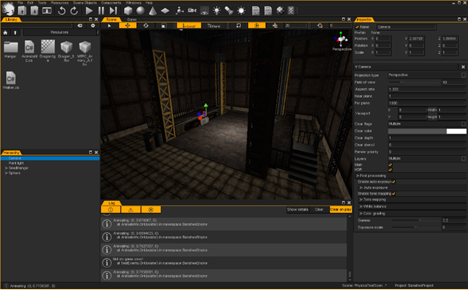
Banshee 3D was an open-source C++ game engine with a full editor and C# scripting, created by Marko Pintera and released under the MIT licence. It was later split: the editor was set aside and the underlying technology continued as a standalone framework, first as bs::framework and now as B3D Framework. That framework is C++17, still MIT-licensed, and still in active development — with a rebuilt Banshee 3D editor on its long-term roadmap.
| Created by | Marko Pintera (GitHub: BearishSun) |
| Current name | B3D Framework — GameFoundry/B3DFramework |
| Former names | Banshee 3D / Banshee Engine, then bs::framework (bsf) |
| Written in | C++17 core, with integrated C# scripting |
| Licence | MIT |
| Rendering | Vulkan backend; physically based shading; hybrid tiled deferred / clustered forward renderer |
| Latest release checked | 0.2, 17 August 2026 |
| Latest commit checked | 7 September 2026 |
| Status | Actively developed. Editor discontinued; a rebuilt one is on the roadmap |
One Project, Three Names
This is the part that trips everyone up, and it is why the engine looks abandoned from the outside.
Banshee 3D was the original: an engine and an editor, C++14 with C# scripting, aimed at being a complete alternative to Unity-style workflows. That is the version nearly every article on the internet still describes.
bs::framework (bsf) was the split. The editor was set aside and the underlying technology was released as a standalone framework — a foundation you build an engine on, rather than an engine you build a game in. Community mirrors from 2019 already show Banshee itself depending on bsf, so the separation was well under way by then.
B3D Framework is where it lives now. The bsf repository redirects to GameFoundry/B3DFramework, the codebase has moved to C++17, and development is ongoing.
The old GameFoundry/BansheeEngine repository does not redirect anywhere. It returns a 404 — so every old link, every “engine website” reference in an engine directory, and every bookmark from the Banshee era simply breaks. That single dead link is probably why this project has a reputation for being abandoned.
Is It Still Being Developed?
Yes, and the evidence is dated rather than impressionistic. Checked directly against the repository in September 2026:
- The most recent commit landed on 7 September 2026 — “Fixed: Shader compile after DXC migration” — with twenty commits in the four days before it, all from the project’s original author.
- Version 0.2 shipped on 17 August 2026, with substantial improvements to BSL, the project’s shading language: structs can now hold opaque types like textures and samplers, and templated structs and functions are supported, including explicit specialisation.
- The repository remains MIT-licensed.
The project describes itself as still in active development, but already able to “serve as a solid foundation for custom game engines.” That is a fair summary of where it sits: not a finished product, not abandoned either.
Active development is not the same as production maturity, and the version number is the tell. This is a 0.x project with no editor, so it is a foundation to build on and commit to — not a drop-in replacement for the Banshee workflow, and not something to hand a team that needs to ship next quarter.
What B3D Framework Does Today
From the project’s own feature list:
- Performance-first architecture — an entity component system built to scale to large object counts, fiber-based task scheduling across systems, and cache-aware data layouts.
- Modern rendering — physically based shading, a hybrid tiled deferred and clustered forward renderer, and a Vulkan backend.
- Full supporting stack — integrated UI, C# scripting, physics, animation, audio, and asset import for common formats.
- Modular and documented — the architecture is designed to be picked apart and extended, which is the entire point of a framework rather than an engine.
On platforms, the project’s own two documents say slightly different things, and it is worth reading them together. The feature list states plainly: Platforms: Windows, Linux, macOS. The README’s roadmap simultaneously lists “platform ports: macOS, Linux and PlayStation 5” under work in progress. The reasonable reading is that Linux and macOS are supported targets receiving continued work, while PlayStation 5 is genuinely new — but if you are choosing on the strength of non-Windows support, build on your target platform early rather than assuming parity.
Also in development, per the roadmap: Direct3D 12 and Metal backends, and GPU features including push constants, bindless resources, a frame graph and memory aliasing.
Further out, the roadmap lists a physically based API for cameras, lights and materials, a renderer overhaul built on a new BSL 2.0 shading language, and — notably for anyone reading this page — a rebuilt Banshee 3D editor, alongside real-time global illumination and navmesh integration.
Either way, the Windows-only description in the old version of this article no longer tells the whole story.
Should You Actually Use It?
Straight answer: only if you are comfortable working code-first, without an editor.
B3D Framework is a foundation — the project describes it as a base for game engines, games and other real-time graphical applications. What it is not is an editor-driven workflow: there is no scene editor, no drag-and-drop level building, and no asset store. You get a well-organised, modern C++ codebase with a renderer, a physics layer, scripting and an asset pipeline, and you write the game systems on top. That is genuinely valuable — for a certain kind of developer.
It suits you if: you want to understand how a modern renderer and ECS fit together, you are building custom technology and want a serious starting point rather than starting from a blank file, or you want to read a clean, documented C++17 engine codebase without the scale of Unreal’s.
It does not suit you if: you want to ship a game soon. The realistic alternative is Godot — free, MIT-licensed, with a mature editor and a large community — or Unreal if you need its production ecosystem. Choosing between them is largely a language and tooling question, which our guide to the best programming languages for game development unpacks.
Games built on it: we could not identify a commercially released game publicly documented as being built on Banshee 3D, bs::framework or B3D Framework. That is not a criticism — it is what you would expect of a framework whose stated purpose is to be a foundation for other people’s engines, and whose current release number is 0.2.
A One-Person Project Worth Watching
One detail worth pausing on: essentially all of this is the work of a single developer. The commit history, the shading language, the ECS, the Vulkan backend, the documentation — one person, over roughly a decade, through two renames.
That cuts both ways. A single maintainer can mean a coherent design and fast architectural iteration, with none of the seams a rotating team leaves behind — but it also concentrates the project risk for anyone building something long-lived on top of it. If you want to study a modern C++ framework end to end without taking on the scale of Unreal, it is an unusually approachable codebase to work through.
Key Takeaways
- Banshee 3D still exists — under a different name. It became bs::framework, and is now B3D Framework.
- The old
GameFoundry/BansheeEnginerepository returns a 404, which is why the project looks dead from the outside. The current repo isGameFoundry/B3DFramework. - It is actively developed: commits on 7 September 2026, and version 0.2 released on 17 August 2026.
- The original Banshee editor is no longer part of the project, which is the biggest practical change.
- It is now C++17, not C++14, and remains MIT-licensed — free for commercial use with no royalties.
- macOS, Linux and PlayStation 5 ports are in development, along with Direct3D 12 and Metal backends.
- Use it when you want a code-first foundation — for a custom engine, a game, or another real-time application. If you want an editor-driven workflow and to ship soon, Godot is the practical choice.
Frequently Asked Questions
Conclusion
Banshee 3D is a good example of how a project can be simultaneously alive and invisible. Its technology has been developed continuously for years, but most of the old signposts pointing at it — the repository link in engine directories, the old name, the editor screenshots — now point somewhere that no longer exists.
If you came here wondering whether Banshee 3D was worth learning, the honest answer is that the thing worth looking at is B3D Framework, and it is worth looking at for a specific reason: it is a modern, coherent, MIT-licensed C++17 rendering and engine framework that one person has kept moving for a decade. For engines you can build a game in today rather than build an engine with, our directory of 100+ C and C++ game engines sorts the field by category and licence.