Developer Tools — Compilers, Libraries, Code Analysis and Programming Utilities

Flat illustration of four developer tool cards showing compiler gear library block stack static analysis magnifying glass and utilities wrench icon in blue and white

The tools you use shape how efficiently you work and how deeply you understand what you are building. A well-chosen compiler surfaces warnings that save hours of debugging. A good static analysis tool catches security vulnerabilities before they reach production. The right library eliminates weeks of implementation work. Understanding which tools are available, what they do well and when to use them is practical knowledge that makes every programmer more productive.

MYCPLUS has been publishing developer tool guides, compiler reviews and library overviews since 2004, building a practical tools resource for C, C++ and broader programming development. With over 25 articles covering compilers, IDEs, static code analysis tools, programming libraries, utilities and productivity tools — this section gives developers the practical tool knowledge they need to build better development environments and workflows.

You will find in-depth guides to C and C++ compilers, overviews of key programming libraries including algorithm libraries and STL resources, honest comparisons of static code analysis tools and reviews of the developer utilities that experienced programmers recommend. Whether you are setting up your first C++ development environment or evaluating enterprise-grade analysis tools for your team — this section helps you choose and use the right tools for the job.

The best tools complement great learning — browse our Programming Books section for the recommended reading that gives you the deep knowledge to use these tools effectively. Explore Best Practices guides for how code analysis and quality tools fit into professional development workflows.

What You’ll Learn

  • Compiler guides — understanding C and C++ compilers including GCC, Clang, MSVC and others, compiler flags, warning levels, optimisation settings and how to get the most out of your compilation toolchain
  • IDEs and development environments — setting up productive C, C++ and multi-language development environments, IDE features that improve code quality and the configuration tips that experienced developers rely on
  • Static code analysis tools — detailed comparisons of static analysis tools including PVS-Studio and others, what each tool catches, how to integrate analysis into your workflow and which tool suits your codebase
  • Programming libraries and frameworks — practical overviews of key C and C++ libraries, algorithm libraries, utility libraries and the reusable code foundations that save significant development time on real projects
  • Productivity and developer utilities — text editors, file comparison tools, profilers, memory analysers, debuggers and the supporting utilities that complete a professional programmer’s development toolkit
  • Version control tools — Git clients, repository hosting platforms, diff tools and the version control utilities that every modern development workflow depends on for collaboration and code management

Trusted by developers and programmers since 2004 — the MYCPLUS Developer Tools section gives programmers honest, experience-backed guides to the compilers, libraries, analysis tools and development utilities that help professional C, C++ and software developers work more effectively every day.

c-algorithms-library

Bayer Tree implementation in C

This is implementation of Bayer-Trees, which are normally used for indices of data bases. These routines provide all stuff that is needed to create and destroy; insert, update and delete; load and destroy; search and traverse; check a tree. Sort huge amounts of data by doing a multi-phase sorting on temporary files.

Personal Organizer

Personal Organizer

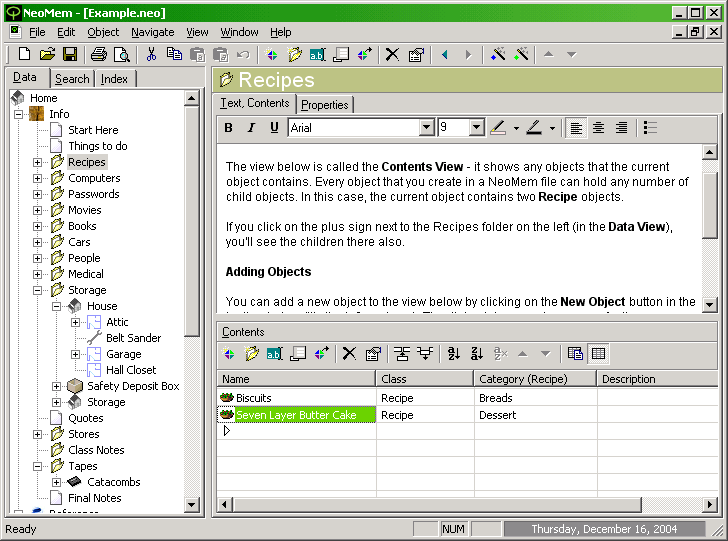
NeoMem allows you to store and organize all kinds of information in a cross between a word processor and database. The interface is similar to Windows Explorer, except that instead of dealing with files on a hard disk you deal with objects in a file. It can be used to store to do lists, books, website passwords, addresses, account information, and collections of all kinds. You can define your own classes for items that you want to store information about, and define properties for those objects. Each object can also store formatted text in a simple word processor view.

Data Structures Library

Data Structure Library

Ubiqx is a collection of ANSI C compatible modules for implementing linked lists, binary trees, caching and spare arrays. The goal of the ubiqx project is to develop a set of clean, small, re-usable code modules which implement fundamental constructs and mechanisms, and to make them available under the terms of the GNU Library General Public License (LGPL).

mycplus

FLIB2C (Fortran Library to C)

FLIB2C is a tool to create header files that provide a simple and easy-to-use interface between FORTRAN (library) routines and C. The differences between the FORTRAN and C calling sequences are hidden in a header file that has to be created for every FORTRAN library. FLIB2C simplifies the task of creating a header file.

c-algorithms-library

A Safer and Better C/C++ String Library

This is a better String Library which is superior to the existing C String library i.e. char string type, or C++’s std::string. It is safer with regard to buffer overflows, simpler than C string manipulation, works ok for ‘\0’ terminated strings and generally faster for common string operations.

Standard Function Library

Standard Function Library – ANSI C

The SFL (Standard Function Library) is an open source portable function library for C/C++ programs. Written by iMatix, the SFL provides about 450 functions for compression, encryption, encoding, datatype conversion and formatting, dates, times, calendars, internet programming (MIME, CGI) and many more.

libGD - Graphics Library

LibGD – Dynamic Image Creation Library

LibGD is an open source Graphics library for the creation of images dynamically by programmers. GD is written in C, and “wrappers” are available for Perl, PHP and other languages. GD is commonly used to generate charts, graphics, thumbnails, and most anything else, on the fly. While not restricted to use on the web, the most common applications of GD involve website development. It allows to quickly draw images complete with lines, arcs, text, multiple colors, cut and paste from other images, and flood fills, and write out the result as a PNG or JPEG file.  

Bank Management Software

Bank Management Program

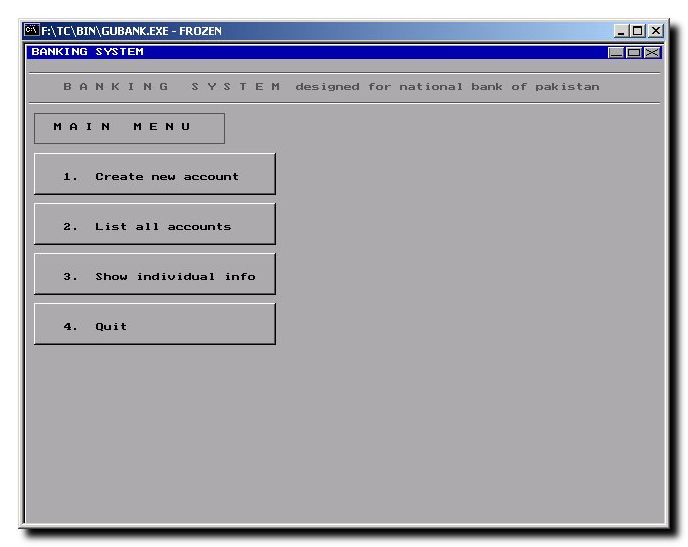
This is an automated software system written in C programming language for Bank Management which can handle accounts for customers. It uses files to handle the daily transactions, account management and user management. Its not a complete accounting software just like implemented in the banks, but still it can manage the accounts of the customers using the files at back end. It has a nice graphical layout written in C Language.

Scroll to Top