

How to Paint in DoS Mode in C [Command Line]
This C program allows you to paint in graphics mode under Dos Prompt. It uses graphic library grphics.h which is […]

Programming powers modern technology — from desktop software and websites to mobile apps, games and enterprise systems. Strong programming skills remain essential for developers, students and technology professionals building modern digital solutions.
MYCPLUS has been publishing programming tutorials, source code examples and practical development guides since 2004. This programming hub brings together tutorials for C, C++, C#, Java, JavaScript, PHP and Python, along with game development and real-world coding examples designed for hands-on learning.
You will find beginner-friendly programming tutorials, practical source code examples and advanced development guides covering object-oriented programming, debugging, modern programming techniques and professional software development practices. Whether you are learning your first language, improving coding skills or exploring modern development technologies, this section provides structured resources for real-world programming and software engineering.
Why MYCPLUS: One of the web’s longest-running programming resources — trusted since 2004 with hundreds of tutorials, practical coding guides, source code examples and developer learning resources designed for real-world programming skills.
This C program allows you to paint in graphics mode under Dos Prompt. It uses graphic library grphics.h which is […]

This is a C program to implement Library Management System by which a librarian can operate a simple library. It uses Linked List, Stack and Pointers to implement different features of the library system. The program also uses struct data structure to add records in the library.
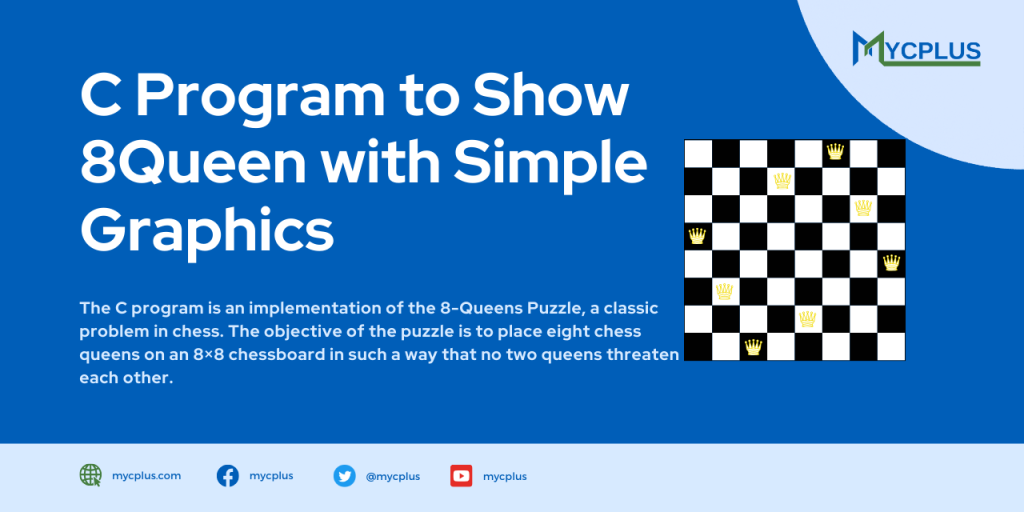
The C program is an implementation of the 8-Queens Puzzle, a classic problem in chess. The objective of the puzzle is to place eight chess queens on an 8×8 chessboard in such a way that no two queens threaten each other. In chess, a queen can attack horizontally, vertically, and diagonally.
This is a small C language program that can read a text file. The program is given file name as command parameter and it reads the file line by line. The program will prints out number of characters and words in each line.

Base64 encoding and decoding schemes are commonly used to encode binary data. Normally this is required when textual data needs to be transferred over the network or similar media and make sure that data is transferred without any modification. Base64 is commonly used in a number of applications, including email via MIME, and storing complex data in XML. This is a very simple implementation of base64 encoding and decoding in C programming language. There are number of C libraries available for encoding and decoding as well i.e. libb64, OpenSSL Base64, Apple’s Implementations, arduino-base64 etc.
Exceptions are the way of flagging unexpected conditions or errors that have occurred in C++ program. C++ Language provides a good mechanism to tackle these conditions. The exception mechanism uses three keywords: try, catch and throw.
The 1998 C++ standard consists of two parts: the core language and the C++ standard library; the latter includes most

Algorithms are are at the core of computing. One intriguing approach is Genetic Algorithms (GAs), which draw inspiration from natural selection and genetics. These algorithms excel at solving optimization and search problems by mimicking evolutionary processes. When it comes to putting these ideas into code, C++ stands out as a powerful and versatile language.
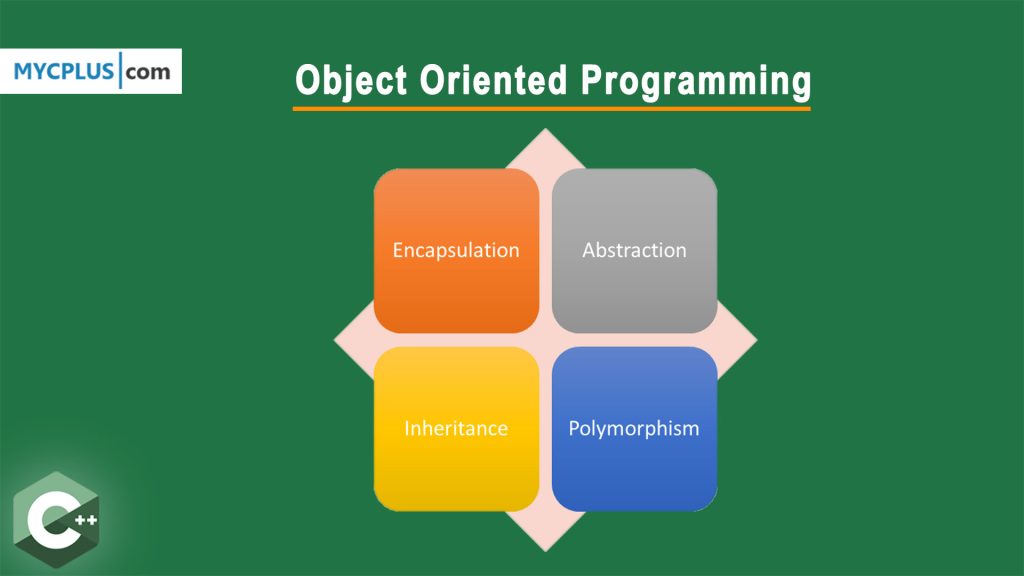
Object- Oriented Programming (OOP) is an approach to program organization and development that attempts to eliminate some of the pitfalls of conventional programming methods by in incorporating the best of structured programming features with several powerful new concepts.
A constructor is a special method that is created when the object is created or defined. This particular method holds the same name as that of the object and it initializes the instance of the object whenever that object is created. The constructor also usually holds the initialization of the different declared member variables of its object.
As opposed to a constructor, a destructor is called when a program has finished using an instance of an object.

Everyone knows that memory management is a difficult and dangerous chore in C++. This series of three articles will show you that the conventional wisdom is not true. When approached correctly, C++’s seemingly archaic memory-management scheme actually provides an opportunity to create spectacular programs – programs that would not be possible with more modern languages that handle memory automatically.