

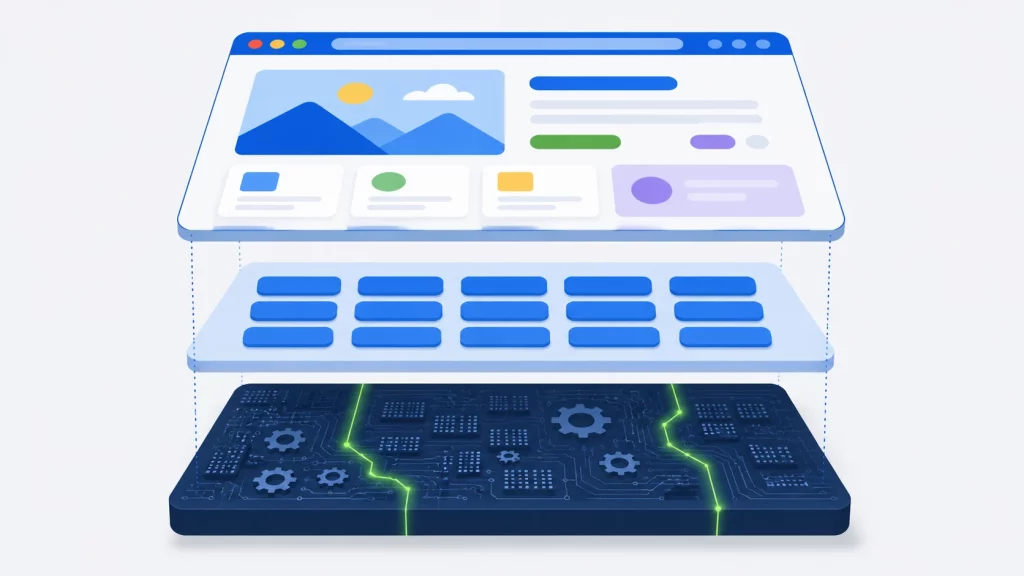
Ask what language Google is “written in” and you have already asked the wrong question. Every big website is a stack of layers, and each layer speaks a different language: one thing runs in your browser, another builds the features, and a third — almost always C++ or Rust — does the heavy lifting underneath. Once you see the layers, every company’s stack stops being trivia and starts being a pattern you can read.
This guide covers the real 2026 technology stacks of ten of the world’s most-used platforms — Google, Meta, Amazon, Microsoft, Netflix, X, TikTok, Discord, Figma, and Shopify — with every claim traceable to engineering blogs, open-source repositories, or official announcements rather than folklore. At the end: exactly which language to learn depending on where you want to work.
The Pattern: One Language Per Layer
No major website is written in a single programming language. The near-universal pattern is: JavaScript or TypeScript in the browser; a “workhorse” backend language (Java, Go, Python, PHP/Hack, Ruby, or Scala) for business logic; and C++ or Rust in the performance layer — databases, video pipelines, ML engines, and the language runtimes themselves.
That bottom layer is why a site about C and C++ cares about web stacks at all: every “Python company” and “Java company” on this list ultimately runs on C/C++ infrastructure — a theme our tour of famous applications written in C and C++ covers from the other direction.
At a glance
| Platform | Frontend | Backend workhorse | Performance layer | Created / famous for |
|---|---|---|---|---|
| JavaScript/TypeScript | C++, Java, Go, Python | C++ | Created Go; created V8 (C++) | |
| Meta | React (JavaScript) | Hack (PHP successor) | C++, Rust | Created React, Hack, PyTorch |
| Amazon/AWS | React (JavaScript) | Java | C++, Rust | Firecracker (Rust) runs Lambda |
| Microsoft | TypeScript | C#, TypeScript | C++, Rust, Go | Created C#, TypeScript |
| Netflix | React (JavaScript) | Java (JVM) | C++ | The reference JVM-at-scale shop |
| X (Twitter) | React (JavaScript) | Scala, Java (JVM) | C++ | Made Scala famous at scale |
| TikTok/ByteDance | JavaScript + native apps | Go | C++ | Kitex/Hertz Go frameworks (open source) |
| Discord | React (JavaScript) | Elixir, Python, Rust | Rust, C++ | The famous Go→Rust rewrite |
| Figma | TypeScript | TypeScript, Go | C++ in the browser (WebAssembly) | Proof WASM changed the frontend |
| Shopify | React (JavaScript) | Ruby on Rails | C++ (YJIT), Rust | Funds Ruby’s JIT compiler |
1. Google
Google’s monorepo standardizes on four primary languages — C++, Java, Python, and Go — each with a defined role: C++ for performance-critical systems (search serving, Chrome, the V8 JavaScript engine), Java for large backend services, Python for tooling and ML, and Go, which Google created in 2009 precisely because C++ compile times and Java ceremony were slowing infrastructure work. TypeScript dominates its web frontends (Angular is a Google project). Google is also developing Carbon, an experimental successor language to C++ — public on GitHub — which tells you how central C++ remains to the company: you only build a successor to something you depend on completely.
2. Meta (Facebook, Instagram, WhatsApp)
Meta’s stack is the best argument that language choice is destiny — because when PHP couldn’t scale to Facebook’s size, Meta changed the language rather than the codebase. The result was Hack, a typed PHP successor running on Meta’s own HHVM virtual machine (written in C++), and Hack remains the primary language of Facebook’s web tier. The frontend is React — which Meta created and open-sourced, reshaping the entire industry. Instagram’s backend is famously Python/Django at extraordinary scale; WhatsApp runs on Erlang; and the performance layer is C++ (plus growing Rust, which Meta officially endorses for backend services). PyTorch — Meta-created, C++ core — rounds out one of the most influential open-source portfolios in the industry.
3. Amazon and AWS
Amazon’s retail platform and much of AWS run on Java — it has been the company’s backbone workhorse for two decades. The interesting 2026 story is underneath: AWS has invested heavily in Rust for its most critical infrastructure. Firecracker, the open-source microVM engine that powers AWS Lambda and Fargate, is written in Rust, as are parts of S3 and EC2’s systems — Amazon is one of Rust’s largest corporate backers. The lesson for learners: Java gets you into Amazon; Rust and C++ get you into the layer Amazon brags about.
4. Microsoft
Microsoft created two of the most-used languages on this list — C# for its application and services tier, and TypeScript, which has become the default language of professional frontend development everywhere. The 2026 twist is delightfully self-referential: Microsoft is shipping TypeScript 7.0 with its compiler rewritten in Go (Project Corsa) — roughly 10× faster than the old JavaScript-based compiler, moved into the mainline typescript package as of the mid-2026 release candidate. Add C++ across Windows and Office, Rust entering the Windows kernel, and you have a company fluent in practically every layer — and unsentimental about which language serves each one.
5. Netflix
Netflix is the industry’s reference Java shop: its streaming control plane, APIs, and the open-source tooling it popularized (Spring Boot ecosystem, Zuul, Hystrix) run on the JVM, a story its engineering blog documents in depth. Python handles data science and the recommendation pipelines’ research side; React (frontend) actually originated some of its server-driven UI patterns at Netflix scale. And the actual video? Encoded by C/C++ — Netflix is a major contributor to open video codecs (AV1, VMAF — the latter open-sourced by Netflix, C++ core). The bits that reach your screen spent their whole journey in C.
6. X (Twitter)
X remains the company that made Scala famous: Twitter’s 2009-era move from Ruby to Scala/JVM services for its core timeline and messaging infrastructure was the case study that put Scala on the enterprise map, and the JVM (Scala plus Java) still underpins the platform. React drives the web client. Honesty note: since becoming X, the company publishes far less engineering detail than the Twitter era did, so current-state claims deserve more hedging than the others on this list — the JVM heritage is well documented; the 2026 specifics are not.
7. TikTok (ByteDance)
ByteDance is the most instructive modern stack on this list: it adopted Go in 2014 for high-concurrency push services and never looked back — by its own account, roughly 70% of ByteDance’s microservices are written in Go, coordinated by frameworks the company built and open-sourced: Kitex (RPC) and Hertz (HTTP) under the CloudWeGo project, plus Sonic, its SIMD-accelerated JSON library. All are on GitHub — rare, verifiable evidence of a hyperscaler’s actual stack. The recommendation engine and video pipeline that make TikTok TikTok are C++ territory, with Python for the ML research layer; job postings consistently ask for C++, Java, and Go.
8. Discord
Discord earned its place in engineering folklore twice. First for scaling real-time chat on Elixir (the Erlang VM’s concurrency model fits millions of simultaneous connections beautifully). Second for the most-cited language-migration post of the decade: “Why Discord is switching from Go to Rust” — its Read States service suffered latency spikes from Go’s garbage-collector pauses, and the Rust rewrite eliminated them outright. Rust now runs through Discord’s hottest paths, with Python for the API tier, React for the client, and C++ in the native voice/video engine. If you want one company that demonstrates why each language exists, it’s this one.
9. Figma
Figma belongs on this list for one glorious reason: its rendering engine is C++ — running in your browser. The design canvas is compiled from C++ to WebAssembly, a bet Figma made early and documented publicly (their engineering blog reported WebAssembly cut load times by 3× versus the earlier asm.js build). The surrounding UI is TypeScript/React, with services in TypeScript and Go behind it. Figma is the clearest proof that the browser layer is no longer JavaScript-only — the same C++ skills this site teaches now ship inside web apps.
10. Shopify
Shopify is the web’s great Ruby on Rails monolith — one of the largest Rails codebases in existence, processing entire countries’ worth of commerce on the framework everyone said couldn’t scale. Rather than migrate, Shopify invested downward: it funds and staffs YJIT, Ruby’s JIT compiler (written in Rust and C), which ships in mainline Ruby and speeds up every Rails app on Earth. React powers the merchant-facing frontend, and performance-critical services use Rust and Go. Shopify’s lesson mirrors Meta’s: at a certain scale, improving your language beats replacing it.
What Language Should You Learn to Work at These Companies?
Map the goal to the layer, not the logo:
| If you want to… | Learn first | Because |
|---|---|---|
| Do frontend anywhere | TypeScript (with React) | The one near-universal answer across all ten companies |
| Join Google/Amazon/Netflix-style backend teams | Java or Go | The two dominant service workhorses at scale |
| Work on infrastructure, engines, or the performance layer | C++ and/or Rust | Databases, video, ML runtimes, browsers — the layer everything else stands on |
| Build ML/data systems | Python + C++ underneath | Python is the interface; the engines are C++ |
| Ship products fast at startups | TypeScript or Ruby/Python | Full-stack speed matters more than raw performance |
Two honest notes: first, big companies hire for fundamentals over specific languages — a strong C++ developer picks up Go in weeks (the reverse takes longer, as our guide to whether C++ is still relevant explores). Second, the performance layer is the least crowded path: everyone learns TypeScript; far fewer can work in the layer below it. Our programming section covers both routes, and if you enjoy the history behind these languages, the story of famous programming languages and their authors connects the names above to the people who created them.
How We Know (and What We Can’t)
A credibility note most listicles skip: companies do not publish complete technology inventories. Everything above traces to primary or near-primary sources — engineering blogs (Discord’s Rust post, Figma’s WebAssembly posts, the Netflix tech blog, Microsoft’s TypeScript announcements), official open-source projects (Go, React, Hack, Firecracker, Kitex/Hertz, YJIT, Carbon), and job postings. Where the public record is thin — X post-2023 being the clearest case — the article says so rather than guessing. Stacks also evolve continuously; this page is reviewed annually (last verified July 2026).
Key Takeaways
- No popular website runs on one language — the universal pattern is TypeScript/JavaScript in the browser, a workhorse backend (Java, Go, Python, Hack, Ruby, Scala), and C++/Rust in the performance layer.
- The giants create languages when existing ones fail them: Google made Go (and is prototyping Carbon), Meta made Hack, Microsoft made C# and TypeScript — and is now shipping TypeScript’s own compiler rewritten in Go for a ~10× speedup.
- Rust is the decade’s infrastructure story: AWS Firecracker, Discord’s GC-pause rewrite, Shopify’s YJIT, and Meta’s endorsement all put Rust next to C++ at the bottom of the stack.
- The browser layer is no longer JS-only — Figma runs a C++ engine in the browser via WebAssembly, the clearest sign of where frontend performance is heading.
- ByteDance/TikTok is the most Go-committed hyperscaler (~70% of microservices), and unusually verifiable thanks to its open-source CloudWeGo frameworks.
- For your career: TypeScript is the universal frontend answer, Java/Go the backend workhorses, Python the ML interface — and C++/Rust the less-crowded layer everything else depends on.
Frequently Asked Questions
Conclusion
Read enough of these stacks and the pattern stops looking like ten different choices and starts looking like one architecture wearing ten uniforms: a universal browser language, an interchangeable workhorse, and a foundation of C++ and Rust that nobody ever migrates off — only builds deeper. The companies differ mostly in which layer they decided to own: Google and Microsoft own languages, Meta owns its runtime, Shopify owns its compiler, Figma owns the browser’s future.
For a developer choosing where to invest, that pattern is liberating: you are not betting on a company’s stack, you are betting on a layer — and every layer on this page is hiring. Pick yours, and our programming tutorials will meet you there.