

Disclosure: This is a sponsored article. It contains paid promotional links and was published as a paid placement on MYCPLUS.
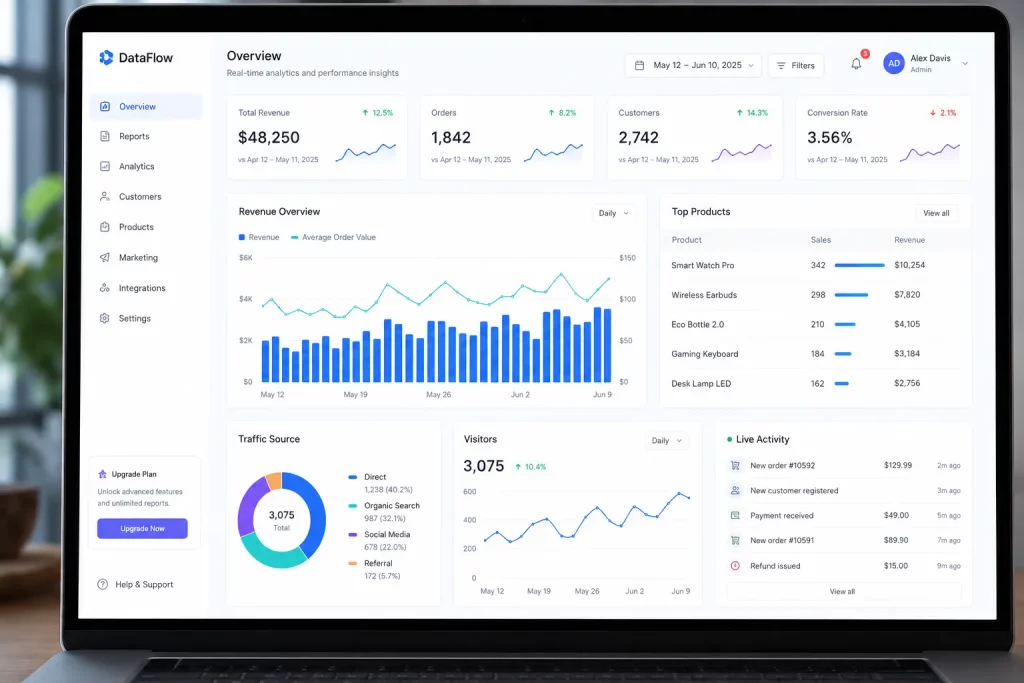
In today’s fast-moving business world, waiting hours or even days for reports is no longer practical. Companies need accurate information right now. Whether you are tracking sales, marketing campaigns, customer behavior, or website performance, real-time data helps you make better decisions faster.
This is where analytics automation becomes valuable. Instead of manually collecting data from different sources and updating dashboards, automation handles the work for you. It gathers information, processes it, and updates dashboards instantly.
Let’s explore how automation improves real-time dashboard performance and why businesses are investing heavily in automated analytics systems.
What Is Analytics Automation?
Analytics automation is the process of using technology to collect, organize, analyze, and display data without requiring constant human involvement.
Traditionally, teams had to:
- Export data from multiple platforms
- Clean and organize spreadsheets
- Create reports manually
- Update dashboards regularly
This process consumed time and often led to errors.
With analytics automation, software performs these tasks automatically. Data flows directly from sources such as websites, CRM systems, marketing platforms, and sales tools into a dashboard that updates continuously.
The result is faster reporting, improved accuracy, and more reliable insights.
Why Real-Time Dashboards Matter
A dashboard is only useful if the information it shows is current.
Imagine a sales manager checking yesterday’s numbers while today’s sales are dropping rapidly. By the time the issue is discovered, valuable opportunities may already be lost.
Real-time dashboards help businesses:
- Monitor performance instantly
- Detect problems quickly
- Respond to changing conditions
- Improve decision-making
- Increase operational efficiency
The faster a company receives information, the faster it can take action. Analytics automation makes this possible by keeping dashboards updated around the clock.
Eliminating Manual Data Entry
One of the biggest advantages of automation is removing manual data entry. Manual processes create several problems:
- Human errors
- Missing information
- Delayed reporting
- Inconsistent data
When employees manually enter numbers into spreadsheets, mistakes are almost inevitable. Even small errors can lead to poor decisions.
Analytics automation automatically pulls data from connected systems and places it into dashboards without human intervention. This creates higher accuracy, faster updates, better consistency, and a reduced workload. Teams spend less time gathering data and more time using it.
Faster Data Processing
Collecting data is only the first step. The information must also be processed before it becomes useful. For example, a company may receive data from online stores, social media platforms, customer support systems, email marketing tools, and financial software.
Processing all of this manually would take hours. Analytics automation handles these tasks in seconds. It combines information from multiple sources, organizes it into a consistent format, and sends it directly to the dashboard. Because processing happens automatically, dashboards stay updated in real time.
Better Visibility Across the Business
Many organizations struggle because data is scattered across different systems. Marketing teams use one platform, sales teams use another, and finance departments often use something completely different.
Without automation, getting a complete picture of business performance becomes difficult. Analytics automation connects these systems and brings everything together into one dashboard. This unified view allows leaders to see revenue trends, marketing performance, customer activity, operational metrics, and financial health. When all information appears in one place, decision-making becomes easier and more accurate.
Instant Alerts and Notifications
Real-time dashboards become even more powerful when combined with automated alerts. Instead of waiting for someone to check a dashboard, automation can notify users when important events occur. Examples include:
- Sales dropping below target
- Website traffic suddenly decreasing
- Customer complaints increasing
- Inventory running low
- Marketing campaigns underperforming
The system automatically identifies unusual activity and sends alerts to the appropriate people. This allows businesses to solve problems before they become larger issues.
Improved Decision-Making
Good decisions depend on good information. If data is outdated, decisions may be based on incorrect assumptions. Analytics automation ensures decision-makers always have access to current information.
For example, a marketing manager can immediately see which advertisements are producing results, a sales director can monitor daily performance as it happens, and an operations manager can identify bottlenecks before they affect customers. Because information arrives in real time, businesses can make adjustments quickly and confidently.
Increased Productivity
Many employees spend a surprising amount of time creating reports. Tasks such as copying data, building spreadsheets, updating charts, and verifying numbers can consume hours every week.
Analytics automation eliminates much of this repetitive work. Instead of spending time preparing reports, teams can focus on strategy, customer service, growth initiatives, problem-solving, and innovation. Higher productivity means businesses get more value from their workforce.
Improved Data Accuracy
Accurate data is essential for effective dashboard performance. Manual reporting often introduces duplicate entries, missing records, calculation mistakes, and formatting issues.
Automation reduces these risks by using predefined rules and processes. Data moves directly from source systems into dashboards without requiring repeated human handling. This improves confidence in the numbers being displayed. When employees trust dashboard data, they are more likely to use it when making decisions.
Scalability for Growing Businesses
As businesses grow, data volumes increase rapidly. What works for a small company may become impossible to manage manually when customer numbers, sales transactions, and marketing activities expand.
Analytics automation scales easily. Whether a company processes hundreds of records, thousands of transactions, or millions of data points, the automated system continues working efficiently. This makes automation a long-term solution rather than a temporary fix.
Supporting a Data-Driven Culture
Successful companies often build a culture where decisions are based on facts rather than assumptions. Real-time dashboards support this culture by making data accessible to everyone.
Employees can monitor performance, track goals, and understand business results without waiting for monthly reports. Analytics automation ensures that everyone sees current information whenever they need it. This transparency encourages accountability and helps teams stay aligned with company objectives.
Common Industries Benefiting from Analytics Automation
Almost every industry can benefit from automated analytics and real-time dashboards.
Retail
Retailers track sales performance, inventory levels, customer behavior, and product demand.
Marketing
Marketing teams monitor campaign results, lead generation, website traffic, and conversion rates.
Healthcare
Healthcare organizations track patient flow, resource allocation, and operational efficiency.
Manufacturing
Manufacturers monitor production output, equipment performance, and supply chain activity.
Financial Services
Financial organizations track transactions, revenue trends, risk indicators, and customer activity.
In each case, automation helps deliver accurate information instantly.
The Future of Real-Time Dashboard Performance
The future of business intelligence is becoming increasingly automated. Modern analytics platforms are now combining automation with artificial intelligence, machine learning, and predictive analytics.
These technologies can do more than simply display current performance. They can predict future trends, detect anomalies automatically, recommend actions, and forecast business outcomes. As technology continues to advance, analytics automation will become even more important for organizations that want to stay competitive.
Conclusion
Real-time dashboards have become essential tools for modern businesses. They provide immediate visibility into performance, allowing teams to respond quickly and make smarter decisions.
However, real-time dashboards are only effective when they receive accurate and current data. This is where analytics automation delivers tremendous value. By eliminating manual processes, improving accuracy, speeding up data processing, and providing instant visibility, automation transforms dashboards into powerful decision-making tools.
Organizations that embrace analytics automation today position themselves for stronger growth, better performance, and greater success in an increasingly data-driven world.