

AMD’s Open Source Framewave Library
AMD’s Framewave (FW) is a free and open-source collection of image and signal processing routines to accelerate application development, debugging, and optimization on x86-class processor platforms. FW is a collection of libraries that contain highly-optimized...

Algorithms in C
These algorithms are represented in terms of compact implementations in C so that readers can both understand their fundamental properties and implement them in real applications. The method of the analysis of algorithms is quite carefully designed. When appropriate, analytic results are described to explain why certain algorithms are preferred. In some cases, the practical algorithms’ relationship being discussed to purely theoretical results is also described.

Matrix libraries for C and C++
This article presents some of the currently available options for open source C/C++ matrix libraries employable within a Linux environment. Particular libraries discussed are Meschach, which provides routines for operating on matrices and vectors for projects coded in...
Binary Trees
A binary tree is made of nodes, where each node contains a "left" pointer, a "right" pointer, and a data element. The "root" pointer points to the topmost node in the tree. The left and right pointers recursively point to smaller "subtrees" on either side. Stanford CS...

Effective C++: 55 Specific Ways to Improve Your Programs and Designs
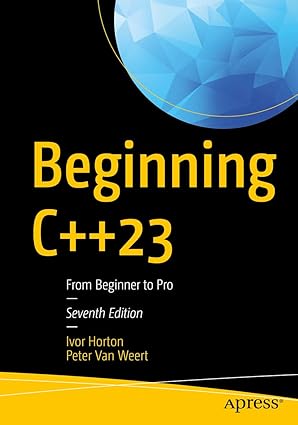
Kickstart your coding journey with Beginning C++23 – the ultimate guide to mastering the latest in modern C++ programming!
View on Amazon
The book opens with some hints for porting code from C to C++ and then moves on to the proper use of the new and delete operators in C++ for more robust memory management. The text then proceeds to class design, including the proper use of constructors, destructors, and overloaded operator functions for assignment within classes. (These guidelines ensure that you will create custom C++ classes that are fully functional data types, which can be copied and assigned just like built-in C++ classes.)